Showing posts with label gender. Show all posts

Monday, 19 March 2012

First Global Conference on Women in Agriculture

Dr. R.S. Paroda (at the right), Executive Secretary, APAARI and Co-Chair, 
International Organizing Committee presented the glimpse 
of synthesis report based on the deliberations held during 
the conference. Dr. Paroda informed the audience that 
second GCWA will be held in 2015 in Africa.
13 - 15 March. New Delhi. India. a dream team of World Food Prize laureates, government ministers, farmers, agriculture researchers, gender experts and community development organizations were in New Delhi, India for the first ever Global Conference on Women in Agriculture. It is sponsored by the Global Forum on Agricultural Research (GFAR), along with the Indian Council of Agricultural Research (ICAR) and the Asian-Pacific Association of Agricultural Research Institutions (APAARI). A Global Conference on Women in Agriculture (GCWA) was organized with participation of researchers, policy makers, women farmers and other stakeholders from different regions of the world.

The OBJECTIVES were:
  • To discuss and deliberate the prevailing and emerging gender issues in agriculture and food systems and the lessons learned for future sustainable development,
  • To take stock of evidence on experiences in enhancing role of women in agriculture,
  • To understand the mechanisms and approaches adopted by the international organizations, regional fora, countries and civil society for empowering women and addressing gender issues in agriculture, and
  • To collate lessons on strategies for strengthening gender research in agriculture to make technology generation and dissemination, agricultural planning and policy making gender sensitive and disseminate them through an edited book and develop a Framework for Action.
Related:


The Women’s Empowerment in Agriculture Index (WEAI), a new tool developed by IFPRI, the US Government’s Feed the Future initiative, the United States Agency for International Development, and the Oxford Poverty and Human Development Initiative, measures the empowerment, agency, and inclusion of women in the agriculture sector. The WEAI is a composite measurement tool that allows researchers to identify women who are disempowered and understand how to increase autonomy and decisionmaking in key domains. For additional information on IFPRI’s gender research please visit the thematic page on gender and the Gender and Food Policy News blog.

IFPRI senior researcher, Ruth Meinzen Dick on the book, "Engendering agricultural research, development, and extension."

Monday, 9 August 2010

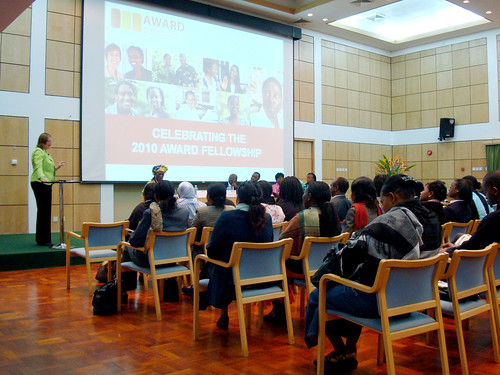
Sixty outstanding women agricultural scientists receive 2010 AWARD fellowships

27 July 2010. In an award ceremony held at the CGIAR World Agroforestry Centre (ICRAF) in Nairobi, Kenya, women scientists from across the continent, including a fruit pathologist, a catfish breeder and a pigeon pea researcher, were recognized and honoured for their contribution to alleviating hunger and poverty in Africa through their agricultural research and innovation.

Over 780 women scientists from 54 institutions competed for this year’s fellowships. Sixty outstanding women agricultural scientists from 10 African countries this week received 2010 fellowships from African Women in Agricultural Research and Development (AWARD), an initiative of the Gender and Diversity program of the Consultative Group on International Agricultural Research (CGIAR).


“We have proven that top-notch female scientists do exist in significant numbers" says Vicki Wilde, Director CGIAR Gender and Diversity Program and AWARD, "and equally important, they are conducting critical food security research that is desperately needed to feed future generations.”


Akinwumi Adesina, Vice President Policy and Partnerships for the Alliance for a Green Revolution in Africa (AGRA), speaks as a scientist, a father and a strong political advocate about the need for better recognition and support for women in agricultural science.


2008 AWARD Fellow, Waceke Wanjohi, uses examples from her own life to show the possibilities offered through AWARD to African women who wish to succeed in the competitive area of agricultural science.


Ruth Amata, new AWARD Fellow, shares her commitment to the program. She describes the challenges and sacrifices facing Africa’s female agricultural scientists who are trying to forward the economic growth of Africa, and the vital help that the AWARD program is giving to make that process possible.


Stella Williams, AWARD Chair, describes the AWARD scheme, its unique nature and why it is necessary to the future of African agriculture.


Ephraim Mukisira, Director Kenya Agricultural Research Institute (KARI), talks about the vital role of African women scientists in the struggle to achieve food security for Africa. He starts with giving his impression on the FARA GA2010 which he attended the week before in Ouagadougou

Wednesday, 30 June 2010

Announcement: Special Online Forum Gender, ICTs and Rural Livelihoods

5-16 July 2010. Join e-Agriculture in a special virtual forum that will explore some of the challenges that people and projects face when implementing projects aimed at empowering women in ICT in relation to rural livelihoods.

Led by e-Agriculture Community members and The Gender, Agriculture and Rural Development in the Information Society (GenARDIS) , the online forum will discuss issues including looking at what has worked, what has not worked, and the ways in which we can learn from good practices. The critical area of capacity building will also be covered during this special event which will attract participants from around the globe. To be part of the discussion, make sure you are registered on the e-Agriculture Platform and just log in on 5 July! Subject Matter Experts will be available during the forum to share their insight.

Friday, 19 February 2010

The 2010 African Women in Agricultural Research Fellowships

The 2010 AWARD Fellowships wants to fast track the careers of African women scientists in the NARS, higher education research and education institutions, the NGO community and private sector institutions who are in professions that serve agricultural research and development, especially for pro-poor innovation. 

African women working in agricultural research and development from Ethiopia, Ghana, Kenya, Malawi, Mozambique, Nigeria, Rwanda, Tanzania, Uganda and Zambia who have completed a bachelor’s, master’s or doctoral degree in selected disciplines are invited to apply. Applicants must be nationals of the above listed countries and be available in Africa throughout the fellowship period.

The deadline for all applications is March 22, 2010. Details and application forms can be downloaded here, plus answers to frequently asked questions

Saturday, 22 August 2009

Gender in agriculture

This resource produced by the World Bank, IFAD and the FAO is not Africa-specific, but it may be useful. (World Bank Publications - October 7, 2008). The report is now also online. It argues that gender inequalities need to be addressed in order for agricultural growth to fulfill the potential to alleviate poverty.

Women play a vital role as agricultural producers and as agents of food and nutritional security. Yet relative to men, they have less access to productive assets such as land and services such as finance and extension. A variety of constraints impinge upon their ability to participate in collective action as members of agricultural cooperative or water user associations.

In both centralized and decentralized governance systems, women tend to lack political voice. Gender inequalities result in less food being grown, less income being earned, and higher levels of poverty and food insecurity. Agriculture in low-income developing countries is a sector with exceptionally high impact in terms of its potential to reduce poverty. Yet for agricultural growth to fulfill this potential, gender disparities must be addressed and effectively reduced.

Content:
Module 1 - Gender and Food Security
Module 2 - Gender and Agricultural Livelihoods: Strengthening Governance
Module 3 - Gender and Rural Finance
Module 4 - Gender Issues in Land Policy and Administration
Module 5 - Gender and Agricultural Markets
Module 6 - Gender Mainstreaming in Agricultural Water Management
Module 7 - Gender in Agricultural Innovation and Education
Module 8 - Gender Issues in Agricultural Labor
Module 9 - Gender in Rural Infrastructure for Agricultural Livelihoods
Module 10 - Gender and Natural Resources Management
Module 11 - Gender and Crises: Implications for Agriculture
Module 12 - Gender in Crop Agriculture
Module 13 - Gender in Fisheries and Aquaculture
Module 14 - Gender and Livestock
Module 15 - Gender and Forestry Module
Module 16 - Gender Issues in Monitoring and Evaluation
Executive summary available in English, French, Arabic and Spanish
Related:
Women's Participation in Agricultural Research and Higher Education: Key Trends in Sub-Saharan Africa. 2009 (PDF 334K)

Clinton's visit to KARI and AWARD

On 5th August 2009, female scientists from the African Women in Agricultural Research and Development (AWARD) project, coordinated by the Gender & Diversity Program of the Consultative Group on International Agricultural Research (CGIAR), met with US Secretary of State, Hillary Clinton, and US Secretary of Agriculture, Tom Vilsack, at the Kenya Agricultural Research Institute (KARI), Nairobi.

AWARD fellow Sheila Ommeh explains her research on indigenous chicken for disease control to distinguished audience including US Secretary of State Hillary Rodham Clinton, US Secretary of Agriculture Tom Vilsack, Kenyan Minister of Agriculture Isaac Ruto and Nobel Laureate Prof. Wangari Maathai

In her official speech, Hillary Clinton emphasized the importance of women in agriculture saying,

"The AWARD program is a great example. It supports women scientists working to improve farming here in Africa and to fight hunger and poverty. And we need women represented in our laboratories as well as our fields. And I really congratulate the AWARD women for being pioneers in plant science."
Refererence:

Monday, 14 July 2008

Gender Equality Mainstreaming Validation Workshop

9th July. A validation workshop was held at FARA about the Gender Assessment exercise at the FARA secretariat. The general objective of the workshop was twofold:

  • To share findings of the Gender Assessment exercise at the FARA secretariat.
  • To validate findings and recommendations related to priorities for action in gender mainstreaming in FARA.
Background:
Within the context of the Gender Equality and African Regional Institution Project (GEARI) an inception mission was carried out from August 31th to September 12th 2007. The purpose of the inception mission was to initiate GEARI Project activities and also to establish the most appropriate participatory approaches and mechanisms for ensuring that benefits from the project’s activities are institutionalized and sustained in FARA.

The International Gender Team worked with FARA in setting up a Gender Working Group (GWG) and gathered - with the GWG - initial information about FARA’s structure, style, system, staff, policies, programs and internal and external communication to gain a clear understanding of its nature and scope in order to select the most appropriate approaches for gender mainstreaming in the institution according to the context and the reality of the organization.
Helene Lagace and Dzodzi Tsikata, gender consultants
Related:

What does Gender Mainstreaming really mean?
The DFID-funded Siyanda website highlights resources on gender mainstreaming in research