14 June 2012. London. Kilimo Salama, a partnership between the Syngenta Foundation for Sustainable Agriculture and UAP Insurance, won the Financial Times’ award for Technology in Sustainable Finance, recognizing their groundbreaking work to provide smallholder farmers with access to insurance cover using innovative technology and approaches.
The FT’s Award for Technology in Sustainable Finance recognizes organizations and initiatives that are addressing the scarcity of essential goods and services across society and those that demonstrate leadership and innovation in addressing environmental, social and corporate governance considerations in business.
Kilimo Salama(Kiswahili for ‘safe farming’) is an innovative, pay-as-you-plant, index-based, micro-insurance program for smallholder farmers in Kenya and the first in the world to use a mobile network-based platform and on-the-ground solar weather stations to provide smallholder farmers with low-cost insurance policies.“When it comes to drought, most farmers have no choice but to simply pray for rain. And if the rains don't come, the crops don't grow. At a time of global change, Kilimo Salama is giving farmers more options so they can meet these challenges and prosper,” said Marco Ferroni, Executive Director of the Syngenta Foundation for Sustainable Agriculture.
Kilimo Salama has seen an eventful second year marked by severe weather and explosive farmer demand for insurance to mitigate current and future weather risk.
Kilimo Salama has just completed one of the largest index insurance payouts ever experienced on the continent has insured nearly 64,000 farmers for the next season.
They are currently making plans to expand to other countries in the region beginning with Rwanda.
In Kenya, small-scale farmers are particularly vulnerable to the vagaries of weather, often losing their entire investment when droughts or floods destroy their crops. Crop insurance is usually too costly for such operations. But a Swiss-based foundation is now offering low cost insurance through a program called "Kilimo Salama," or "safe farming." Cathy Majtenyi reports for VOA from the western Kenyan town of Eldoret.
Rose Goslinga, Technical Coordinator of the Agricultural Insurance Initiative, Kilimo Salama, speaks at the Power of Information: New Technologies for Philanthropy and Development conference. This conference was co-hosted by the Indigo Trust, Omidyar Network and Institute for Philanthropy. In this video, Rose talks about her work in the field of crop insurance via mobile phone.
This manual (272 pages) aims to translate available climate science and current international climate policies into the tools for practical action in Africa, in the context of sustainable development. In this regard the guidebook focuses on the potential climate change impacts on key sectors in Africa and appropriate adaptation and mitigation options. It outlines the governance, technological, financial and capacity building opportunities available to the continent to work effectively towards sustainable development.
The manual is self-contained and stands alone, but provides guidance to intended users to other relevant materials in the form of links and annexes. The primary audiences for the guidebook are policymakers, decision makers, practitioners from public and private sector, civil society organizations, environment and climate change negotiators and experts.
Organization:
UNEP
Partner(s):
African Ministerial Conference on the Environment, African Union Commission
Scientists have issued an analysis of East Africa’s future climate as the first step in a new programme that will help farmers grow crops that will best thrive in the changed weather conditions 20 years from now, a new study has shown.
“Climate change will significantly alter growing conditions, but in most places the new farming environment will not be novel in the global context,” said Julian Ramirez, a scientist based at the International Centre for Tropical Agriculture in Colombia and a lead author of the study.
The report is compiled by the Consultative Group on International on International Agricultural Research programme on Climate Change, Agriculture and Food Security. Titled, Climate Analogues: Finding Tomorrow’s Agriculture Today, the report forms the platform of a global programme to exchange knowledge between communities on current agriculture practices that can help maintain productivity in the future, despite potentially dramatic shifts in growing conditions.
Related: Under Climate Change, Agriculture and Food Security (CCAFS), researchers have developed a software-based tool that offer farmers a glimpse into their future by identifying places where growing conditions today match those expected in their fields in two to five decades’ time. The tool can be used to link climate and crop models with agricultural technologies, including improved varieties and agronomic practices, by matching sites that could offer ideas for adaptation to shifting climate patterns. The software offers two interfaces developed for different user groups. The first, known as an R-library - a free software environment for statistical computing and graphics - is targeted at those with some background in programming and statistics. The second is an online interface that draws from the R-library, built for scientists working in agriculture but with more limited technical skills. The tool uses a series of statistical functions applied onto future and current climate data, as well as input from the user (target-site location and some tool-specific parameters) to find out where the analogue areas of a particular site’s future or current conditions are located. Hence it answers the very important question: how will my site look in 30 or 50 years?
The CCAFS programme will also fund a series of farmer exchanges between South Asia (involving India, Nepal, and Bangladesh) and East Africa (covering Ethiopia, Tanzania and Kenya). This initiative, called “Farms of the Future”, is being coordinated by social and agro-climate scientists, and aims to evaluate farmers’ responses to changing climatic conditions. The key idea is to use the climate analogue tool to acquaint farmers with their possible climate futures via physical farm visits in different regions of the world.
DECEMBER 28, 2011.POSTMEDIA NEWS. The International Development Research Centre, that is distributing millions of dollars of the climate funding, said that research is the first step toward identifying credible projects and ensuring federal dollars are spent well.
``This is really kind of a critical priority because in my view, there's a whole lot of noise around (adaptation issues), but not that many effective projects,'' said Mark Redwood, a program leader on climate change and water at IDRC.
IDRC chose seven research projects in Africa, working with local stakeholders that deliver development projects on the ground to find the most effective investment options.
``One thing that they observed and which I also noted is that there are many, many adaptation projects that would not pass basic criteria for a development bank or a private investor,'' said Redwood, who specializes in urban and environmental planning. ``The benefits are difficult to identify, sometimes with climate change adaptation. The field is still sorting itself out a little bit, so basically there's a disconnect . . . between those projects and the number of projects that a development bank could fund.''
Fast-start funding, a key commitment by developed countries in recent international climate change negotiations, was supposed to build a foundation for a global green climate fund, worth about $100 billion per year by 2020, to help developing countries cope with escalating impacts of global warming on their economies and way of life. But lacking any tools to measure the value of dollars spent, the proposed fund is different from the Clean Development Mechanism and other provisions under the Kyoto Protocol that allow private companies or countries to invest in projects that measure and track the level of emissions reductions.
``There's no standardized reporting format (to evaluate the value of fast start funding announcements by countries) and either you believe it or you don't,'' said David Waskow, climate change program director of Oxfam America. ``We don't have those measurements and so we have countries putting out their own numbers and their own formats . . . without any clarity.''
Background:
On November 25, 2011, Canada's Environment Minister, the Honourable Peter Kent, announced funding for seven winning projects from across Africa. Also in attendance at the Ottawa announcement were two of the AARC recipients: Saïd Hounkponou from Benin's Initiatives pour un Développement Intégré Durable and via video from South Africa, Lindiwe Majele Sibanda from the Food, Agriculture and Natural Resources Policy Network.
AARC supports seven centres of excellence across Africa to enable each to conduct research and strengthen organizational capacity in the field of climate change adaptation. Its goal: to improve the ability of African research centres to deliver scientific advice to decision-makers that will inform national adaptation strategies and investment decisions.
The initiative is a three-year, CA$10 million project managed by IDRC’s Climate Change and Water program and funded through the Government of Canada’s $400 million Fast-start Climate Financing, announced in 2010 as part of Canada’s commitment under the Copenhagen Accord. It builds on the accomplishments of the Climate Change Adaptation in Africa program, a six-year initiative (2006-2012) jointly funded by IDRC and the UK’s Department for International Development.
Burkina Faso, to reduce the risk of food insecurity to farmers in the Sahel, a region that has experienced a decline in rainfall and a high degree of variability to the start of rainy seasons (led by the Institut International d’Ingénierie de l’Eau et de l’Environnement);
Egypt, to establish an adaptation research centre for the Nile Delta, an area that is particularly vulnerable to the impacts of climate change (led by the University of Alexandria);
Kenya, to investigate climatic risk, vulnerability, and appropriate adaptation strategies in the food crops and livestock production sectors in arid and semi-arid lands (led by the Kenya Agricultural Research Institute);
Horn of Africa, to measure the impacts of climate change on agriculture and water resources and recommend feasible adaptation options in Ethiopia, Kenya, Sudan, and Tanzania (led by the Sokoine University of Agriculture);
Southern Africa, to conduct assessments of household vulnerability and encourage research-based food security policies by linking researchers and policymakers in South Africa, Malawi, Lesotho, and Swaziland (led by the Food, Agriculture and Natural Resources Policy Analysis Network).
A group of 15 leading agricultural organisations (including three United Nations agencies, the World Bank, the Global Forum on Agricultural Research (GFAR), the World Farmers' Organisation, CTA, FANRPAN and the International Food Policy Research Institute) have jointly endorsed a letter to the COP17 climate negotiators with a specific call-to-action, namely to approve a Work Programme for agriculture at the climate talks in Durban [under the Subsidiary Body for Scientific and Technological Advice (SBSTA)] .
Agriculture is the low-hanging fruit for a deal at the climate talks this year, and this letter represents a strong consensus from key actors in agriculture on how negotiators can make progress this year -- both to mitigate agriculture's current level of emissions but also to help farmers adapt to changing growing conditions. The letter calls on negotiators to "take early action to determine the long-term investments needed to transform agriculture to meet future challenges."
The letter comes ahead of Agriculture and Rural Development Day, which takes place in parallel to the COP17 climate talks this Saturday, 3 Dec in Durban.
You can also read a Wall Street Journal article about the letter just published today:
The International Crops Research for the Semi-Arid Tropics (ICRISAT) and several partners, including China’sBGI-Shenzhen, have mapped the genome of the pigeonpea. The pigeonpea, or toor dāl in India, is an important food for millions of small farmers in semi-arid regions of Asia, Africa, and Latin America. Often dubbed “poor man’s meat,” pigeonpeas are high in protein and amino acids, and flourish in dry, hot regions. The new knowledge of its gene sequence will be used to breed more productive, disease- and drought-resistant varieties of pigeonpea. This video from ICRISAT elaborates on the breakthrough and some of its implications.
24-26 October. Ede, The Netherlands. “Scientists and technology have a critical role to play if we are to achieve food security in the context of climate change,” said Sir John Beddington, Chair of the Commission on Sustainable Agriculture and Climate Change at the opening of the Global Science Conference on Climate-Smart Agriculture in Ede, The Netherlands. He urged the participating agricultural experts from governments, international agencies, and universities to think about smart ways for farmers to produce enough food while managing and adapting to climate change.
The talk included a foretaste of the soon to be launched recommendations from the Commission on Sustainable Agriculture and Climate Change. The Commission, made up of thirteen experts from around the world, has been collecting evidence to synthesizing the evidence to develop practical actions to support sustainable agriculture in the context of climate change. The summary will be aimed for policy makers and launched in time to be fed into the discussions in Durban.
COP 17 - a unique opportunity to put agriculture on the climate change agenda
Sir John urged scientists to contribute to the global challenge of moving the world into a ‘safe operating space’ in which agriculture can meet global food needs while reducing its greenhouse gas emissions. He highlighted how the scientific evidence base can contribute to policy action. Beddington also proclaimed COP17 in Durban in December as a unique opportunity to put agriculture on the climate change agenda.
Sir John said that the agricultural potential in Africa is substantial and existing technologies can be used to create the necessary transformations. Farmers need to produce more food without further encroaching on sensitive ecosystems in order to contribute to a food system that is sustainable and climate safe. Climate-smart agriculture, he said, has to both appeal to and benefit the rural farmer while not undermining livelihoods. Sir John will deliver the Commission's full recommendations at Agriculture and Rural Development Day on 3 December, in Durban.
Lindiwe Sibanda, CEO of FANRPAN attended
the Global Science Conference on Climate-Smart Agriculture in
Wageningen 24-26 October. Photo: C. Schubert (CCAFS)
Lindiwe Sibanda, CEO of the Food, Agriculture and Natural Resources Policy Analysis Network (FANRPAN), and member of the International Science Panel of the CGIAR climate program (CCAFS), said that Africa, a vulnerable continent to climate change, needs to improve its productivity in a climate smart manner. And this is where climate-smart agriculture becomes imperative, since CSA puts people and food first. Sibanda underlined that women are driving agriculture in Africa, which is why “we need to follow women – in everything”.
To create an international platform for students and youth to exchange ideas and experiences in the field of climate change research and the role of indigenous knowledge systems in climate change adaptation and mitigation;
To facilitate the building of a sustainable Young African Scientists Network on Climate Change research initiative;
To inform the formulation of the African Young Scientists Initiative on Climate Change (AYSICC) based on indigenous knowledge systems.
The conference themes are:
The Role of Indigenous Knowledge Systems in Climate Change Adaptation and Mitigation;
Climate change and vulnerable groups (women, children, disabled, etc,);
Climate change, food security and health;
Climate change, Migration and social conflicts;
Climate change, land, water and other natural resources management;
Climate change and biodiversity management and conservation.
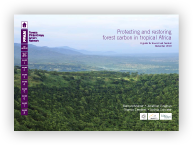
This report on forests in tropical Africa is the first to be published by the Forests Philanthropy Action Network (FPAN). The culmination of nearly two years of desk and field research, it provides an introduction and some initial guidance on important questions such as: which interventions to protect and restore Africa's tropical forest carbon are likely to be successful? Under what circumstances? And how can donors and funders engage most effectively.
Protecting and restoring forest carbon in tropical Africa is vital reading for philanthropic donors, public funding bodies and forest carbon companies interested in supporting efforts to halt the loss of tropical forests in Africa.
These mini-films, of 5-7 minutes each, show two sustainable land management (SLM) technologies that have a proven track record in Africa: Stone Lines and Fanya Juu. The technologies presented can constitute important components within the climate change adaptation strategies of small-scale farmers.
Making use of archive and new footage, each technology is presented in a consistent way: this includes construction, views of mature structures/systems and dynamic graphics showing how each functions. This is then complemented by interviews with farmers.
Included with the DVD are information cards which provide a summary of each technology - including their range of suitably, input requirements and design specifications, as well as references for further reading.
4 December 2010.Cancún, Mexico. More than 400 experts, including policymakers, farmers, scientists and representatives from the private sector and civil society, came together for the Agriculture and Rural Development (ARD) day during the COP16 climate negotiations. The goal of the ARD day was to identify and discuss the best practices and technologies for the agricultural sector to help meet climate mitigation and adaptation targets, while advocating for the inclusion of agriculture in the new global climate agreement being discussed.
Giving farmers the knowledge and incentives needed to incorporate new farming techniques requires an aligned global policy environment and complementary regulatory frameworks, stated Bruce Campbell, Director of the CGIAR Research Programme on Climate Change, Agriculture and Food Security (CCAFS).
Yet Farming First spokesperson Morgane Danielou of the International Fertilizer Industry Association (IFA) highlighted that, "Solutions to climate change and food security need to be tailored to local conditions and local needs." She continued, "Public-private partnerships between research organizations, governments and industry are important collaborations to help adapt agricultural technologies to the unique climate situations faced around the world."
Water Efficient Maize for Africa (WEMA), for example, brings private and public sector researchers together to improve the drought-tolerance of African maize varieties using conventional breeding, marker-assisted breeding, and biotechnology. The food company Danone has also partnered with IUCN and the Ramsar Convention to restore biodiversity and develop significant carbon offset programmes, such as mangrove restoration projects which have planted hundreds of millions of mangrove trees along coastlines next to vulnerable farming communities.
"If left unaddressed, climate change will seriously impact farmers' ability to grow sufficient crops, potentially leading to a world where food security is a luxury enjoyed by a minority," emphasised Howard Minigh of CropLife International. "The good news is that science is already helping farmers to do more with less, and we can intensify that effort to help reduce agriculture's carbon emissions."
Interview with Bruce Campbell (Director CCAFS)
Interview with Rodney Cooke (IFAD)
Interview with Yemi Katarere (UN-REDD Secretariat)
Interview with Lindiwe Sibanda (FANRPAN)
Interview with Pauline Kalunda (Ecotrust Uganda)
31/10 - 5/11/2011. the Hague. The Government of the Netherlands, in close cooperation with the Governments of Ethiopia, Mexico, New Zealand, Norway, Vietnam, the World Bank and the FAO, organized the 2010 conference on Agriculture, Food Security and Climate Change. The conference was attended by governments, international organizations, the private sector, non-governmental organizations, philanthropic foundations, local community producers and the scientific community. Sixty government ministers were among the 800 participants.
Juergen Voegele, director of the World Bank Agriculture and Rural Development Department, has been leading the effort to re-energize and broaden the World Bank's commitment to agricultural development since 2008. Over the past two years, there has been a visible refocus on this long neglected issue. Voegele talked at the Down 2 Earth conference in The Hague about the key issues at stake here. Professor Robert Watson's keynote speech revolved around knowledge: 'There's a huge gap between those that have it, and those that need it'. He propagated the establishment of an online network of agricultural and climate science research available to anyone with access to the internet. Watson summarizes his arguments in this video interview
The five-day meeting ended with a final Roadmap for Action : a call to invest in new farming practices that will curb greenhouse gas emissions and will better use currently available land to feed a global population of 9 billion by 2050.
About 30 per cent of carbon emissions come from farming, livestock and forest destruction.
Despite its huge share of global emissions, accounting for the use of land is one of the toughest issues under negotiation at U.N. climate talks, and the one which has made the least progress.
The talks involve creating incentives for emission reductions by vast agricultural conglomerates and by farmers still using wooden plows on tiny plots. It also touches an industry that is heavily subsidized in many countries.
Prioritization of ecological over industrial agriculture
Avoidance of expensive technological fixes that support corporate control of agricultural genetic resources
A focus on adaptation that includes financing to developing countries to help them cope with the consequences of climate change
Exclusion of a carbon markets approach that attempts to “offset” the production and consumption patterns in the developed world
Implementation of the policy and investment options outlined in the International Assessment of Agricultural Knowledge, Science and Technology for Development (IAASTD)
28/09/2010, Brussels. Interview with Alan Edwards (EC/DG Research, Earth Observation Sector) @ the South Africa's biodiversity research partnership.
Alan Edwards answers what the genesis is of the FP7 call ENV.2011.4.1.4-1 "Developing increased EO capacity for better agriculture and forestry management in Africa". About non-research actors, he answers that the main non-research actors are [African] policy makers.
Related:
AGRISAT WORKSHOP, Brussels - 13-15 October 2010
The objective of this workshop is to review the state-of-the-art, the current issues and the way forward in agricultural monitoring systems for the different regions of the world. Key recommendations will be formulated in order to improve food security and agricultural production monitoring on a global scale, taking into account policy evolutions, agro-ecosystems diversity and satellite system developments.
The workshop frames under the GMES initiative and is a contribution to the GEO Agricultural Monitoring Task (Ag 0703) which has the goal of improving international coordination on earth observation for enhanced agricultural monitoring.
Back ground FP7 ENV Call
Area 6.4.1.4 Developing capacity building activities in the domain of Earth Observation in the new EU countries and in the developing countries. ENV.2011.4.1.4-1 Developing increased EO capacity for better agriculture and forestry management in Africa.
The main objective of this action is to contribute to food security in Africa by enhancing the
current global capabilities in the areas of agriculture monitoring, famine early warning, foodsupply and crop prediction and agriculture risk assessment, through increased use of Earth observation data.
Emphasis is placed on the creation and sustained provision of the required Earth observation data, enhancements of the observations (data products and predictive models) and the development of the necessary capacity and infrastructure to make the data and products available to improve agricultural and forestry management, including irrigation issues, using the full interoperable capability of the GEOSS.
The activity shall integrate and build upon GEO tasks, in particular AG-07-03: Global Agricultural Monitoring and GMES initiatives, including the ESA GMES Global Monitoring for Food Security Project, establishing the appropriate connections.
Funding scheme:
Collaborative Project (small or medium-scale focused research project) for specific cooperation actions (SICA) dedicated to international cooperation partner countries Expected Impact: Assembly, integration and provision of existing and newly generated geoinformation relevant for Agriculture, Forestry and Ecosystem management by building the necessary capacity, especially within developing countries. The substantial uptake of Earth Observation techniques, information and products by an increasingly large community of managers and decision makers.
6 to 8 September 2010. Addis Ababa, Ethiopia. More than 100 researchers and policymakers met this month to try to articulate a common African position ahead of the United Nations climate change conference due to take place in Mexico in December.
In 2009 at the thirteenth African Union summit, heads of state tasked the African Union Commission (AUC) and the New Partnership for Africa's Development (NEPAD) to develop an agriculture-based climate change mitigation and adaptation framework, which is apparently still under progress.
The September meeting was meant "to make sure that Africa will benefit from the climate change discussions'' and to ensure that agriculture was not ignored in negotiations, according to a statement released by Rhoda Peace Tumusiime, the African Union's Uganda-born commissioner for rural economy and agriculture since 2008.
"Food security, agriculture and climate change… are all inextricably linked with significant consequences for us if they are not carefully managed," she said.
Tumusiime urged researchers to consider how Africa could benefit from carbon gas trade arrangements like the Clean Development Mechanism (CDM) of the United Nations Framework Convention on Climate Change (UNFCCC).
She noted that only two percent of CDM's market-related projects come from Africa. The fifty-sixth meeting of the CDM executive board takes place from 13 to 17 September 2010 in New York, USA.
At the climate change meeting in Cancún, Mexico, at the end of 2010, African negotiators will focus at sustainable land management, which they argue has the potential to mitigate climate change and strengthen the economic resilience to the impacts of global warming.
The seventh African Development Forum will meet from 10 to 15 October 2010, on the theme of Acting on Climate Change for Sustainable Development in Africa, at the United Nations Conference Centre in Addis Ababa, Ethiopia.
The forum is a collaboration between by the United Nations Economic Commission for Africa (ECA) in partnership with the AUC and the African Development Bank (AfDB).
IFPRI has just published a review of the strategies that the 10 countries that make up ASARECA, the Association for Strengthening Agricultural Research in Eastern and Central Africa, plan to use to adapt to climate change. Only two strategies are common to all 10 countries: “the development and promotion of drought-tolerant and early-maturing crop species and exploitation of new and renewable energy sources”. Leave aside that the second strategy encompasses biofuels, and there’s still something else striking about the strategies. Burundi recognizes the conservation of genetic resources as an important strategy although this is also potentially important for dealing with drought.
4th -7th May. Nairobi, Kenya. The Challenge Program on Climate Change, Agriculture and Food Security (CCAFS) is a new 10-year research initiative by the Consultative Group on International Agricultural Research (CGIAR) and the Earth System Science Partnership (ESSP) to facilitate new research on the interactions between climate change, agriculture, natural resource management and food security.
CCAFS will in late 2010, morph into the CGIAR mega programme seven (MP7) on climate change. Its initial focus regions are West Africa, East Africa and the Indo-Gangetic Plains.
It has four strategic thematic areas around which activities are designed:
Adaptation to progressive climate change
Adaptation through managing climate risk
Poverty alleviation through mitigation
Diagnosis and scenarios for making strategic choices
The workshop was to identify key research and development priorities and make inputs into implementation in the target regions of East Africa, West Africa and the Indo-Gangetic Plains.
Achim Steiner (UNEP) talked about implications of climate change for agriculture and underscored the need to break farmer dependency on seed companies and fertilizer suppliers. He further explained that promoting the ideology of more seeds, fertilizers and water as the sole means to achieving agricultural productivity will result in disaster.
Lindiwe Sibanda discussed an Africa-wide policy on climate change adaptation and mitigation while David Radcliffe (European Commission) spoke about enhancing food security in the face of climate change and highlighted several global and European initiatives that support the same e.g. Global Initiative on climate Change, Global Initiative on Food Security, Global Climate Change Alliance, Food Security Thematic Programme, European Development Fund, Framework Programme 7.
Related: 12-17th April 2010. Brighton, UK. AfricaAdapt review and planning meeting. The aim of the meeting was to review implementation during year 2 of AfricaAdapt (April 2009 – March 2010) and plan for Year 3 (April – September 2010) as well as Phase 2 (October 2010 – September 2012).
Researchers have published a compendium of more than 400 case studies which reveal how indigenous people have been affected by and are adapting to climate change. The report recommends that Western scientists draw on the knowledge and experience of indigenous people when creating climate change policy.
The case studies were drawn from reports by UN departments, NGOs, universities and research organisations from around the world. The compendium - Advance Guard: Climate Change impacts, Adaptation, Mitigation and Indigenous peoples - was published by the United Nations University - Institute of Advanced Study and contains over 70 case studies from Africa.
Download the advance reading copy. The final publication will be available in April 2010
Bring different stakeholders and practitioners to share and discuss knowledge of Community Based Adaptation (CBA) planning and practices from different parts of the developing world, particularly Africa
Capture the latest learning from CBA planning and practices around the developing world
Enhance capacity of the practitioners to help the most vulnerable groups and people in improving livelihoods in developing countries
Share lessons learnt to facilitate integration of climate change into national and international development programmes
Disseminate lessons learnt at the conference through proceedings and immediate conference summary.
25/02: Plenary opening session: Agriculture
Agricultural Services Support Programme and Agricultural Sector Development Programme - Livestock, Zanzibar - Seif A. Seif and Khalfan M. Saleh, IFAD
Climate change and food security in Maradi District, Niger – Moussa na Abou Mamouda, ENDA
Sharing lessons from the use of different type of organic manures: Malawi - Dalitso Kafuwa, FAIR, Malawi
Changing seasonality and ways in which farmers can adapt at a community level – Steve Jennings, Oxfam Vulnerability of rain-fed agriculture to climate change and variability - Hector John Mongi, Tumbi Agricultural Research Institute, Tanzania
Mr. Muyungi, a prominent negotiator for Least Developed Countries discusses the importance of community based adaptation in Africa and the role that it should play in post-Copenhagen climate change negotiations.
Dr. Saleemul Huq. Senior Fellow, Climate Change, provides updates on the conference via his video blog.