Showing posts with label EU. Show all posts

Saturday, 24 March 2012

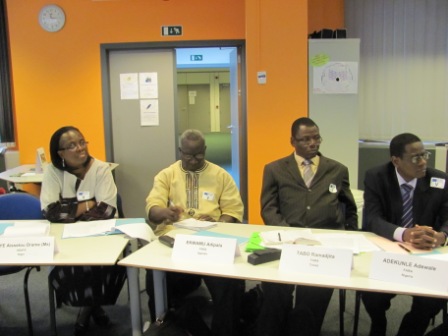
Informal stakeholder consultation on agriculture research in Africa

Prof. Monty JONES (FARA)
20-22 March 2012. Brussels, organized by the European Commission Directorate General for Development and Cooperation - DG DEVCO. Improving the quality and effectiveness of development cooperation with African agricultural knowledge organisations: Informal stakeholder consultation.

In order to improve the quality and effectiveness of development cooperation with African continental and sub-regional agricultural knowledge organisations, the European Commission organized an informal stakeholders consultation which brought together representatives of African agricultural knowledge organisations, of the Development Partners, and EC/EU experts.
Dan KISAUZI & Silim Mohamed NAHDY
(AFAAS) ; Paco SEREME & Harold
ROY MACAULEY (CORAF) ;
David NIELSON (World Bank)

David NIELSON, Melissa BROWN, Bremala
MALLI & Juergen ANTHOFER (WB)
The objectives of this meeting were to:
  • share experiences of African continental and sub-regional leading organizations linked to agricultural research, advisory services, and tertiary agricultural education on how these organisations have contributed to the objectives of the Comprehensive African Agriculture Development Programme (CAADP) under the Framework for African Agricultural Productivity (FAAP);
  • Carolyn GLYNN & Philip CHIVERTON
    (Swedish University of Agricultural 

    Sciences)
    Nicoliene OUDWATER 

    (AgriCulture ETC Foundation)
  • dialogue with representatives of African continental and sub-regional organisations, Development Partners organisations, and EC/EU experts on the key lessons learnt through such processes – what worked well and less well and why;
  • looking to the future, discuss how such processes might continue to be strengthened into the future and scaled up where appropriate, share views of African organisations on their future role in their mandate areas and discuss this with representatives of the Development Partners organisations and EC/EU experts.
The outcomes were:
Aissetou Drame YAYE (ANAFE), Adipala
EKWAME (RUFORUM), Ramadjita TABO
& Adewale ADEKUNLE (FARA)
  • raised awareness of the value of African continental and sub-regional leading organizations linked to agricultural research, advisory services, and tertiary agricultural education in support to the objectives of CAADP;
  • shared experience on key initiatives of African continental and sub-regional leading organizations linked to agricultural research, advisory services, and tertiary agricultural education to advance African agriculture;
  • Patrick TAWONEZVI & Mwape
    BWANALI (CCARDESA)
  • deepen understanding of the challenges and opportunities of African continental and sub-regional leading organizations linked to agricultural research, advisory services, and tertiary agricultural education to support the objectives of CAADP;
  • recommendations made to donors and Development Partners organisations on how to increase effectiveness of their support to agricultural research, advisory services, and tertiary agricultural education in support to the objectives of CAADP.

Thursday, 13 October 2011

Conference on Scientific Support for Food Security and Global Governance

28 September 2011. Brussels. The JRC-organised conference 'Scientific Support for Food Security and Global Governance', held on Wednesday 28 September in Brussels attracted 380 participants for a high-level discussion on the need to reconcile the necessity to increase production and competitiveness while respecting sustainable development in the framework of global governance. The conference focused on the links between food security and science, the interdependence between agriculture and environment, and the need for new global governance for improved food availability.

The daylong programme featured 21 speakers with attendees coming from national governments and international organisations EU Institutions, industry and NGOs, and research institutes and universities. Senior officials from the United Nations, the World Bank, the ACP Group of States and the EU presented ongoing initiatives ranging from crops monitoring and forecasting to concrete projects in the food system. Others analysed the sustainability of food production, food price volatility and food supply governance.

The European Commission's Joint Research Centre and the UK Government Office for Science (Foresight) co-organised on 30 March 2011 in Brussels a High Level Seminar on "Future of Global Food and Farming: How can Science Support Food Security?". European policy makers, scientists and practitioners debated the impediments and choices for global food security driven by the expanding world population and the need to develop sustainable agriculture minimizing the over-exploitation of natural resources and the impact of climate change. The conclusions of this conference have underlined the needs for developing and using a new common data and modelling system. The European Union and other international partners have insufficient or sets of data that are not up to date on many topics, such as farming systems.

The conference fostered a debate on following issues and highlighted the contribution of science in policy making at EU and global level on food security aspects:
  • Improving agricultural production and productivity both in the short and long term in order to respond to a growing demand for agricultural commodities;
  • Increasing market information and transparency in order to better anchor expectations from governments and economic operators;
  • Strengthening international policy coordination in order to enhance confidence in international markets and to prevent and respond to food market crises more efficiently;
  • Improving and developing risk management tools for governments, firms and farmers in order to build capacity to manage and mitigate the risks associated with food price volatility, in particularly in the poorest countries;
  • Improving the functioning of agricultural commodities' derivatives markets.

Dominique Ristori is the general director of the Joint Research Centre of the European Commission. In this interview, he speaks about the food security conference organised by the JRC and about the value of research and science in food security.

 In the closing remarks, JRC Director General Dominique Ristori said the conference offered strong evidence for the urgent necessity to invest in science and innovation for global food availability. Shared infrastructures and exchange of science-based knowledge are needed to turn capacities and knowledge into new products and new markets. He called for an interdisciplinary approach and a strong partnership between agriculture, environment, energy and development together with innovation and science. To achieve a sustainable intensification of the farming sector – he said - farmers should be placed inside the innovation chain with a capacity to invest and to reduce direct pressure on land and sea. According to Mr Ristori, a new global governance is necessary, which will strengthen the links between producers, traders, governments and all other stakeholders. He pointed to G20 initiatives as a good start and emphasised the importance of the co-operation between the FAO and the World Bank.


Prof. Monty Jones, Executive Director of FARA talks about the input that science can bring to agriculture, and the responsibility of African governments in food security


Joseph Alcamo, Chief Scientist at the United Nations Environment Programme (UNEP) talks about the untapped potential of fisheries and the possibilities of achieving food security and environmental protection.


Paulo Gouveia is the director of the General Affairs Department at Copa-Cogeca, the European farmers' representation in Brussels. In this interview, Gouveia speaks about the role of GMOs for food security and the European farmers' responsibility for global food security.

Monday, 23 May 2011

PAEPARD's contribution to Public consultation on the EC Green Paper

On 9th February 2011, the European Commission presented a Green Paper 'From Challenges to Opportunities: Towards a Common Strategic Framework for EU research and innovation funding' (COM (2011) 48).

  • This paper proposed major changes to EU research and innovation funding to make participation easier, increase scientific and economic impact and provide better value for money.
  • The changes, to be introduced in the next EU budget after 2013, would bring together the current Framework Programme for research, the Competitiveness and Innovation Programme, and the European Institute of Innovation and Technology.
  • The Commission was seeking the views of all interested individuals and organisations on these proposed changes and on the specific questions set out in the Green Paper.
  • The deadline for contributions was Friday 20 May 2011.

Following international organisations/research institutes or projects related to agriculture have submitted a contribution:


Hereunder  is an extract of the Contribution of PAEPARD to the Green Paper:


The ‘Africa’ Call for proposals under the 7th Framework programme generated considerable interest and over one hundred proposals were submitted.  However, only a small number of proposals were funded and the role of African organizations in the partnership teams tended to be quite limited.  This reflects the findings from the early stages of PAEPARD which showed that there are serious barriers to the participation of African organizations in the framework programmes.  The reasons include:
  • The limited number of research themes that are relevant for African organizations, in spite of the large scope for topics of mutual interest and benefit to Europe and Africa.  The new EC-funded African Union Research Grant Program is a welcome development which will help to address this issue.
  • The focus on ‘high end’ science in which only organizations with an established track record are able to compete successfully.  Funding agricultural research for development does not necessarily compromise research quality.  This may involve a degree of risk when new partners are involved.  But there should be a willingness to take on a certain level of risk where the potential for impact is high.
  • The participation of small and medium-sized enterprises and civil society organizations in Africa is constrained by the strict eligibility requirements which are difficult for them to meet.
  •  The complexity of the administrative procedures discourages African organizations from participating. 
  • European researchers may be reluctant to enter into partnerships with organizations from Africa because of the high transaction costs in project management activities. 
  • In many European research organizations, there are limited incentives for staff to engage in work with a strong developmental orientation.  Ultimately, researchers are judged by their ability to publish in high impact factor peer-reviewed journals.

These factors point to the need to simplify administrative procedures and review eligibility criteria.  They also suggest that there is a strong case to provide more support for capacity strengthening at both the individual and organizational level.  Currently, the EC provides this type of support through its EDULINK and ACP Science & Technology programmes.  These are very useful programmes, particularly as they provide opportunities for strengthening the capacity of educational and research organizations in areas such as strategic planning, financial management and quality assurance.  The strengthening of organizational capability in such areas will allow African researchers to participate more effectively in EU-funded research programmes.  A good example is the ACP S&T project "Strengthening Research and Innovation Management in Africa and the Caribbean" which has established a communication network for persons engaged in research and innovation management issues. 

Many African research and educational organizations currently have a highly skewed staff age structure.  This has been caused partly by a long period of under-investment leading to low levels of recruitment.  An additional factor is the low retention rate due to the unfavorable working conditions and low remuneration.  In some countries, more resources are now being allocated and recruitment has begun to increase.  Furthermore, there are now increasing opportunities for staff to upgrade their skills through postgraduate studentships and mechanisms such as internships and exchange programmes.  An encouraging development is the emergence of regional PhD programmes offered by universities in Africa supported by the Regional Universities Forum for Capacity Strengthening in Agriculture.  One of these programmes is on Agricultural and Rural Innovation Studies (ARIS) and is being established with support from the EU. 

However, when these researchers return to their organizations the opportunities for them to apply their new skills is often limited.  We recommend that greater emphasis is placed on instruments that support Fellowships for young professionals in order to assist them to fulfill their potential.  This will contribute to the development of a cadre of researchers who are able to contribute effectively to EC-funded research programmes.

Monday, 11 April 2011

3rd European Forum on Rural Development


29th March-1st April 2011. The 3rd European Forum on Rural Development was held in Palencia, Spain. This forum was an initiative by the European Commission and EU Presidency with the support of France, Germany, Ireland, the Global Donor Platform for Rural Development and CTA. Around 500 experts in rural development form all around the world attended.

The Global Donor Platform is an alliance of 34 donor institutions, including agencies in France, Spain, Sweden, Belgium, Germany the European Commission, the World Bank and others. Each agency has a so-called “Focal Point”, a contact who mediates between his own agency and coordinating organs in the Global Donor Platform

Six breakout session (download their programmes here) focussed on:
  1. Institutions and policies for effective governance of rural development
  2. Ecologically efficient agricultural systems for smallholder farmers
  3. Access to land and other natural resources
  4. Food Security and Social Protection
  5. Role of rural women in achieving food security and
  6. Linking smallholder farmers to efficient markets.
Interview with Brian Baldwin. Brian Baldwin is the Vice-Chair of the Global Donor Platform and a Senior Operations Advisor for the International Fund on Agricultural Development (IFAD). In this video he talks about the successes of the Forum – and why it is necessary to involve Parliamentarians into rural development policies.
Interview with Willem Olthof. Willem Olthof is currently tasked with agricultural development issues in DG Development of the European Commission. Besides, he is the Focal Point for the Global Donor Platform, sharing Commission ideas and interests with other members of the platform. In this video he talks about his work as a focal point and his impressions of the Forum.


Besides the breakout session several side events were organised.

At a side event of EIARD, EFARD and AGRINATURA discussed the role of Agricultural Research: a drive of rural development.

Another remarked side event was about Rural financing. Betty Wampfler of CIRAD presented a case study which resulted from the research Organisations professionnelles agricoles et institutions financières rurales. Construire une nouvelle alliance au service de l'agriculture familiale. 


IFAD organized a side event on the Support to Farmers' Organizations in Africa Programme (SFOAP) with the participation of Elizabeth Atangana, the President PROPAC.


At a side event of the CTA, policy-makers and field experts debated the role of Information and Communication Technologies (ICTs) in rural development. 80 participants followed panel debates on ICTs policies, promoting extension services to farmers and improving market access for farmers.

Interview with CTA Director Michael Hailu, who chaired the discussions.

Type: booklet
108 pages
Download pdf - 12 MB [12 MB]
One of the side events of the EC presented the “EU Food Facility”. For this facility the Commission unblocked a sum of 1 bn €, to be used in the period from 2008 to 2012. More than half of the funds have been allocated to international organizations like the UN Food and Agriculture Organization (FAO) and the World Food Programme (WFP) for programmes in developing countries. But NGOs and the Commission itself also received some of the funds, said Willem Olthof, responsible for agricultural development issues in DG DEVCO at a side event about the EU Food Facility. The Commission screened a short film about the implementation of EU Food Facility Programmes.

Interview with T.K. Omana of RASTA: the Rural Agency for Social and Technological Advancement. RASTA began in 1984 as a branch of a globally reputed institution, the Barefoot College , the Social Work and Research Center of Tilonia, Rajasthan with the belief that solution to rural problems lie within the community.


RASTA addresses the problems of rural people especially women, indigenous communities, small and marginal farmers related to agriculture deterioration, rural unemployment, food security, technology gaps in rural development, backwardness of women and tribal communities, water and sanitation, conservation of ecosystems, health and decentralized governance.

Thursday, 23 December 2010

Connecting Farmers to Markets: the Purchase Progress (P4P) pilot initiative

As the world's largest humanitarian agency, the UN World Food Programme (WFP) is a major food buyer. WFP spends hundreds of millions of dollars in food every year and around 82 percent of these purchaes in developing countries. Local procurement for WFP's food assistance programmes requires cost-efficiency, quality commodities and timeliness of deliveries.

Through the Purchase Progress (P4P) pilot initiative, WFP’s uses its demand in innovative ways to support the development of agricultural markets and small holders farmers' engagement in these markets. As the majority of the world's poorest people live in rural areas and rely on agricutural for their livelihood, P4P's contribution to agricultural development is an important step towards reducing hunger and poverty. Critical to the success of P4P is the wide range of partner to farmers in gaining access to new markets, for example:
  • Improving their skills to increase the quantity and quality of their crops-e.g.,training in farming techniques, and use of the best seeds and fertilizers for their land
  • Reducing post harvest loss-e.g., training in storage techniques and rehabilitation/construction of storage facilities.
  • Enhancing farmers' knowledge of markets-e.g., quality, pricing, packaging
  • Strengthening their farmers' organizations-e.g., training in management and negotiation of contracts, strengthening account and fiscal systems
  • Improving business skills-e.g., preparing business plans, access to credit.
During the European Development Days a panel discussion was organised on December 7th around the theme Food Security What Role For Local Authorities In Least Developed Countries?

The following extract of this panel discussion focuses on the presentation made by Ken Davies
P4P Coordinator.


Related videos:

Small farmers in Mozambique are making huge strides towards becoming competetive players in local markets with the help of techniques and equipment provided through WFP's innovative Purchase for Progress programme (P4P).
P4P in Zambia established a revolving fund for 38 maize shellers that have been distributed in 10 districts on a loan basis. These shellers save farmers’ time, reduce their costs and improve the quality of their crops.
In Uganda, P4P helps smallholders gain access to markets by expanding the network of collection points and warehouses and by improving the general transport infrastructure. Improved access to markets provides farmers the incentive to invest in production and enables partners to provide trainings.
David Tibo, a small farmer in Ethiopia, looks back on his first year under the P4P programme, which has helped him raise his profits and think optimistically about his plans for the future.
Kenya has the potential to produce enough staple foods to be self-sufficient. But smallholder farmers struggle with poor market infrastructure, inadequate agronomic practices, lack of technical support and an over-reliance on rain-fed agriculture. Through P4P, farmers are being trained to address some of these hurdles.
P4P in Kenya his helping smallholder farmers improve their agricultural production and access markets for staple crops. The project is providing farmers training in agricultural production techniques, as well as in post-harvest handling, storage and quality standard. This video is being used to train farmers on some of these aspects.

Wednesday, 22 December 2010

5th edition of the European Development Days

6 and 7 December. Brussels. This year, the 5th edition of the European Development Days (EDD) took place in Brussels. Organised by the European Commission and the Belgian Presidency of the Council of the European Union, EDD is the leading European forum where the questions and issues about international development cooperation are debated.


The scope and scale of EDD are growing every year, as links with new networks and new partners are made, and new platforms are created. The European Development Days represent an opportunity to make good use of the diversity of viewpoints and models operating in the world. The European Development Days are a policy forum which highlights recent developments and important initiatives "to be continued" in the key areas of development cooperation: peace, security, democracy, good governance, the economic crisis, international finance, free and fair trade, food security, resources, the media, human rights, culture...

The previous four editions of EDD have all confirmed the role of Europe, not only as the leading donor of development aid but also as the leader of international thinking about development cooperation. They have strengthened public awareness of development issues and helped to improve European cohesion with a view to increasing the effectiveness of aid.

Interview WITH Simon Maxwell. Simon Maxwell is director of the Overseas Development Institute (ODI), Britain's leading think tank on international development and humanitarian issues.

Sunday, 3 October 2010

Developing increased EO capacity for better agriculture and forestry management in Africa

28/09/2010, Brussels. Interview with Alan Edwards (EC/DG Research, Earth Observation Sector) @ the South Africa's biodiversity research partnership.


Alan Edwards answers what the genesis is of the FP7 call ENV.2011.4.1.4-1 "Developing increased EO capacity for better agriculture and forestry management in Africa". About non-research actors, he answers that the main non-research actors are [African] policy makers.

Related:
AGRISAT WORKSHOP, Brussels - 13-15 October 2010
The objective of this workshop is to review the state-of-the-art, the current issues and the way forward in agricultural monitoring systems for the different regions of the world. Key recommendations will be formulated in order to improve food security and agricultural production monitoring on a global scale, taking into account policy evolutions, agro-ecosystems diversity and satellite system developments.

The workshop frames under the GMES initiative and is a contribution to the GEO Agricultural Monitoring Task (Ag 0703) which has the goal of improving international coordination on earth observation for enhanced agricultural monitoring.

GMESGEOBELSPOVITOUCLJRC
Back ground FP7 ENV Call

Area 6.4.1.4 Developing capacity building activities in the domain of Earth Observation in the new EU countries and in the developing countries. ENV.2011.4.1.4-1 Developing increased EO capacity for better agriculture and forestry management in Africa.

The main objective of this action is to contribute to food security in Africa by enhancing the
current global capabilities in the areas of agriculture monitoring, famine early warning, foodsupply and crop prediction and agriculture risk assessment, through increased use of Earth observation data.

Emphasis is placed on the creation and sustained provision of the required Earth observation data, enhancements of the observations (data products and predictive models) and the development of the necessary capacity and infrastructure to make the data and products available to improve agricultural and forestry management, including irrigation issues, using the full interoperable capability of the GEOSS.

The activity shall integrate and build upon GEO tasks, in particular AG-07-03: Global Agricultural Monitoring and GMES initiatives, including the ESA GMES Global Monitoring for Food Security Project, establishing the appropriate connections.

Funding scheme:

Collaborative Project (small or medium-scale focused research project) for specific cooperation actions (SICA) dedicated to international cooperation partner countries Expected Impact: Assembly, integration and provision of existing and newly generated geoinformation relevant for Agriculture, Forestry and Ecosystem management by building the necessary capacity, especially within developing countries. The substantial uptake of Earth Observation techniques, information and products by an increasingly large community of managers and decision makers.

Saturday, 2 October 2010

20th Brussels Development Briefing was on 'Financing agriculture'

13/09/2010. Brussels.The 20th Brussels Development Briefing was on ‘Financing agriculture’ and took place on the 15th of  September 2010 at the Borschette Center . As an input to the UN Summit on MDGs to be held in New York on 22-26 September 2010, issues related  to financing development in the context of agriculture and rural development were discussed. 


This included issues such asAid and ODA , taxation (Domestic tax revenues), private investment (new donors), revenue generation. Speakers included: Centre for Environmental Policy at  Imperial College in London, the  Partnership to Cut Hunger and Poverty in Africa in the US, CONCORD, OECD, African Development Bank, Caribbean Development Bank, YARA, African regional framers organizations.


Here are a number of interviews with key note speakers:

Mr. Rajesh Behal is Principal Investment Officer at International Finance Corporation, The World Bank. In his feedback, Mr. Behal outlines what the World Bank does to facilitate access to credits for small scale farmers.


Ms. Julie Howard is Executive Director and Chief Executive Officer of the Partnership to Cut Hunger and Poverty in Africa, an NGO based in the USA. In her feedback, she presents the activities of her organization and gives insights about the increased attention of the US government towards African agriculture.


Sir Gordon Conway is a Professor for international development at the Imperial College in London. In his feedback, Sir Conway recalls the highlights of the discussions during the Briefing.


Additional information: