Showing posts with label FP7. Show all posts

Saturday, 21 July 2012

Infoday FP7 Cooperation Theme 2: Food, Agriculture and Fisheries and Biotechnologies

16th July 2012. Info Day and Brokerage Event on Call FP7-KBBE-2013-7. This information day was for everyone interested in taking part in call 2013 of FP7 Cooperation Theme 2: Food, griculture and Fisheries and Biotechnologies.

The objective of the event was to bring together research stakeholders, from both the public and private sectors from the EU and Third Countries, together with Commission officers and provide information and ground for discussion and networking.

FARA under the Biocircle project gave the opportunity to two members of PAEPARD supported consortia to participate in this event:
  1. Dr I.Charles Okoli (Tropical Animal Health and Production Research Lab. Department of Animal Science and Technology, Federal University of Technology, Nigeria to discuss the collaboration on the research proposal Nigeria - Low cost and high quality livestock feed production knowledge delivery to Nigerian poultry industry (NIPOFERD)
  2. Dr. Samuel Adjei Nsiah Ghana - Improving food security and income for smallholder farmers through improved post harvest technology
The event included in the morning a general introduction with presentations of the main features and areas addressed by the 2013 call. (see programme)

During the afternoon session: parallel sessions were organised with group discussions by thematic areas:
  1. Parallel Session 1: Sustainable production and management of biological resources from land, forest and aquatic environment
  2. Parallel Session 2: Fork to farm: Food (including seafood), health and well being Consumers, nutrition, food processing, food quality and safety, environmental impact and total food chain, European research area 
  3. Parallel Session 3: Life sciences, biotechnology and bio-chemistry for sustainable non-food products and processes
The official Call was published on the 9th of July 2012.

Contrary to previous years none of the themes of the Work Programme 2013 - Food, Agriculture and Fisheries, and Biotechnology  is mentioning as mandatory the participation of an ICPC (International Cooperation Partner Country) from Africa. But African countries are free to join any consortium.

The video recordings of the Infoday will be accessible a few days after the event.

On Tuesday 17th of July, a meeting was organised for the national contact points: 7th Bio-NCP meeting for theme 2.

On Wednesday 18th of July, Biocircle organised its Third Country BIO-NCPs of the BIOCIRCLE 2 project. The objective of this training was to show options, ways and means to enhance the visibility of Third Country researchers within the European research areas.

A keynote presentation was made by Daan du Toit, Senior S&T Rep. of South Africa to EU on South Africa’s S&T partnership with the European Union: Visibility and Networking – key for success.

Two principles: 
  1. Answer calls & Find partners 
  2. Create enabling national environment for researchers to participate: 
Early identification of : 
  • FP7 topics relevant to SA priorities and strengths SA researchers best placed to respond 
  • Support SA links to leading European groups with best chances of success, bearing in mind: Lead in proposal preparation coming for Europe 
  • Highly competitive – excellence key criteria Networking and visibility essential

Thursday, 19 July 2012

The participation of African researchers to FP7 comes under stress


Participation of two African researchers to the Biocircle Info Day of 16th of July (second row):
Dr I.Charles Okoli (Tropical Animal Health and Production Research Lab. Department of Animal Science and Technology, Federal University of Technology, Nigeria. PAEPARD supported consortium: Low cost and high quality livestock feed production knowledge delivery to Nigerian poultry industry (NIPOFERD)
Dr. Samuel Adjei Nsiah from Ghana. PAEPARD supported consortium: Improving food security and income for smallholder farmers through improved post harvest technology
16th July 2012. Brussels. Contrary to previous years none of the themes of the Work Programme 2013 - Food, Agriculture and Fisheries, and Biotechnology (FAFB)  is mentioning as mandatory the participation of an ICPC (International Cooperation Partner Country) from Africa.

But African countries are free to join any consortium.

In the previous years (2010, 2011, 2012) a number of themes related to the FP7-FAFB call had as requirement: mandatory ICPC  (International Cooperation Partner Country)/ with at least 1 African country or  SICA (Specific International Cooperation Actions) with at least 1 African country .  SICA means that non EU members are mandatory.


Pas experience with the mobilisation of African researchers to participate in FP7, has demonstrated that when themes do not mention specifically the participation of an African ICPC (International Cooperation Partner Country) European consortia are less inclined to involve African research groups. For the FP7-FAFB call of 2013, not a single theme mentions ICPC or SICA Africa. 


This concern was already raised in the response of PAPEARD to the Public consultation of the EC on the Green Paper: From Challenges to Opportunities: Towards a Common Strategic, Framework for EU Research and Innovation Funding [COM (2011) 48 ]. This response was submitted on behalf of the partner organizations in the EC-funded ‘PAEPARD’ initiative. PAEPARD was supported in the first phase through the 7th Framework Programme, and is currently supported by the Food Security Programme (FSTP) of DevCo. The project is led by the Forum for Agricultural Research in Africa with support from the European Alliance on Agricultural Knowledge for Development (Agrinatura) and several other research and development organizations in Africa and Europe.
We recommend that international cooperation, including partnership with developing countries, is systematically integrated into all funding instruments in the Common Strategic Framework. (page 3) 
The green paper on development convincingly shows that inclusive, demand-led approaches are essential if agricultural research is to deliver benefits for rural households. Therefore, it is crucial that EU research and development policy are suitably aligned. During the early stages of the project, PAEPARD partners made a significant input to a workshop that was organized jointly by the EU Research and Development Directorates. The results of the workshop helped to shape a special ‘Africa’ Call for Proposals under the 7th Framework programme by identifying and describing a set of priority research topics. We recommend that mechanisms to facilitate the convergence between the development and research strands of EU policy are built into the Common Strategic Framework. (page 4) 
The ‘Africa’ Call for proposals under the 7th Framework programme generated considerable interest and over one hundred proposals were submitted. However, only a small number of proposals were funded and the role of African organizations in the partnership teams tended to be quite limited. This reflects the findings from the early stages of PAEPARD which showed that there are serious barriers to the participation of African organizations in the framework programmes. (page 4)
On the other hand it has to be noted that the last two years has seen a remarkable increase of interest for collaborative research projects with Africa in the field of agriculture, namely with countries like (in alphabetic order) Australia; BRICS countries; China; Canada, Japan, and the United Sates;

Background:

14-16 April 2008.  DGDEV Headquarters, Brussels, Belgium. FARA & EFARD Consultation on Agricultural Research Programming for FP7-FAB and FSTP.

Organised by European Commission in collaboration with CTA, forty experts from African and European institutions including the European Commission met during 3 days, to decide on and define ARD priority research topics and activities for enhancing S&T cooperation between Africa and Europe within the framework of 10 broad priority areas under two EU instruments; FP7-FAB and FSTP.

The objective was to increase the impact of agricultural research and knowledge systems on rural productivity, poverty reduction, food security and sustainable management of natural resources through the delivery of global public goods. The face to face meeting was preceded by an e-consultation which provided a wealth of information on targeted research areas and identified modalities and policies for ensuring synergy, coherence between FP7-FAB and FSTP.

The experts produced a 26 page document which provides a brief description of 2-3 research priorities and related activities for each of the 10 broad priority areas including climate change, bioenergy and traditional knowledge.

10th July 2009. The FP7-KBBE-2010 CALL [AFRICA CALL] launched in July 2009 was a targeted research effort of the European Commission to meet the challenges for Water, Food Security and Better Health for Africa. A cross-thematic call brought together three funding Themes under FP7: (a) Health; (b) Food, Agriculture, Fisheries and Biotechnology; (c) Environment (including climate change).

The topics of the call under Theme 2: Food, Agriculture, Fisheries and Biotechnology were:
  • KBBE.-2010.1.-2-03: Sustainable water resources management (WRM) and Soil fertility conservation for food production in Africa - SICA  (Specific International Cooperation Actions) Africa
  • KBBE.2010.2.2-03: Identifying research needs on malnutrition in Africa – Mandatory Africa 
  • KBBE.2010.3.5-02: Coping with water scarcity in developing countries: Role of biotechnology in water treatment – Mandatory ICPC Africa
  • KBBE.2010.4-02: Networking of non-governmental organisations involved in agricultural research for development
10th July 2010.  The FP7-KBBE-2011 CALL launched in July 2010. Following themes targeted more explicitely the African continent:

  • KBBE.2011.2.5-02 Reducing post-harvest losses for increased food security — SICA, Mandatory 3 different ICPC
  • KBBE.2011.1.3-01 New/next generation of researchers for Neglected Zoonoses at the animal-human interface – Mandatory 3 different ICPC (of which at least 2 from Africa
  • KBBE.2011.1.4-08 Role of aquaculture in improving food security and eradicating poverty worldwide - Mandatory 3 different ICPC
10th July 2011.  The FP7-KBBE-2012 CALL  launched in July 2011. 
Topics of particular interest for Africa were:
  • KBBE.2012.1.4-03 Advocacy and informational material for different media targeting decision makers at different levels and end-users in Africa in the fight against neglected zoonotic diseases 
  • KBBE.2012.3.4-01 Conversion of bio-waste in developing countries - SICA, 3 different ICPC from African, ACP and Mediterranean Partner Countries
Other topics in areas of mutual interest between Africa and Europe included: 
  • KBBE.2012.1.4-05 Volatility of agricultural commodity markets 
  • KBBE.2012.2.3-05 Insects as a novel source of proteins - SICA, 3 different ICPC.
  • KBBE.2012.1.3-0 Development and evaluation of scientific methodologies for costeffective risk-based animal health surveillance
  • KBBE.2012.3.3-02 Support to standardisation for bio-based products
10th July 2012.  The FP7-KBBE-2013 CALL  launched in July 2012. 

Only 1 theme mentions as mandatory the inclusion of ICPC countries.
  • KBBE.2013.3.1-02: EU-Latin America Partnering Initiative on sustainable biodiversity in agriculture. 3 different ICPC countries from Latin America.
The FP7-KBBE-2013 CALL has no SICA  (Specific International Cooperation Actions) nor a Mandatory ICPC from Africa.


Topics in areas of mutual interest between Africa and Europe may be: 
  • KBBE.2013.2.3-02: Network for the transfer of knowledge on traditional foods to SMEs
  • KBBE.2013.1.2-02: Legume breeding and management for sustainable agriculture as well as protein supply for food and feed 
  • KBBE.2013.1.2-04: Control of pests and pathogens affecting fruit crops 
  • KBBE.2013.1.2-05: Biological control agents in agriculture and forestry for effective pest and pathogen control 
  • KBBE.2013.1.3-02: Sustainable apiculture and conservation of honey bee genetic diversity 

Related:

The FP7-KBBE-2010 CALL [AFRICA CALL] launched in July 2009 resulted in following consortia which have been highlighted in the past on the PAEPARD and FARA blog:


EAU4Food    European Union and African Union cooperative research to increase Food production in irrigated farming systems in Africa
Start date:2011-07-01 
End date:2015-06-30 
Duration:48 months 
Total cost:4,943,245 EURO 
EU contribution3,994,856 EURO 
Subprogramme Area:Sustainable water resources management (WRM) and Soil fertility conservation for food production in Africa - SICA (Africa) 
Abstract:
EAU4Food seeks to address the need for new approaches to increase food production in irrigated areas in Africa, while ensuring healthy and resilient environments. Potential pitfalls of introducing innovations in local farming systems, like limited adoption by farmers and trade-off effects to other (environmental) systems are overcome by, respectively, i) utilizing a true trans-disciplinary approach, which involves the active participation of all stakeholders in all relevant disciplines, and ii) by determining and respecting so called sustainable production thresholds. EAU4Food is executed in four irrigated areas in Africa, viz. Southern Africa (Mozambique and South-Africa), Tunisia, Mali and Ethiopia to fully benefit from the potential of cross distributing promising strategies and innovations.


SUNRAY  Sustainable Nutrition Research for Africa in the Years to come 
Start date: 2011-01-01 
End date: 2012-12-31 
Duration: 24 months 
Total cost: 1,088,201 EURO 
EU contribution: 968,463 EURO 
Subprogramme Area:Identifying research needs on malnutrition in Africa - Mandatory Africa 
Abstract:
SUNRAY has seven work packages: WP1 optimises communication and coordination within the Consortium. WP2 maps current nutrition research activities in sub-Saharan Africa, and examines the operating environment. WP3 analyses the views of stakeholders. WP4 examines the impact of environmental changes on nutrition. WP5 builds consensus on research priorities through workshops in three African regions. WP6 develops a strategic framework for future research in the form of a roadmap. WP7 disseminates project outputs. The SUNRAY Consortium has four African and five European institutions and an Advisory Group of six external experts with complementary expertise. 

Waterbiotech Biotechnology for Africa's sustainable water supply   
Start date: 2011-08-01 
End date: 2014-01-31 
Duration: 30 months 
Project cost: 1,264,465 EURO 
EU contribution 999,528 EURO 
Subprogramme Area: Coping with water scarcity in developing countries: Role of biotechnology in water treatment - Mandatory ICPC (Africa) 
Abstract:
Natural biological treatment systems include lagooning, land treatment, phytodepuration, or constructed wetlands systems. They can be applied as secondary or tertiary purification treatment, allowing the removal of pathogenic microorganisms and the degradation of the organic pollutants, so that waste water can be recycled for irrigation and domestic use and hence reduce the pressure on the hydric resources. Other biotechnological techniques to be taken into account within this proposal are bio-filtration, membrane bioreactors and algae and other aquatic crops application for wastewater purification.

INSARD  Including Smallholders in Agricultural Research for Development
Start date: 2011-01-01 
End date: 2013-12-31 
Total cost: EUR 536,940
EU contribution: EUR 498,330 

Subprogramme area: 
KBBE.2010.4-02 Networking of non-governmental organisations involved in agricultural research for development 

Abstract:
The main aim of this project is to facilitate the participation of a broader range of European and African civil society organizations in the formulation and implementation of ARD. It will do so by:
1. Designing a structure for coordination and communication between European and African CSO’s involved in influencing policies and practices around ARD.
2. Define policy influencing strategies, including thematic priorities, target groups/individuals and tools.
3. Lobby key African and European research organizations and donors.
4. Working towards defining research priorities which draw on interaction between researchers and CSOs.

Monday, 23 May 2011

PAEPARD's contribution to Public consultation on the EC Green Paper

On 9th February 2011, the European Commission presented a Green Paper 'From Challenges to Opportunities: Towards a Common Strategic Framework for EU research and innovation funding' (COM (2011) 48).

  • This paper proposed major changes to EU research and innovation funding to make participation easier, increase scientific and economic impact and provide better value for money.
  • The changes, to be introduced in the next EU budget after 2013, would bring together the current Framework Programme for research, the Competitiveness and Innovation Programme, and the European Institute of Innovation and Technology.
  • The Commission was seeking the views of all interested individuals and organisations on these proposed changes and on the specific questions set out in the Green Paper.
  • The deadline for contributions was Friday 20 May 2011.

Following international organisations/research institutes or projects related to agriculture have submitted a contribution:


Hereunder  is an extract of the Contribution of PAEPARD to the Green Paper:


The ‘Africa’ Call for proposals under the 7th Framework programme generated considerable interest and over one hundred proposals were submitted.  However, only a small number of proposals were funded and the role of African organizations in the partnership teams tended to be quite limited.  This reflects the findings from the early stages of PAEPARD which showed that there are serious barriers to the participation of African organizations in the framework programmes.  The reasons include:
  • The limited number of research themes that are relevant for African organizations, in spite of the large scope for topics of mutual interest and benefit to Europe and Africa.  The new EC-funded African Union Research Grant Program is a welcome development which will help to address this issue.
  • The focus on ‘high end’ science in which only organizations with an established track record are able to compete successfully.  Funding agricultural research for development does not necessarily compromise research quality.  This may involve a degree of risk when new partners are involved.  But there should be a willingness to take on a certain level of risk where the potential for impact is high.
  • The participation of small and medium-sized enterprises and civil society organizations in Africa is constrained by the strict eligibility requirements which are difficult for them to meet.
  •  The complexity of the administrative procedures discourages African organizations from participating. 
  • European researchers may be reluctant to enter into partnerships with organizations from Africa because of the high transaction costs in project management activities. 
  • In many European research organizations, there are limited incentives for staff to engage in work with a strong developmental orientation.  Ultimately, researchers are judged by their ability to publish in high impact factor peer-reviewed journals.

These factors point to the need to simplify administrative procedures and review eligibility criteria.  They also suggest that there is a strong case to provide more support for capacity strengthening at both the individual and organizational level.  Currently, the EC provides this type of support through its EDULINK and ACP Science & Technology programmes.  These are very useful programmes, particularly as they provide opportunities for strengthening the capacity of educational and research organizations in areas such as strategic planning, financial management and quality assurance.  The strengthening of organizational capability in such areas will allow African researchers to participate more effectively in EU-funded research programmes.  A good example is the ACP S&T project "Strengthening Research and Innovation Management in Africa and the Caribbean" which has established a communication network for persons engaged in research and innovation management issues. 

Many African research and educational organizations currently have a highly skewed staff age structure.  This has been caused partly by a long period of under-investment leading to low levels of recruitment.  An additional factor is the low retention rate due to the unfavorable working conditions and low remuneration.  In some countries, more resources are now being allocated and recruitment has begun to increase.  Furthermore, there are now increasing opportunities for staff to upgrade their skills through postgraduate studentships and mechanisms such as internships and exchange programmes.  An encouraging development is the emergence of regional PhD programmes offered by universities in Africa supported by the Regional Universities Forum for Capacity Strengthening in Agriculture.  One of these programmes is on Agricultural and Rural Innovation Studies (ARIS) and is being established with support from the EU. 

However, when these researchers return to their organizations the opportunities for them to apply their new skills is often limited.  We recommend that greater emphasis is placed on instruments that support Fellowships for young professionals in order to assist them to fulfill their potential.  This will contribute to the development of a cadre of researchers who are able to contribute effectively to EC-funded research programmes.

Monday, 11 April 2011

Mycotoxin reduction – Global solutions

4/6 April 2011 - Cape Town South Africa
“Mycotoxin reduction – Global solutions"

The MycoRed Africa 2011 Conference brought together a range of international experts to discuss mycotoxicological issues in general and mycotoxin reduction measures in particular.

The Conference was held from under the auspices of the International Society for Mycotoxicology. The academic programme addressed a wide range of issues concerning mycotoxins, including their production by mycotoxigenic fungi, natural occurrence, their fate during processing from farm to plate, toxicology and regulatory control. Emphasis was placed on the conference theme, but prominence was given to the problems in different African environments and their potential solutions.


One of the presentations addressed the Biological control of Aflatoxins: Experiences from Africa (Ranajit Bandyopadhyay, IITA, Ibadan). IITA worked with partners to develop a safe and natural biocontrol method that drastically cuts aflatoxin contamination in African food crops. The resulting product is called aflasafe™ 
Related: PAEPARD Interview with Dr. Angelo Visconti, Institute of Sciences of Food Production (ISPA), National Research Council (CNR) Bari, Italy (Bio Circle working visit, 2nd of April 2010).

The EC FP7 MycoRed project builds significantly on the outcome of several European projects (through most coordinators/partners of FP5 and FP6). Because of the scale of the problem, which also affects European crops, the European Commission has funded a number of research projects to investigate several aspects related to toxic fungi and mycotoxins in food crops. The MYCO-GLOBE Specific Support Action of the VI Framework Programme, begun in October 2004, has been set up to exchange results with other countries that have bilateral science and technology agreements with the EU, within the wider framework of a global information system on mycotoxins and toxigenic fungi. A consortium of international experts, acting as the MYCO-GLOBE steering committee, decided to found the “International Society for Mycotoxicology” in order to more effectively disseminate knowledge and skills on Toxigenic Fungi and Mycotoxins. 


Related: 

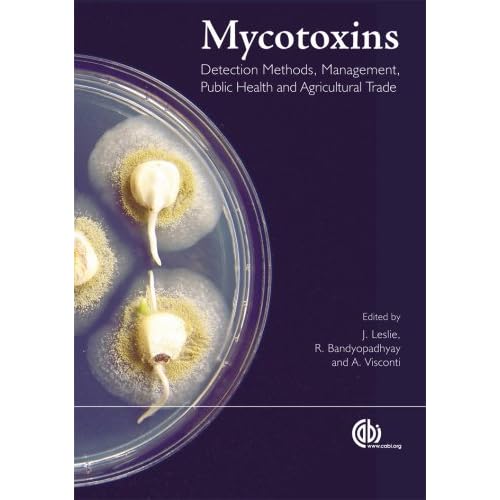
Mycotoxins Detection Methods, Management, Public Health and Agricultural Trade

Edited by J Leslie, Kansas State University, USA, R Bandyopadhyay, International Institute of Tropical Agriculture, Nigeria, A Visconti, Institute of Sciences of Food Production, Italy

Content: Mycotoxins are produced worldwide by several fungi on a wide range of agricultural commodities and are closely related to human and animal food chains. Examining mycotoxins and their impact from a public health viewpoint, this book provides an overview and introduction to the subject and examines the health, trade and legislation issues involved. Management of mycotoxins is discussed in detail as well as the global problems caused by mycotoxins.

Monday, 25 October 2010

AGRISAT WORKSHOP: Earth observation for worldwide agricultural monitoring

13-15 October 2010 AGRISAT WORKSHOP, Brussels. The objective of this workshop was to review the state-of-the-art, the current issues and the way forward in agricultural monitoring systems for the different regions of the world. Key recommendations were formulated in order to improve food security and agricultural production monitoring on a global scale, taking into account policy evolutions, agro-ecosystems diversity and satellite system developments.

It was admitted that agriculture has not been the priority of remote sensing so far.
  • The focus has been on land cover areas for environmental purposes.
  • Also the climate change community is mainly concerned by land cover and not land use.
  • Crop monitoring is mainly focusing on high production countries, not subsistence farming
  • Participants urged for more funding for  subsistence farming’ crop monitoring
  • Remote sensing specialist cannot be expected to responsible for the use of their information up to the level of farmers. They need information intermediaries for this but experience a lack of follow up
  • A separate forum/venue is needed to discuss the recipients’ perspective (dixit Christopher Justice, University of Maryland, USA)
  •  The users’ perspective was not so well represented because a number of persons participate at the Fifth International Conference on Agricultural Statistics (ICAS-V) ( 12-15 October 2010, Kampala, FAO).
  • Only one NGO attended: Action Contre la Faim ACF Espagne-Mali: Erwann FILOL & Frederic HAM
  • The African participants came from Senegal, Sudan, Ethiopia, Niger, Kenya, Zimbabwe, Malawi and Mozambique (BEYE Gora Centre de Suvi Ecologique Senegal;  AZAHRI FARH MAHGOUP Mohamed Federal Ministry of Agriculture and Forests Sudan; EL SHEIKH Hassan GMFS Sudan; TULU Mathewos Hunde Ministry of Agriculture and Rural Development, Ethiopia; ALFARI Issifou AGHRYMET Niger; AGATSIVA Jaspat Regional Center for Mapping of Resources Development (RCMRD) Kenya; GALU Gideon USGS/FEWS NET Kenya; KORME Tesfaye RCMRD Kenya; SITUMA Charles Department of resource survey and remote sensing Kenya; MBUKWA Christopher Ministry of Agriculture and Food Security Malawi; PATRICIO Domingos Instituto Nacional de Meteorologia, Mozambique; DAMELIO Jacopo FAO Zimbabwe

Satellite images with a high and moderate spatial resolution are expected to have a strong development in the coming years. It will become easier to integrate remote sensing data in the policy making and foresight capacity of African Ministries of Agriculture. Remote sensing data are to lead to improved statistical analysis and the creation of information products which allow for easier interpretation. Having reliable figures before harvest is a major challenge. In well organized African countries crop area estimates are generally available a few months after harvest. The management of agricultural policy and food security requires timely and possibly objective agricultural statistics.

Following the presentation of David Radcliffe on “EU Policy framework and (future) challenges: Agriculture and food security for development” there was a discussion on how to stimulate the uptake of Earth Observation (EO) data by other users (non governmental and non research actors). Pathways are to be designed for transitioning from research to operations, targeting information providers and users. Local organizations (ngo, farmer organizations, etc) have not the capacity to generate sophisticated data. It is thus difficult to expect from local stakeholders to generate ground truthing data (verification, calibration and validation of remote sensing data). Universities should partner with non-research stakeholders to clarify the local need for natural resources data.

In the plenary David Radcliffe said that he saw a role for PAEPARD to articulate the demand of non-research stakeholders for EO data. Proposals (ENV.2011.4.1.4-1) should include a strong communication strategy “to get the message down to the farmer organizations”.

Background:
The workshop frames under the GMES initiative and is a contribution to the GEO Agricultural Monitoring Task (Ag 0703) which has the goal of improving international coordination on earth observation for enhanced agricultural monitoring. Related blog post: Developing increased EO capacity for better agriculture and forestry management in Africa
GMESGEOBELSPOVITOUCLJRC
Downloads
Presentations

Saturday, 2 October 2010

Knowledge Based Bio-Economy towards 2020 Conference

14/09/2010. Brussels. Knowledge Based Bio-Economy towards 2020 Conference. The aim of this conference was twofold: to take stock of the progress made since 2005 (the first KBBE conference) and the forward look towards 2020, contributing to the new vision and action plan for a Sustainable Bright Green Bio-Economy.

After the opening session of the conference, parallel sessions were organised around three topics: feedstocks for the bio-economy, innovative biobased products and innovative food production. Policy makers, academics, industry and civil society representatives jointly assessed the present achievements and the future needs of the bio-economy.

In the final part of the conference conclusions were drawn and policy recommendations were formulated. Site visit: On Monday 13 September, participants had the opportunity to join a site visit to the Life Sciences and bio-energy clusters in Ghent, highlighting two different aspects of the bio-economy.

Related: Information Day and Brokerage Event on Call FP7-KBBE-5-2011
13/09/2010. Brussels. The European Commission organised a European Info day for the upcoming call for proposals under the 'Food, Agriculture and Fisheries and Biotechnology' theme of the Seventh Framework Programme (FP7).

The afternoon programme consisted of a Brokerage Event for the 2011 call, organised by the BIO CIRCLE project. During this Brokerage Event, researchers from Europe and Third Countries will have the opportunity to discuss opportunities to collaborate on proposals for topics in the 2011 KBBE Work Programme.

Tuesday, 8 June 2010

Announcement: Call FP7-KBBE-2011 and FP7 Info Day and Brokerage Event


The registration form to the FP7 Info Day and Brokerage Event (Brussels, 13 September 2010) is now available on the BIO CIRCLE web site.

Bio Circle will upload additional information about the detailed programme of this event as soon as it is available.

http://www.biocircle-project.eu/dnn4/home/tabid/75/idev/54/Default.aspx

3 themes are relevant for Africa in this call which will be launched end of July (deadline for submission of proposals 15/01/2011)

  1. KBBE.2011.2.5-02 Reducing post-harvest losses for increased food security — SICA Up (Specific International Cooperation Actions) to 2 projects may be funded (SICA means that non EU members are mandatory)
  2. KBBE.2011.1.3-01 New/next generation of researchers for Neglected Zoonoses at the animal-human interface – Mandatory ICPC (International cooperation partner countries ) Coordination and Support Action targeted to SMEs. Minimum number of participants: 3 from different Member States or Associated Countries and 3 from different ICPC (of which at least 2 from Africa)
  3. KBBE.2011.1.4-08 Role of aquaculture in improving food security and eradicating poverty worldwide - Mandatory ICPC Coordination and Support Action (coordinating action) Minimum number of participants: 2 from Member States and Associated Countries and 3 from different ICPC (International cooperation partner countries )
Related blog posts:


BIO CIRCLE trains African researchers in FAFB (3)

During the Bio Circle FP7 training workshop held at FARA, Accra on first and second of June 2010, the participants have been watching and commenting following video interviews where African researchers express their views on the FP7 or working with European Researchers more in general. 


Dr. Habiba Hassan-Wassef (Egypt) sees a misunderstanding in the fact that many researchers in Africa perceive the Frame Work Programme 7 of the European Commission first of all as a source of money forgetting it is about science and knowledge based economy. But few realise what this means. It is about generating new knowledge to serve the bio-economy and not research for research or research for development.


There is a need to look at research with a different perspective which is bringing innovation to European research. Therefore it is important to follow developments at the European and World research front. FP7 is not a lottery. It is important to understand how the evaluators of proposals think. Dr. Hassan-Wassef answers the question of which the biggest difficulties are for African researchers to participate in FP7 research projects.


Dr. Habiba Hassan-Wassef has been wondering why Europe has a renewed interest for joint research in the field of agriculture and nutrition in Africa (Framework Programme 7 Theme 2: Food, Agriculture, Fisheries and Bio-technologies).

She takes as example a recent call by the European Commission for proposals from the South-Mediterranean Area about research on African traditional technology about the use of food resources, the management of natural resources, the use of African traditional food processing technologies in order to benefit the European food industry.

She questions the principle of mutual benefit and wants to secure Africa's interest and intellectual property rights. She believes though that FP7 is a genuine change compared to the past. But she fears African scientists do not know all their rights while FP7 provides for it. Collaboration between North African researchers and Sub-Saharan researchers could be improved and accelerated. FARA, NEPAD and the different Sub-regional organisations have a role to play in this.


Sanaa ZEBAKH (Point d'Information National sur les programmes de recherche europeens - Maroc) says: "The role of NIPs is not to create illusions but about contributing to European research knowledge and about excellence". In Marocco light information products have been developped with a focus on themes which Moroccan researchers may find interesting.

Morocco has been relatively successful in participating in FP6 & FP7 calls because of the long history of scientific collaboration between Europe and Marocco. The contribution of the National Information Point to this is more difficult to evaluate. Some 30 information sessions have been organised for FP7 call all over the country and Marocco has now focal points in every university. But despite the information dissemination the success rate for the first FP7 call has been low: on the 45 submitted proposals only 2 were selected.

A new strategy is to work with a restricted group of scientists whose potential is real instead of wanting to reach as much as possible researhers. But it is difficult to judge who is part of the top of Maroccan research. The biggest bonus for Marocco from FP1 to FP6 participation is to have seen 130 research institutes collaborate in 98 EU funded projects with an average of 3 to 4 researchers per research project.


Dominique PALLET, the French coordinator of the AFTER project (African Traditional Food Revisted by research) explains the objectives of the project and the challenges of managing a FP7-project consortium (FP = Frame work programme 7 of the Eurepean Commission.


Interview with Dr. Kevin Urama African Technology Policy Studies (ATPS Kenya) at the NEPAD Tertiary Institutions Dialogue FARA Secretariat 28 - 30 July 2009, Accra, Ghana. He thinks that the modus operandus of the European Framework Programme is very useful because it is trying to forge partnerships and collaborations both between disciplines and across cultures and countries. Currently ATPS is working on a Manifesto for Science and Technology involving Indian, European and African partners. Work packages allow African institutes to take the lead and in this they can set their own research priorities. The multilateral research platform is a guarantee for quality control. Such types of collaboration should happen more in Africa. He gives as an example the banana tissue culture which was developed in Kenya but now involves researchers from Cameroon, Nigeria and other places. The requirement of involving policy makers, researchers, the producers and the civil society allows for innovation to develop and forces researchers to think critically about their research. He answers following questions:

  • Will newcomers like Japan, China and Brazil foster Africa-Africa collaboration ? (ATPS is currently developing a Donor Watch initiative)
  • Will we have one day an African Union FP7 type of programme?


Prof. Umezuruike Linus Opara is a Professor at Stellenbosch University where he holds the South African Chair in Postharvest Technology. In this interview, Prof. Opara explains the various fields of research implied in Postharvest Technology. Furthermore, Prof. Opara makes the case for a multi-stakeholder and multi-disciplinary approach, where researchers from different backgrounds would interact with professionals of the food supply chain. Finally, Prof. Opara explains the importance of networking among researchers from Europe and Africa.

ANOTHER INTERVIEW VIEWED AND COMMENTED BY THE PARTICIPANTS WAS THE INTERVIEW WITH Dr. Angelo Visconti, Institute of Sciences of Food Production (ISPA), National Research Council (CNR) Bari, Italy