Tuesday, 8 June 2010

Announcement: Seminar: Innovation and decision aid in agriculture : which roles of research and which partnerships

Thursday September 2nd. Seminar: Innovation and decision aid in agriculture : which roles of research and which partnerships. This symposium will illustrate and analyse how research in agronomy can contribute to a sustainable agricultural progress, in both African and European contexts, through various types of deliverables and through diverse modes of interaction between research, farmers and their organizations, extension services and agro industry.


The conference aims to illustrate and analyze, for a varied range of socio-economic and agricultural situations, the place and the role of agronomic research in the processes of innovation in the framework of Sustainable Development. Above all, the conference will identify and discuss:

  • The nature and the form of the deliverables through which research in agronomy contributes to innovation: new techniques, new cultural practices or cropping systems, but also new decision support systems applicable at various space scales and organization levels;
  • The conditions and steps through which these various types of deliverables are elaborated (modelling, experimentations of various types, inquiries, co construction of questions, etc.), and the types of subjacent knowledge;
  • The modes of interaction efficient between research and the actors (sometimes new) of innovation: farmers and their organizations, extension services, companies and organizations concerned by the inputs (agro supplies) and outputs (collecting and transformation of the production) of the farms ;
  • The ways in which public policies and agronomic research may interact for stimulating sustainable innovation processes, in agriculture.
Reference:
Provisional program - Download French version (pdf file)
It is possible to register only for this seminar by sending back the specific registration form to the Association Française d'Agronomie
Download the registration form

Gestion des systèmes post-récoltes en Afrique de l'Ouest et du Centre

24 au 27 Mai 2010. Cotonou, Benin. 2ème Semaine Scientifique de l'Afrique de l'Ouest et du Centre. Gestion des systèmes post-récoltes des produits végétaux, animaux et halieutiques pour l'amélioration de la productivité, de la compétitivité des marchés agricoles en Afrique de l'Ouest et du Centre, c'est autour de ce thème central que les scientifiques de la sous région et leurs partenaires ont échangé du Pendant quatre jours, les participants ont fait des propositions pratiques et novatrices dans la recherche de solutions intégrées pour la réduction des contraintes post-récoltes.


28 au 29 Mai 2010. Cotonou, Benin. 9ème Assemblée Générale du CORAF/WECARD. Les acteurs et partenaires du CORAF/WECARD se sont réunis du pour la 9ème session ordinaire de l'Assemblée Générale. Les travaux ont permis d'éxaminer le rapport moral du Conseil d'Administration, le rapport d'activités du CORAF/WECARD de Juin 2008 à Mai 2010, d'adopter des documents statutaires et de renouveler les membres du Conseil d'Administration.


Des technologies novatrices et des stratégies appropriées devraient être élaborées pour promouvoir l'accès des grands et petits transformateurs aux prototypes de transformation modernes, ont-ils souligné.

Les nombreuses études réalisées dans la sous-région au cours des dix dernières années ont révélé de manière pertinente la nécessité de mettre l'accent sur les technologies et les techniques post-récoltes pour que l'agriculture joue convenablement sa partition, en tant que moteur de croissance économique.

Selon des études récentes, les pertes post-récoltes atteignent en Afrique de l'Ouest et du centre, plus de 30 pc de la production et celles relatives uniquement à la filière-riz, avoisinent parfois 2,3 milliards FCFA.

Initiée par le Conseil ouest-et-centre africain pour la recherche et le développement agricoles (CORAF), la deuxième semaine scientifique agricole de l'Afrique de l'Ouest et du centre se veut un cadre d'échanges sur les innovations agricoles, afin d'accroître la sensibilité des participants et du public sur la problématique des systèmes de post-récolte.


References: 
Press release CORAF
Pana 29/05/2010 Afrique: Plaidoyer pour une gestion efficace des systèmes post-récolte
REWMI 05/06/2010 Agriculture : Réflexions transversales à Cotonou

Nouvelle Expression 03/06 Les progrès sur les recherches de la gestion après récoltes dévoilés

BIO CIRCLE trains African researchers in FAFB (3)

During the Bio Circle FP7 training workshop held at FARA, Accra on first and second of June 2010, the participants have been watching and commenting following video interviews where African researchers express their views on the FP7 or working with European Researchers more in general. 


Dr. Habiba Hassan-Wassef (Egypt) sees a misunderstanding in the fact that many researchers in Africa perceive the Frame Work Programme 7 of the European Commission first of all as a source of money forgetting it is about science and knowledge based economy. But few realise what this means. It is about generating new knowledge to serve the bio-economy and not research for research or research for development.


There is a need to look at research with a different perspective which is bringing innovation to European research. Therefore it is important to follow developments at the European and World research front. FP7 is not a lottery. It is important to understand how the evaluators of proposals think. Dr. Hassan-Wassef answers the question of which the biggest difficulties are for African researchers to participate in FP7 research projects.


Dr. Habiba Hassan-Wassef has been wondering why Europe has a renewed interest for joint research in the field of agriculture and nutrition in Africa (Framework Programme 7 Theme 2: Food, Agriculture, Fisheries and Bio-technologies).

She takes as example a recent call by the European Commission for proposals from the South-Mediterranean Area about research on African traditional technology about the use of food resources, the management of natural resources, the use of African traditional food processing technologies in order to benefit the European food industry.

She questions the principle of mutual benefit and wants to secure Africa's interest and intellectual property rights. She believes though that FP7 is a genuine change compared to the past. But she fears African scientists do not know all their rights while FP7 provides for it. Collaboration between North African researchers and Sub-Saharan researchers could be improved and accelerated. FARA, NEPAD and the different Sub-regional organisations have a role to play in this.


Sanaa ZEBAKH (Point d'Information National sur les programmes de recherche europeens - Maroc) says: "The role of NIPs is not to create illusions but about contributing to European research knowledge and about excellence". In Marocco light information products have been developped with a focus on themes which Moroccan researchers may find interesting.

Morocco has been relatively successful in participating in FP6 & FP7 calls because of the long history of scientific collaboration between Europe and Marocco. The contribution of the National Information Point to this is more difficult to evaluate. Some 30 information sessions have been organised for FP7 call all over the country and Marocco has now focal points in every university. But despite the information dissemination the success rate for the first FP7 call has been low: on the 45 submitted proposals only 2 were selected.

A new strategy is to work with a restricted group of scientists whose potential is real instead of wanting to reach as much as possible researhers. But it is difficult to judge who is part of the top of Maroccan research. The biggest bonus for Marocco from FP1 to FP6 participation is to have seen 130 research institutes collaborate in 98 EU funded projects with an average of 3 to 4 researchers per research project.


Dominique PALLET, the French coordinator of the AFTER project (African Traditional Food Revisted by research) explains the objectives of the project and the challenges of managing a FP7-project consortium (FP = Frame work programme 7 of the Eurepean Commission.


Interview with Dr. Kevin Urama African Technology Policy Studies (ATPS Kenya) at the NEPAD Tertiary Institutions Dialogue FARA Secretariat 28 - 30 July 2009, Accra, Ghana. He thinks that the modus operandus of the European Framework Programme is very useful because it is trying to forge partnerships and collaborations both between disciplines and across cultures and countries. Currently ATPS is working on a Manifesto for Science and Technology involving Indian, European and African partners. Work packages allow African institutes to take the lead and in this they can set their own research priorities. The multilateral research platform is a guarantee for quality control. Such types of collaboration should happen more in Africa. He gives as an example the banana tissue culture which was developed in Kenya but now involves researchers from Cameroon, Nigeria and other places. The requirement of involving policy makers, researchers, the producers and the civil society allows for innovation to develop and forces researchers to think critically about their research. He answers following questions:

  • Will newcomers like Japan, China and Brazil foster Africa-Africa collaboration ? (ATPS is currently developing a Donor Watch initiative)
  • Will we have one day an African Union FP7 type of programme?


Prof. Umezuruike Linus Opara is a Professor at Stellenbosch University where he holds the South African Chair in Postharvest Technology. In this interview, Prof. Opara explains the various fields of research implied in Postharvest Technology. Furthermore, Prof. Opara makes the case for a multi-stakeholder and multi-disciplinary approach, where researchers from different backgrounds would interact with professionals of the food supply chain. Finally, Prof. Opara explains the importance of networking among researchers from Europe and Africa.

ANOTHER INTERVIEW VIEWED AND COMMENTED BY THE PARTICIPANTS WAS THE INTERVIEW WITH Dr. Angelo Visconti, Institute of Sciences of Food Production (ISPA), National Research Council (CNR) Bari, Italy

BIO CIRCLE trains African researchers in FAFB (2)

Participants at the FP7 Bio Circle training workshop (FARA, Accra, 01/06-02/06):


From left to right and top to bottom:
  1. Amoa Awah  Wisdom , Food Research Institute/Ghana  
  2. Sharon Alfred , FANRPAN, Pretoria, South Africa
  3. Gustave Ewole, PROPAC, Cameroun
  4. Mr. Moses Limuwa ,  Programmes Coordinating Office,  Bunda College of Agriculture Lilongwe, Malawi
  5. Jonas Mugabe, FARA, Accra-Ghana
  6. Majaliwa Mwanjololo,  MUIENR,  Makerere University Uganda
  7. James Aucha , ANAFE, Nairobi - Kenya
  8. Ben Kubbinga, Facilitator,  APRE/Italy
  9. Francois Stepman, Euro- PAEPARD, Bruxelles, Belgium
  10. Moses Osiru , RUFORUM, Kampala- Uganda


Additional participants (who did not stay for the full 2 day
  1. Amoah King David, National Co-ordinator, FONG/ECASARD
  2. Sasu Lydia , Executive Director, Development Action Association
  3. Banson Kwamina , Research Scientist, Biotechnology and Nuclear Agriculture Research Institute
  4. Myra Wopereis, FARA, Accra-Ghana
  5. Vesta Nunoo, FARA, Accra-Ghana
  6. Dr. Adewale Adekunle, FARA, Accra-Ghana
  7. Johnson Ukpong, FARA, Accra-Ghana

Guests:
  1. Dr. Leovegildo Lopes de Matos, Office Coordinator EMBRAPA Ghana
  2. Jose Luiz Bellini Leite, Agri business coordinator, EMBRAPA Ghana

Monday, 7 June 2010

BIO CIRCLE trains African researchers in FAFB (1)

June 1st and June 2nd. Accra, Ghana. TRAINING SEMINAR OF FOCAL POINTS IN AFRICA to participate in EC/FP7 and EC/FSTP calls for proposals. The Training Workshop was organized in the framework of the Bio Circle project (01/10/2008 – 30/09/2010) co-financed by European Commission under the 7th Framework Programme (FP7).


The participants watched the video interviews of 
  • Dr. Angelo Visconti (Institute of Sciences of Food Production (ISPA), National Research Council (CNR) Bari, Italy and 
  • Dr. Kevin Urama, the director of the African Technology Policy Studies (ATPS Kenya)


The BIO CIRCLE NET is a two year project that aims to reinforce the network of National Contact Points (NCP) for the Seventh Framework programme under Theme 2 “Food, Agriculture and Fisheries, and Biotechnology” (FAFB) and extend the network to include National Information Points (NIP) for major Third Country partners in two years. BIO CIRCLE promotes the work of the EU-Africa Joint Partnership through stimulating international cooperation between EU and African researchers.

Thanks to its cooperation with BIO CIRCLE, FARA is able to provide consistent and accurate advice to researchers throughout the African continent about FP7 participation in the FAFB theme. The Round Table on African Agricultural Research priorities (co-organised with CTA in Brussels - April 2008), brokerages, twinning and the present tailor made trainings all help stimulate dialogue on these issues, thereby contributing to Overall Objective 2 (Better define specific areas of mutual interest and mutual benefit in FAFB international cooperation research between the EU and Third Countries as well as new cooperation mechanisms).

Complementing the activities which are planned under the PAEPARD project this training will enhance the capacity and capabilities of national research teams to compete for EC funds in IAR4D. More in particular it will increase the knowledge about European funding opportunities among African ARD stakeholders.
Specifically, the workshop is aimed at training some experts (information points) from Africa who will be able to:

INFORM
Favour knowledge of EU opportunities by means of Internet, organisation of events, meetings on specific calls for proposals or thematic sectors.

ASSIST/TRAIN
Support scientific community to submit projects proposals that could be co-financed by European Commission (by explaining modalities of funding schemes, advising on administrative procedures and legal issues, assisting in partner search activities).

Presentation of the FSTP proposal HORTINOV by Leo Matos, Regional Director of Embrapa Accra

PROVIDE FEEDBACK
Draft statistics on issues that could be useful to PAEPARD: such as: a) the participation of ARD actors to S&T events organised by EC; b) the number of national participations in co-financed projects, c) the thematic sector in which there are more projects submitted and the sector in which there are more projects co-financed, d) distribution of projects per geographic area; e) average of funds per project, and so on.

FAVOUR NETWORKING WITH OTHER IP.
Networking to share and disseminate EC funding opportunities among the African Information Points.

The beneficiaries of this training were participants and their institutions but also the PAEPARD II project and all partners who benefit from their knowledge.


Related
The upcoming FP7 call on  FOOD, AGRICULTURE AND FISHERIES, AND BIOTECHNOLOGY (FAFB) will be launched by EC 31st of July 2010. Following research themes are relevant for Africa: (disclaimer: this may still change when the final call will be launched)
  1.  KBBE.2011.2.5-02 Reducing post-harvest losses for increased food security — SICA Up (Specific International Cooperation Actions) to 2 projects may be funded (SICA means that non EU members are mandatory
  2.  KBBE.2011.1.3-01 New/next generation of researchers for Neglected Zoonoses at the animal-human interface – Mandatory ICPC (International cooperation partner countries ) Coordination and Support Action targeted to SMEs. Minimum number of participants: 3 from different Member States or Associated Countries and 3 from different ICPC (of which at least 2 from Africa
  3. KBBE.2011.1.4-08 Role of aquaculture in improving food security and eradicating poverty worldwide - Mandatory ICPC Coordination and Support Action (coordinating action) Minimum number of participants: 2 from Member States and Associated Countries and 3 from different ICPC (International cooperation partner countries )

Announcement: MycoRed AFRICA 2011 Conference

4/6 April 2011 - Cape Town South Africa
“Mycotoxin reduction – Global solutions"

The MycoRed Africa 2011 Conference will bring together a range of international experts to discuss mycotoxicological issues in general and mycotoxin reduction measures in particular.
The Conference will be held from 4 to 6 April 2011 under the auspices of the International Society for Mycotoxicology.
The academic programme aims to address a wide range of issues concerning mycotoxins, including their production by mycotoxigenic fungi, natural occurrence, their fate during processing from farm to plate, toxicology and regulatory control. Emphasis will be placed on the conference theme, but prominence will be given to the problems in different African environments and their potential solutions.


Besides talks on numerous topics by invited speakers (local and international), there will be opportunity for presentation of original research work, either as oral or poster presentations. Participation of delegates from the African continent will be encouraged and actively promoted.
Delegates are encouraged to use this meeting as a forum to discuss their research findings.
The conference is organized by Gordon Shephard from MRC.
25/27 October 2010 - Cairo, Egypt.Mycotoxicological risks in Mediterranean countries: economic impact, prevention, management and control.
This workshop will be focused on the cooperation among Mediterranean Countries, with an overview on the current situation on the occurrence of mycotoxins and toxigenic fungi in Mediterranean Bacin.
Prevention and control of mycotoxins in Mediterranean food and feed chain, as well as Mycotoxins of Public and Animal Health Significance in the Meditteranean will be other relevant themes to be discussed.


2nd of May 2010. Interview with Dr. Angelo Visconti, Institute of Sciences of Food Production (ISPA), National Research Council (CNR) Bari, Italy (Bio Circle working visit).

Mycotoxins are secondary metabolites produced by fungi that are toxic to humans and animals consuming the products. The mycotoxins represent one of the most important and sensitive problem for our world and our life, as various many products we normally use in our diet are exposed to their contamination.


This EC FP7 project called MycoRed builds significantly on the outcome of several European projects (through most coordinators/partners of FP5 and FP6).

Mycotoxins are dangerous for  feed and food chains  as  they can create contamination in pre- and post-harvest processes. Mycotoxin research is making strong efforts to improve knowledge and reduction of aflatoxins, trichothecenes   (deoxynivalenol, nivalenol, T-2 and HT-2 toxins, etc.) , zearalenone, fumonisins and ochratoxin A   are very important to handle this problem.
Mycotoxin reduction targets of vital importance have been identified by some international food organizations (e.g. FAO, CIMMYT, EFSA, IITA, SAFE consortium), EU reports and relevant food industry representatives.


Mycotoxins effects


  • Aflatoxin B is a proven carcinogen for humans. It is immunotoxic and causes stunted growth in children and growth retardation in animals.
  • Fusarium toxins, especially fumonisins , are neurotoxic and possible carcinogens, trichothecenes  are immunotoxic and zearalenone  is estrogenic.
  • Ochratoxin A  is a nephrotoxin, possibly carcinogenic to humans and associated with Balkan Endemic Nephropathy.
Mixtures of mycotoxins probably have at least an additive, if not synergistic, egregious effects. These toxins are primary sources of both yield losses and increase of management costs worldwide.


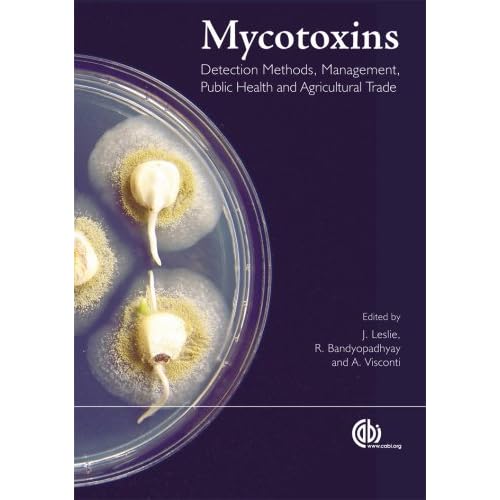
Mycotoxins Detection Methods, Management, Public Health and Agricultural Trade

Edited by J Leslie, Kansas State University, USA, R Bandyopadhyay, International Institute of Tropical Agriculture, Nigeria, A Visconti, Institute of Sciences of Food Production, Italy

Content:
Mycotoxins are produced worldwide by several fungi on a wide range of agricultural commodities and are closely related to human and animal food chains. Examining mycotoxins and their impact from a public health viewpoint, this book provides an overview and introduction to the subject and examines the health, trade and legislation issues involved. Management of mycotoxins is discussed in detail as well as the global problems caused by mycotoxins.

Related:
29-30 April 2010 BIO CIRCLE organised in Rome its 3rd midterm Meeting and above mentioned working visit in Bari. (BIO CIRCLE = Creating a CIRCLE by extending the BIO NCP network to Third Country NIPs

ECOWAS and the West African Food and Nutritional Crisis

19 May 2010. Lomé, Togo. Extraordinary Meeting of Ministers of Agriculture, Trade and Social/Humanitarian Affairs of ECOWAS Member States on the West African Food and Nutritional Crisis and its Implications for the sub-region.


At the invitation of the ECOWAS Commission, the Extraordinary Meeting of Ministers of Agriculture, Trade and Social/ Humanitarian Affairs of ECOWAS Member States on the West African Food and Nutritional Crisis and its Implications for the sub-region, was held


This meeting is a follow-up on the regional and international meetings of the Food Crisis Prevention and Management Mechanism (PREGGEC/FCPMM) and the Food Crisis Prevention Network of the Sahelian region and ECOWAS sub-region coordinated by CILSS. The purpose of the meeting was to:

  • Examine the food crisis situation in the Sahelian countries and its implications for the region;
  • Consider the proposals and recommendations made by the Experts;
  • Decide on appropriate measures to be adopted in order to curtail the food crisis and its consequences.

The meeting was attended by Ministers of ECOWAS member States (Benin, Côte d’Ivoire, Ghana, Gambia, Guinea, Niger, Nigeria, Senegal, Sierra Leone and Togo), representatives from the Technical and Cooperation Institutions (UEMOA, CILSS, ReSAKSS, FARA), representatives from Support and Cooperation Agencies (Spain, European Union, France, USAID, HLTF, WFP) as well as representatives from the Civil Society and NGOs (OXFAM, CARE, SAVE THE CHILDREN, BILLITAL MAROOBE).


Reference:
ECOWAS press release 18/05

Improve access to markets for Africa’s animal resources to significantly contribute to economic growth and reduction of poverty

14 May 2010. Entebbe, Uganda. Delegates to the 8th AU conference of Ministers responsible for Animal Resources adopted six resolutions at the end of their conference in Entebbe, Uganda. The adopted resolutions included Investment in the Livestock Sector, AU-IBAR Strategic Plan, Access to market, Rinderpest eradication and control of Transboundary Animal Diseases (TADs), Pastoral production systems and climate change.
Hon. Henry Kajura, Uganda's 2nd Vice Prime Minister delivering his closing address. In the picture are Prof. El-Sawalhy, Director AU-IBAR (seated second left) and H.E. Mrs. Rhoda Peace Tumusiime, Commissioner for Rural Economy and Agriculture (seated third left), among other officials.
The conference held under the theme “Improve access to markets for Africa’s animal resources to significantly contribute to economic growth and reduction of poverty” took place at the Imperial Resort Beach Hotel from 13 to 14 May 2010. During the conference delegates, among other things, reviewed progress made since the last conference of Ministers held in Kigali, Rwanda in November 2005 and considered other contemporary matters related to the development and utilisation of animal resources in Africa.


Reference:
AU Ministers Adopt Six Resolutions in Uganda

Launching of the Brazil/ Africa Marketplace Initiative


10-14 May 2010. Brasilia, Brazil. Launching of the Brazil/ Africa Marketplace Initiative and the Brazil/ Africa Dialogue on Food Security, Fight Against Hunger and Rural Development anchored by the Ministry of External Affairs in Brazil.

Following the logic that gave birth to PAEPARD, FARA initiated partnerships with EMBRAPA on what is termed Africa/Brazil Innovation Marketplace. Through this initiative, both parties in the agreement hope to organize a platform for researchers on both sides to come together with common topics which would be considered for funding using the Marketplace principles. Both DFID and the World Bank embraced the idea and agreed to provide seed money. Currently, IFAD and AFDB are considering their participation in this innovative South-South partnership approach.

The Africa/Brazil Dialogue involved African Ministers in charge of Agriculture, Water Resources, Rural Development and Fisheries. The Ministry saw the Innovation Marketplace Initiative as a tangible element that gives immediate meaning to a well publicized Dialogue and decided not only to put money into it but also agreed to have it launched with its own identity, but as part of the whole Dialogue process with Africa.

The Launching of the Marketplace Initiative was followed by the inauguration of the Center for Strategic Studies and Capacity Strengthening at EMBRAPA by the president of Brazil, Mr Luiz Inacio Lula da Silva. This structure is a $10m project which is targeted at providing critical services to developing countries in strategic discussions and capacity strengthening. Many African Ministers saw value in this Center and the first set of themes that were presented during the launching. Immediately after the launching of the Center, the participants were led through a display of technologies and innovations coming from EMBRAPA addressing various challenges along the value chain for several commodities.
FARA was represented by Dr Ramadjita Tabo, Deputy Executive Director, and Dr Adewale Adekunle, Director, Partnerships and Strategic Alliances

Climate Change Agriculture and Food Security (CCAFS) Launch Conference and Planning Workshop

4th -7th May. Nairobi, Kenya. The Challenge Program on Climate Change, Agriculture and Food Security (CCAFS) is a new 10-year research initiative by the Consultative Group on International Agricultural Research (CGIAR) and the Earth System Science Partnership (ESSP) to facilitate new research on the interactions between climate change, agriculture, natural resource management and food security.

CCAFS will in late 2010, morph into the CGIAR mega programme seven (MP7) on climate change. Its initial focus regions are West Africa, East Africa and the Indo-Gangetic Plains.

It has four strategic thematic areas around which activities are designed:

  • Adaptation to progressive climate change
  • Adaptation through managing climate risk
  • Poverty alleviation through mitigation
  • Diagnosis and scenarios for making strategic choices
The workshop was to identify key research and development priorities and make inputs into implementation in the target regions of East Africa, West Africa and the Indo-Gangetic Plains.

Achim Steiner (UNEP) talked about implications of climate change for agriculture and underscored the need to break farmer dependency on seed companies and fertilizer suppliers. He further explained that promoting the ideology of more seeds, fertilizers and water as the sole means to achieving agricultural productivity will result in disaster. 


Lindiwe Sibanda discussed an Africa-wide policy on climate change adaptation and mitigation while David Radcliffe (European Commission) spoke about enhancing food security in the face of climate change and highlighted several global and European initiatives that support the same e.g. Global Initiative on climate Change, Global Initiative on Food Security, Global Climate Change Alliance, Food Security Thematic Programme, European Development Fund, Framework Programme 7.

International Conference on Agricultural Biotechnology in Developing Countries (ABDC)


The FAO International Technical Conference on Agricultural Biotechnologies in Developing Countries (ABDC-10) took place in Guadalajara, Mexico from 1 to 4 March 2010. A major objective of the Conference was to take stock of the application of biotechnologies across the different food and agricultural sectors in developing countries, in order to learn from the past and to identify options for the future to face the challenges of food insecurity, climate change and natural resource degradation.

The Conference brought together about 300 policy-makers, scientists and representatives of intergovernmental and international non-governmental organizations from 68 countries, including governmental delegations nominated by 42 FAO Member States.

A key feature of ABDC-10 was the involvement of a broad range of different stakeholders, including several intergovernmental and non-governmental organizations and regional fora, which organized/supported parallel sessions that were sector-specific, regional or of cross-sectoral interest. These included the CGIAR, ICGEB, the UN Conference on Trade and Development (UNCTAD), the UN Industrial Development Organization (UNIDO), the World Intellectual Property Organization (WIPO), the International Union for Conservation of Nature (IUCN), Oxfam International, the International Federation of Agricultural Producers (IFAP), the Association of Agricultural Research Institutions in the Near East and North Africa (AARINENA), the Asia-Pacific Association of Agricultural Research Institutions (APAARI) the Forum for Agricultural Research in Africa (FARA), the Inter-American Institute for Cooperation on Agriculture (IICA) and the Technical Cooperation Network on Plant Biotechnology in Latin America and the Caribbean (REDBIO). For each session, a Summary Report was prepared and all of these, as well as presentations made, are available on the webpage dedicated to these 27 Parallel Sessions.

During the Conference, 22 different organizations, including international and national research institutions, intergovernmental and non-governmental organizations, also participated in the 'Knowledge Share Fair' to promote good knowledge sharing practices in the field of agricultural biotechnologies.

Reference: Read the conference report

Guidelines for Donor Support to CAADP Process at country-level

21-23 April 2010. The 6th Partnership Platform Meeting of the Comprehensive Africa Agriculture Development Programme (CAADP) took place recently in Johannesburg, South Africa. The approximately 200 delegates included representatives of the African Union Commission, NEPAD Planning and Coordinating Agency, Regional Economic Communities, farmers organisations, civil society organisations, knowledge institutions, as well as Pan-African organisations and representatives of 8 development partner agencies. The meeting called upon all parties to make sure that adequate post-compact roadmaps were in place in each country upon signing of the compact, to be followed without delay by the formulation of agricultural investment plans. 


Reference:
Meeting Documents - CAADP - The Comprehensive Africa Agriculture Development Programme


Related:
The Guidelines establish steps by which donors agree to harmonise support for country-led agriculture and rural development in Africa.
English | French

AfricaAdapt’s YouTube Channel

Several Climate Change videos, relevant for Africa can also been viewed on the You Tube channel created by AfricaAdapthttp://www.youtube/com/user/africaadapt

Related:
12-17th April 2010. Brighton, UK. AfricaAdapt review and planning meeting. The aim of the meeting was to review implementation during year 2 of AfricaAdapt (April 2009 – March 2010) and plan for Year 3 (April – September 2010) as well as Phase 2 (October 2010 – September 2012).

Thursday, 3 June 2010

MANAGEMENT TEAM MEETING of PAEPARD II

27 - 28 May 2010, Accra, Ghana. MANAGEMENT TEAM MEETING (MTM) Platform for African-European Partnership on Agricultural research for Development (PAEPARDII). The main objective of the MTM was to resolve the critical issues that are confronting the implementation PAEPARD II activities.

From left to right: Vesta Nunoo (Finance officer FARA), Jonas Mugabe (co-manager PAEPARD for Africa), Jon Daane (ICRA), Adewale Adekunle (FARA), Tim Chancellor (NRI)

Other objectives included:

  1. Review and approval of work plans and Budgets (distribution among work packages and partners)
  2. Development of a reporting system (based on Work packages basis versus Partners). The budget of the project should be based on the work package while the Consortium Agreement (CA) funds will be directly transferred to each partner. The reporting system becomes a bit difficult (complex), a situation which can slacken project activities. Members should discuss and agree on which system is to fast the reporting. All reports should have a uniform format.
  3. Develop a M&E framework: PAEPARD is a complex project involving many partners from a diversity of fields and activity. How to ensure all partners are doing activities they are supposed to conduct? There is a need to define a clear M&E framework to track implementation activities.
  4. Resolve the issue of Partner’s contribution (Cost sharing): what is the level of contribution of each partner? A collective sharing is it possible?
  5. Define the roles of different organs which govern PAEPARD (Co-managers, Management Team, Steering Committee)
  6. Launch of PAEPARD II (FARA General Assembly)

Wednesday, 2 June 2010

Creating a consortium on African traditional food research

Dominique PALLET, the French coordinator of the AFTER project (African Traditional Food Revisted by research) explains the objectives of the project and the challenges of managing a FP7-project consortium (FP = Frame work programme 7 of the Eurepean Commission.

Tuesday, 1 June 2010

The South African Chair in Postharvest Technology

Prof. Umezuruike Linus Opara is a Professor at Stellenbosch University where he holds the South African Chair in Postharvest Technology. In this interview, Prof. Opara explains the various fields of research implied in Postharvest Technology. Furthermore, Prof. Opara makes the case for a multi-stakeholder and multi-disciplinary approach, where researchers from different backgrounds would interact with professionals of the food supply chain. Finally, Prof. Opara explains the importance of networking among researchers from Europe and Africa.


Link Chair in postharvest technology
Link South-African Mission to the EU