Friday, 22 June 2012
Establishment of an African Food and Agricultural Policy Platform
30th – 31st May, 2012. Accra, Ghana. Workshop to Plan the Establishment of an African Food and Agricultural Policy Platform (AFAPP).
The workshop was organized by the Forum for Agricultural Research in Africa (FARA) in collaboration with the Center for International Food and Agricultural Policy (CIFAP) of the University of Minnesota, USA. Policy research institutions or think tanks support and influence public and private sector decisionmaking by conducting policy research, disseminating the results and engaging in advocacy for its use. They also act as catalysts for new thinking and new solutions to address current, emerging and potential future problems and offer a nursery of ideas on the direction policies should take. With its new role as a weaver of knowledge networks in Africa,
FARA will provide a continental forum for networking (catalyzing, connecting and communicating) among African policy research institutions. Affiliate members of AFAPP will be drawn from these and other institutions to constitute the research resources by which AFAPP can carry out its mandate. The platform will provide the opportunity for them to catalyze, connect and communicate thus complementing and adding value to the work of each other. The platform will also provide several venues (e.g. workshops, seminars, training, conferences) for “venting” or communicating research outputs to affiliates of AFAPP, policymakers, and the broader community of policy analysts. By providing a platform for promoting the production, dissemination and uptake of policy research outputs, FARA expects to enhance the contribution of policy research institutions to public policy in Africa.
A small group (15 – 20) of policy experts drawn from policy research and development institutions within and out of Africa with ample knowledge and experience in food, agriculture and natural resources participated in the 2-day workshop. The participants have developed an action plan that shows the objectives, outputs and activities to be implemented. It should also provide a structure and operational mechanism of AFAPP, potential sources of funding and a roadmap on the way forward with identified responsibilities.


Wednesday, 6 June 2012
Africa Human Development Report 2012 on Food security
 |
| Launch of the report at the UNON compound in Nairobi. (Photo: UNDP) |
“Impressive GDP growth rates in Africa have not translated into the elimination of hunger and malnutrition. Inclusive growth and people-centred approaches to food security are needed” said UNDP Administrator Helen Clark at the launch on 15/05, attended by Kenya’s President Mwai Kibaki. Arguing that action focused on agriculture alone will not end food insecurity either, the Report calls for new approaches covering multiple sectors; from rural infrastructure to health services, to new forms of social protection and empowering local communities.
Ensuring that the poor and vulnerable have greater voice through strengthened local government and civil society groups is also needed to ensure food security for all. The quickening pace of change and new economic vitality on the continent make this an opportune time for action, the Report says. “Building a food-secure future for all Africans will only be achieved if efforts span the entire development agenda” Helen Clark said. While acknowledging that there are no quick fixes, the report argues that food security can be achieved through immediate action in four critical areas: Increasing agricultural productivity; more effective nutrition; building resilience; empowerment and social justice.
Towards a Food Secure Future

Sub-Saharan Africa has the highest prevalence of hunger in the world. Until this situation improves, the human development prospects of millions of Africans will remain at risk. UNDP’s first Africa Human Development Report shows that food security and human development reinforce each other.
If African countries are to realize their long-term potential, the report says, they must boost agricultural productivity to both improve the availability of food and reduce poverty. Policies to enhance nutrition are central to ensuring that access to food translates into human development. The report argues further that local populations must have the resources and decision-making power to produce and consume nutritious food throughout the year, overcoming the risks represented by continuing conflict, climate change and variations in food prices.
These drivers of change, by ending the ravages of hunger and malnourishment, will nurture capabilities and conditions for human development. A well-nourished and empowered population, in turn, is more likely to seek education, participate in society and expand its productive and human potential. With the right policies and institutions Africa can sustain this virtuous cycle of higher human development and enhanced food security.

Watch the video of the report below, featuring Ethiopian Prime Minister Meles Zenawi, Liberian President Ellen Johnson-Sirleaf, Harvard Professor Calestous Juma, UNDP Administrator Helen Clark and the Director of UNDP Africa, Tegegnework Gettu. All interviews can be watched individually.
Africa Human Development Report 2012 from UNDP on Vimeo.
Connecting Farmers to the Agricultural Value Chains in southern Africa

The theme of the two-day conference was “Connecting Farmers to the Agricultural Value Chains in southern Africa” and aimed at fostering more structured relations between farmers and agribusinesses in southern Africa.
CEOs and Presidents of national farmers’ unions from 16 countries in southern Africa attended. Key agribusinesses with a regional scope, such as SENWES, AFGRI, RUSELLSTONE, Massmart/Wal-mart, SAB Miller, Agribusiness Chamber and ABSA were invited to participate as well as regional institutions including SADC’s Trade, Investment, Finance and Industry (TIFI), COMESA and NEPAD.
Presentations were made by some of the leading agricultural procurement agri-businesses and discussions focused on sharing some of key developments and issues related to value chains in Southern Africa Region.
The conference was aligned to SACAU’s aim to strengthen its relationship with agribusinesses and create an environment that allows farmers to be well informed about value chain issues with respect to trading/marketing, retailing, direct production, storage, financing, processing, input supply and others. Increased agribusiness activity can be a key driver towards the deepening and broadening of the commercialisation of primary production, and especially of the smallholder sector.
Core areas of agreement between farmers and agribusiness from the conference will be used by SACAU to develop its positions on the sustainability of agriculture, especially from the perspective of agriculture primary producers in the region.
The conference was aligned to SACAU’s aim to strengthen its relationship with agribusinesses and create an environment that allows farmers to be well informed about value chain issues with respect to trading/marketing, retailing, direct production, storage, financing, processing, input supply and others. Increased agribusiness activity can be a key driver towards the deepening and broadening of the commercialisation of primary production, and especially of the smallholder sector.
Core areas of agreement between farmers and agribusiness from the conference will be used by SACAU to develop its positions on the sustainability of agriculture, especially from the perspective of agriculture primary producers in the region.
Annoucement: e-mail conference from 4 June to 1 July 2012 on "Ensuring the full participation of family farmers in agricultural innovation systems
4 June to 1 July 2012. FAO
is hosting a moderated e-mail
conference on "Ensuring the full participation of family farmers in agricultural innovation systems: Key issues and case studies".
The
UN General Assembly has declared 2014 to be the International Year of Family
Farming and has invited FAO to facilitate implementation of the International
Year, in collaboration with its partners. Among its initiatives for the
International Year, FAO is planning to publish a major study on family farming
and Agricultural innovation systems (AIS) in 2014 in the State of Food and
Agriculture series, which is FAO’s major annual flagship publication.
Agricultural
innovation systems are systems of individuals, organizations and enterprises
that bring new products, processes and forms of organization into social and
economic use to achieve food security, economic development and sustainable
natural resource management. AIS include a multitude of potential actors, such
as producer organizations, research organizations, extension and advisory
services, universities and educational bodies, governments and civil society
organizations, co-coordinating bodies, individual farmers and farm laborers,
and the private sector (including traders, processors, supermarkets etc.).
The
e-mail conference is open to everyone, is free and will be moderated.
The Background
Document to this FAO e-mail conference is available here.
Meeting
the needs of smallholder farming families also provides the central theme of
the GCARD RoadMap, which sets out the systematic changes
required to transform and strengthen innovation systems to better meet the needs
of resource-poor smallholders around the world. Results from the FAO
e-mail consultation will help inform discussion in The Second Global Conference on
Agricultural Research for Development (GCARD 2): “Foresight and
partnership for innovation and impact on small-holder livelihoods” on
practical actions underway and that are required to implement these systematic
changes. The GCARD 2 will be organized in Punta del Este,
Uruguay, 29 October – 1 November 2012, more information is available on the GFAR website.
The Pre-Registration
for the GCARD 2012 Conference is now open.
Outcomes
from the email consultation and the GCARD Conference will inform preparation of
the major FAO study in 2014, as well as help to build cooperation around key
forward-looking agendas and facilitate planning of joint actions among all AIS
stakeholders to deliver large scale development outcomes.
Announcement:: e-discussion: The potential of information and communication technologies (ICT) to improve data collection and M&E in agriculture in Africa
Participate in the 3rd e-Forum: June 11-22
The potential of information and communication technologies (ICT) to improve data collection and M&E activities is striking. Mobile phones, new platforms and repositories, and even software for reporting have reduced costs and time, improved data validity, and increased the ease of implementation. Some studies are showing these benefits.
The potential of information and communication technologies (ICT) to improve data collection and M&E activities is striking. Mobile phones, new platforms and repositories, and even software for reporting have reduced costs and time, improved data validity, and increased the ease of implementation. Some studies are showing these benefits.
When a team from Catholic Relief Services used iformbuilder to register and distribute vouchers to beneficiaries in a seed fair in Central African Republic, they saved over a one week prep time and reduced the personnel needed by half. CRS is now developing an entire M&E system using iformbuilder.
The ICT in Agriculture e-Sourcebook touches on these tools in a number of modules. Module 6 on Agriculture Innovation Systems, Module 3 on Mobile Phones, and Module 8 on Farmers Organizations describe how some of these tools have been used. The following videos are taken from only a few of the many digitized data collection and M&E service providers.
EpiSurveyor, demo of SMS data entry--
FrontlineSMS, explanation of origins and basics--
iformbuilder, basic demo--
This forum will explore two main topics:
1) Tools and issues in data collection and
2) Post-data collection—repositories, analytics, and dissemination in monitoring and evaluation. The forum will open the discussion to challenges related to using these technologies and their solutions as well.
Thursday, 24 May 2012
e-Agriculture for Improved Livelihoods and Food Security in Africa.
 21st - 23rd May 2012. Johannesburg, South Africa. International Association of Agricultural Information Specialists. 3rd IAALD Africa Chapter Conference: e-Agriculture for Improved Livelihoods and Food Security in Africa.
The conference drew attendance from 90 professionals and experts involved in the application of information and communication technology (ICT) in the rural domain, with a primary focus on agriculture (e-Agriculture), from both inside and outside Africa.
Speakers included government policy makers, industry, international development community, rural development practitioners, as well as researchers and graduate students from the agricultural and rural development field, including ICT. They presented and discussed the latest topics in e-agriculture and shared their experiences and lessons learned in the implementation of e-agriculture initiatives.
The conference activities comprised an exhibition showcasing e-agriculture initiatives and activities; pre-conference workshops, seminars and training. Prior to the conference, an online global discussion was held on e-Agriculture in Africa.
The Role of South-South Cooperation in Agricultural Development in Africa

Both China and Brazil are becoming increasingly important players in agricultural development in Africa, whether through technical assistance or trade and commercial investments in land and agriculture. In the longer term, these new players may reshape the way agricultural development is thought about, financed and implemented across Africa.
The implications of these new patterns of South-South cooperation have been discussed at a meeting in Brasilia on 17/05 organised by the Future Agricultures Consortium in collaboration with the International Policy Centre for Inclusive Growth (IPC-IG) and the UK Department for International Development (DFID), with support from Articulação Sul, the International Cooperation Centre in Agronomic Research for Development (CIRAD), and the United Nations Entity for Gender Equality and the Empowerment of Women (UN Women).
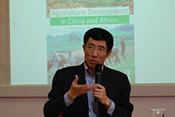 Professor Li Xiaoyun and Professor Qi Gubo of the Chinese Agricultural University in Beijing offered their perspectives based on the findings of their recently-published book, Agricultural Development in China: A Comparative Analysis.
Focusing on China's experience of supporting agricultural development in Africa, they argued that China has made massive strides in achieving food security and poverty reduction, feeding 20 per cent of the world's population with only 8 per cent of the world's arable land. Lessons from this experience are potentially important for Africa, they said. China has experience of labour intensive agriculture supported by locally developed appropriate technologies. China's 'green revolution', they pointed out, was home-grown and based on long-term public investment in research, agricultural education and infrastructure, and was not reliant on market led development.
Setting Brazilian agricultural development cooperation in its geopolitical and policy context – what are the attributes of the Brazilian model and what challenges is it facing? Reflecting on lessons from different agricultural development models in Brazil and their implications for cooperation with Africa – how to get the blend right?
Panel 2: Agriculture, climate change and a green economy in Africa: what role for South-South?
Focusing on the opportunities and challenges for African agriculture [in the context of the Rio+20 and post-Durban agendas on sustainability], inclusive green growth and climate change mitigation – climate smart agriculture and the socioenvironmental lesson-learning process from Brazilian agricultural development. What lessons exist from including rural women for example? How can we do better rather than simply produce more?
Panel 3: Brazil and China in Africa: similarities and differences in South-South exchange
Identifying contrasts and commonalities in Brazilian and Chinese approaches for agricultural development cooperation with Africa, and potential for future exchange – what might Brazil and China do together?
Rwanda's remarkable progress in almost all FARA’s priority areas of intervention
21-23 May. Kigali, Rwanda. The Executive Board of the Forum for Agricultural Research in Africa (FARA) was to review the programs and plans of FARA over the 18-month period from July 2012 to December 2013. The main reason for choosing Rwanda as venue for the Board meeting is the country’s remarkable progress in almost all FARA’s priority areas of intervention such as advocacy and policy, improved access to knowledge and technologies, strengthened capacities, and partnerships and strategic alliances. The total investment is USD 700,000 per annum for the past 3 years. FARA has also trained seven postgraduate students who have already complemented their courses of study and returned to their assignments with RAB.
 In order to find out first-hand how Rwandan farmers are benefiting through the interventions introduced by FARA and supported by various donors, the Board members visited two key field locations of the Rwanda Agriculture Board (RAB) in Rulindo and Musanze districts.
In Rulindo, the Board visited the Kotemu Cooperative, where farmers have achieved new prosperity through cultivation of Orange-flesh Sweet Potato (OFSP), which was introduced by the FARA project Dissemination of New Agricultural Technologies in Africa (DONATA).
 The members of the cooperative, most of whom are women, were dressed in bright orange shirts bearing the slogan Turye ibijumba bikungahaye kuri Vitamine A! (Let’s eat sweet potatoes rich in Vitamin A!). The women prepared an array of baked OFSP products. One, which they called ‘DONATA Doughnuts’, so impressed Dr Tiemoko Yo, Chairman of the FARA Board, that he exclaimed ‘This is the best cake I have ever eaten!’
At the Musanze site in the village of Gataraga, Irish potato farmers were similarly expressive about FARA’s work through the Sub-Saharan Africa Challenge Program (SSA CP). When Professor Monty Jones, Executive Director of FARA, asked the farmers what specific improvements in their lives had come about as a result of the FARA initiatives, he was overwhelmed by the immediate and varied responses of the farmers. One had been able to build a new house that he rents to a tenant. Another had been able to place her children in school, including one in university. Yet another had purchased a motor vehicle for transporting her crop to market. One after another, the farmers demonstrated their enthusiasm and satisfaction with the SSA CP project.
 In order to find out first-hand how Rwandan farmers are benefiting through the interventions introduced by FARA and supported by various donors, the Board members visited two key field locations of the Rwanda Agriculture Board (RAB) in Rulindo and Musanze districts.
In Rulindo, the Board visited the Kotemu Cooperative, where farmers have achieved new prosperity through cultivation of Orange-flesh Sweet Potato (OFSP), which was introduced by the FARA project Dissemination of New Agricultural Technologies in Africa (DONATA).

At the Musanze site in the village of Gataraga, Irish potato farmers were similarly expressive about FARA’s work through the Sub-Saharan Africa Challenge Program (SSA CP). When Professor Monty Jones, Executive Director of FARA, asked the farmers what specific improvements in their lives had come about as a result of the FARA initiatives, he was overwhelmed by the immediate and varied responses of the farmers. One had been able to build a new house that he rents to a tenant. Another had been able to place her children in school, including one in university. Yet another had purchased a motor vehicle for transporting her crop to market. One after another, the farmers demonstrated their enthusiasm and satisfaction with the SSA CP project.
Thursday, 10 May 2012
Announcement: POSTHARVEST AFRICA 2012: 25 - 28 November, 2012


7th International CIGR Technical Symposium
"Innovating the food value chain"
incorporating
2nd International Conference on Postharvest Technology &
Quality Management
"POSTHARVEST AFRICA 2012"
 |
|
Invitation!
Following the success and scientific reputation of the previous CIGR Section VI Postharvest Symposia held in Beijing (China), Warsaw (Poland), Napoli (Italy), Iguascu (Brazil), Potsdam (Germany) and Nantes (France), and the 1st International Conference on Postharvest Technology held in Muscat (Oman), we are pleased to invite you and your colleagues to the next event to be held in the beautiful and historical 'Oak City' of Stellenbosch, South Africa.
The Conference will highlight recent scientific advances and technological tools to handle, preserve, process, maintain and control quality and reduce losses in fresh and processed foods and agro-industrial raw materials, including fruit and vegetables, grains, roots and tuber, meat, seafood, herbs, spices, and cut flowers.
Convenor
 Prof Linus Opara
South African Research Chair in Postharvest Technology
Faculty of AgriSciences, University of Stellenbosch
Private Bag X1, Stellenbosch 7602, South Africa.
Phone: +27 218084064 Fax: +27 218083743
Email: opara@sun.ac.za


Programme DONATA : diffusion des nouvelles technologies agricoles en Afrique
 La technique de multiplication rapide des boutures de manioc par recépage à Dabou en Côte d’Ivoire fait école en Afrique. Conçu par le FARA, le Forum pour la Recherche Agricole en Afrique, le CORAF-WICARD et financé par la BAD, la Banque Africaine de Développement, le programme DONATA est un projet dont le but est d’améliorer la productivité agricole en Afrique.
Dans le cadre d’un atelier chercheurs-médias organisé par le FARA/CTA, du 19 au 23 mars à Abidjan (Côte d’Ivoire), une trentaine de chercheurs et journaliste francophones de l’Afrique de l’Ouest et du Centre étaient sur les traces de ce projet exécuté à Dabou. Sur le site du village de petit Badien, la recherche agricole ivoirienne, les services de vulgarisation expérimentent la production de deux nouvelles variétés de manioc à haut rendement : Boucou I et Boucou II à partir de la nouvelle technique de multiplication rapide des boutures de manioc par recépage. Une technique de production de manioc qui suscite beaucoup de convoitises et fait de DONATA un projet de recherche agricole à succès en Côte d’Ivoire.
Le reportage de Ernest KAMBIRE RTB/Télévision
Second African Organic Conference
 |
| UNCTAD's Deputy Secretary-General, Mr. Petko Draganov, together with the H.E. Mr. Emmanuel Chenda, Zambian Minister of Agriculture and Livestock, and representatives of IFOAM, the African Union and the FAO, the first President of Zambia, Dr. Kenneth Kaunda, a fervent supporter of organic agriculture, participated in the opening session of the conference. |
The Conference aimed to showcase the role of organic agriculture in ensuring food security and poverty alleviation. More than 300 participants from 40 countries are in attendance. The Conference was held under the theme "Mainstreaming organic agriculture into the African development agenda," with support from the UN Conference on Trade and Development (UNCTAD). The conference stressed that shifting agriculture towards organic practices leads to farming methodologies that rely on local resources, thus shielding farmers from external price shocks as well as encouraging local job creation and preserving arable farm land.
[The Lusaka Declaration on Mainstreaming Organic Agriculture into the African Development Agenda] [UN Press Release] [2nd African Organic Conference Website]
8th CAADP Partnership Platform (PP) Meeting

Over 200 participants, including agriculture experts, researchers, policy makers, civil society, development partners, farmers' groups and media from within Africa and beyond attended the two-day event.

“CAADP is an opportunity but the slow implementation of its agenda is of concern to farmers. In Central Africa, the launch of CAADP is still facing a lot of challenges. I hope that this meeting will give us space and lead to conclusion, implementation and joining of countries that have not joined,” she said.
Background: CAADP was established in 2003 as part of the AU's NEPAD programme and as Africa's response to the various challenges facing agriculture in the continent. Some of its main goals are to influence countries to increase their budgetary allocation to agriculture by 10%, achieve 6% growth, promote land and water management, agricultural research, marketing and food security. Some 30 countries have signed the CAADP compact, which is a blueprint for accelerating agricultural growth, while over 24 countries have established agriculture and food security investment plans.
Saturday, 28 April 2012
Farmer training videos have been produced in two more languages, Hausa and Zarma (Niger)
During
a workshop in Niamey from 11 till 17 March 2012, ICRISAT has supported the
translation of ten videos on Integrated Striga and Soil Fertility Management
for sorghum and millet into two more languages, namely Hausa and Zarma.
The
workshop involved local radio broadcasters, researchers and representatives of
farmer organizations. The video and audio files are downloadable from the Access
Agriculture website. In the coming months, guidelines to support local
language translations will be made available on the site.
Friday, 27 April 2012
IFPRI 2011 Global Food Policy Report

Based on rigorous research, the Global Food Policy Report is designed specifically to provide an overview of 2011 and an outlook for 2012 for non-technical audiences. For the international community, the 2011 Global Food Policy Report makes a number of specific recommendations:
- The G20 should do more to reduce competition between biofuel and food production and discourage trade restrictions that exacerbate price swings.
- The international community should consolidate global and regional agricultural growth strategies and create or strengthen the institutions needed to make these strategies work.
- Rio+20 conference participants should integrate economic, social, and environmental sustainability in their discussions and commit to concrete action on long-term development challenges, including poor nutrition, degraded soils, and scarce water.
- A broad intersectoral coalition should work together to address nutrition, food, and health issues.
- Launch Seminar: April 23
- Full Report
- Preview booklet: English | Français
- Media materials
- All related video
Download in PDF
Friday, 20 April 2012
Second Annual Ministerial Dialogue on Integrating Research, Extension and Education in the CAADP Country Process for Increased Agricultural Productivity in Africa
 18-19 April 2012. FARA Secretariat, Accra, Ghana.
 The purpose of the dialogue was to provide a platform for Ministers of Agriculture; Science &; Technology; Education; and other agriculture-related Ministries to examine the topical issues relating to integrating research, extension and education into the CAADP country process for increased agricultural productivity in Africa.
Participants at the 2nd Annual Dialogue included: representatives of the Governments of Algeria, Angola, Burkina Faso, Burundi, Central African Republic, Chad, Côte d’Ivoire, Democratic Republic of Congo, Ethiopia, the Gambia, Ghana, Guinea, Liberia, Mali, Niger, Nigeria, Senegal, Sierra Leone, South Africa, Sudan, Swaziland, Togo, Uganda and Zimbabwe.
Also in attendance were the African Union/NEPAD, the ECOWAS Parliament, the East African Legislative Assembly (EALA), ECOBank, Technical Centre for Agricultural and Rural Cooperation ACP/EU (CTA), Food and Agriculture Organization of the United Nations (FAO), Kuffuor Foundation, the First Bank International, the African Forum for Agricultural Advisory Services (AFAAS), Tertiary Education for Agriculture Mechanism (TEAM Africa) and the Forum for Agricultural Research in Africa (FARA).
The specific objectives were to:
- Identify issues of strategic importance to integrating research, extension and education in the CAADP country process, stimulate dialogue on them.
- Identify how to develop strategies for integrating research, extension and education in the CAADP country process.
- Raise awareness among Ministers and parliamentarians of the need for increased investments in research, extension and education.
Presentations:
- Enhancing agricultural development in Africa. Key note address by Pro. Monty P. Jones (FARA)
- Integrating research, extension and education in the CAADP country process for increased agricultural productivity. (Ms. Idowu Ejere- FARA)
- Contribution of pillar IV to the CAADP country process. (Dr. Emmanuel Tambi- FARA)
- CAADP country process. (Dr. Marcel Nwalozie- AU-NPCA)
- Innovation systems for enhancing the value of research, extension and education. (Dr. Adewale Adekunle- FARA)
- Funding of agricultural research, extension and education: private sector perspectives. (Mr. Dauda Lawal- First Bank International)
- Developing capacities for improving agricultural productivity. (Dr. Irene Annor-Frempong- FARA) Improving agricultural productivity through direct access to knowledge resources. (Dr. Stephen Rudgard- FAO)
- CAADP Pillar IV strategy and operational plan. (Dr. Emmanuel Tambi - FARA)
- Agricultural Advisory Services (AAS) strategy and operational plan. (Dr. Silim Nahdy - AFAAS) Tertiary Agricultural Education (TAE) mechanism. (Prof. Hamidou Boly - TEAM Africa)
- Systems for knowledge management. (Mrs. Myra Wopereis - FARA)
- Emerging and cross-cutting issues affecting agriculture in Africa. (Dr. Ramadjita Tabo - FARA)
Thursday, 19 April 2012
Pilot for protecting against counterfeit crop protection products

Unscrupulous entrepreneurs produce counterfeit pesticide packaging and fill it with inert product, sell inferior grain as quality seed and palm gravel off as fertilizer. Neither law enforcement agencies nor Ministries of Agriculture nor the private sector have been able to make any real headway in reducing this illegal trading which, according to Felix Jumbe, Executive Director of the Seed Trade Association of Malawi, “makes the poor poorer.”
 |
| Felix Jumbe |
Monday, 16 April 2012
Farmers in Africa should switch to biopesticides
12 April 2012. SciDev. Manuele Tamò. Farmers in Africa should switch to biopesticides
 Biopesticides are better and safer than chemical pesticides — policymakers must do more to promote them, says insect ecologist Manuele Tamò.
Local production. Bio-pesticides can be produced locally with cheap materials and simple equipment, and can generate additional household income by engaging womengroups or unemployed youth.
Recent examples of the production of a baculovirus to attack the cotton bollworm in India clearly demonstrate the feasibility of this approach. Community-based production of this virus was initially funded by a grant from the UK's Department for International Development. But it has continued beyond the end of the project, prompting nongovernmental organisations (NGOs), the private sector and even the government to set up production units.
In another example from Benin in West Africa, the international NGO SENS is encouraging community-owned enterprises to help farmers co-invest in producing biopesticides. One of these start-up enterprises, Phileol-HVC is already marketing a mixture of neem oil and essential oils branded BioPhyto. Designed for spraying horticultural crops, it costs a fraction of the price of synthetic pesticide, yet still provides the desired pest control and environmental benefits.
Scaling up. So why aren't more farmers using bio-pesticides in Africa? In West Africa, the main reason is the lack of 'off the shelf' availability. Some farmers may know the advantages of using botanical extracts, such as the absence of hazardous side-effects, but are reluctant to invest extra time and labour to produce them by themselves during the peak cropping season.
This is particularly true for male farmers. So engaging women groups or unemployed youth in producing biopesticides, as well as making them affordable and of good quality, helps promote their use. Research institutions and NGOs need to develop appropriate training materials to support the use, production, and quality control of biopesticides. Because there is no lab accreditation for quality control of biopesticides in Africa, it is currently done by producers in Africa — and they need appropriate training materials.
Similarly, vendors, consumers and policymakers need to be made aware of the higher quality and safety of products treated with bio-pesticides.
The fungus Beauveria bassiana can protect cabbage against the diamondback moth
Flickr/BugMan50
Local production. Bio-pesticides can be produced locally with cheap materials and simple equipment, and can generate additional household income by engaging womengroups or unemployed youth.
Recent examples of the production of a baculovirus to attack the cotton bollworm in India clearly demonstrate the feasibility of this approach. Community-based production of this virus was initially funded by a grant from the UK's Department for International Development. But it has continued beyond the end of the project, prompting nongovernmental organisations (NGOs), the private sector and even the government to set up production units.
 |
| Manuele Tamò is the Country Representative IITA in Benin. |
In another example from Benin in West Africa, the international NGO SENS is encouraging community-owned enterprises to help farmers co-invest in producing biopesticides. One of these start-up enterprises, Phileol-HVC is already marketing a mixture of neem oil and essential oils branded BioPhyto. Designed for spraying horticultural crops, it costs a fraction of the price of synthetic pesticide, yet still provides the desired pest control and environmental benefits.
Scaling up. So why aren't more farmers using bio-pesticides in Africa? In West Africa, the main reason is the lack of 'off the shelf' availability. Some farmers may know the advantages of using botanical extracts, such as the absence of hazardous side-effects, but are reluctant to invest extra time and labour to produce them by themselves during the peak cropping season.
This is particularly true for male farmers. So engaging women groups or unemployed youth in producing biopesticides, as well as making them affordable and of good quality, helps promote their use. Research institutions and NGOs need to develop appropriate training materials to support the use, production, and quality control of biopesticides. Because there is no lab accreditation for quality control of biopesticides in Africa, it is currently done by producers in Africa — and they need appropriate training materials.
Similarly, vendors, consumers and policymakers need to be made aware of the higher quality and safety of products treated with bio-pesticides.
Wednesday, 11 April 2012
Deepening IFAD’s engagement with the private sector
 |  | |||||
|
 |  | |||||


More specifically, the strategy proposes the following three
broad themes to deepen engagement with the private sector:
- Strengthen IFAD’s existing instruments, such as country strategic opportunities programmes (COSOPs), project loans and grants, partnerships, and policy dialogue as related to rural pro-poor private-sector development;
- Further build the capacity and knowledge of IFAD and its staff in engaging with the private sector and establishing partnerships;
- Explore further and in a gradual manner the options for IFAD to better support the growth of rural small- and medium-sized enterprises (SMEs) in developing countries, in line with its mandate.
Tuesday, 3 April 2012
Increasing Agricultural Productivity & Enhancing Food Security in Africa

This conference provided a forum for the exchange of ideas, experiences, and innovations on improving agricultural productivity for achieving food security in Africa by: (i) showcasing research results on the trends, determinants, constraints, and opportunities for improving agricultural productivity in Africa within the framework of the Comprehensive Africa Agriculture Development Program (CAADP), national agricultural and rural development strategies, and investment plans; (ii) identifying areas for policy actions, further research, and innovations toward enhancing food security and reducing poverty in the continent; and (iii) encouraging appropriate communication strategies for conveying and implementing research results that improve agricultural productivity, enhance food security, and reduce rural poverty in Africa.
See PAEPARD blog post: Increasing Agricultural Productivity and Enhancing Food Security in Africa: New Challenges and Opportunities
Subscribe to:
Posts (Atom)