Showing posts with label FARA. Show all posts

Tuesday, 8 April 2014

President of IFAD receives FARA Executive Director


The President of the International Fund for Agricultural Development (IFAD) Dr Kanayo Nwanze hosted the Executive Director of the Forum for Agricultural Research in Africa (FARA) Dr Yemi Akinbamijo in his Rome Office on Monday 7th April 2014 during a courtesy call of the latter.

Both heads of institution discussed amongst others the modalities of increasing the collaboration between FARA and IFAD. FARA Executive Director expressed appreciation for the support provided by IFAD in support of the elaboration of the Science Agenda for African Agriculture (S3A) and acceptance by President Nwanze to serve as a member of the FARA High Level Advocacy Panel (HiLAP) – a group of eminent Africans (under the chairmanship of H.E Dr Jean Ping) tasked with the responsibility of strengthening advocacy, visibility and resource mobilization for FARA and the SROs.

FARA recognizes the very strong impact of IFAD’s contribution to the Africa’s agricultural development strategy and in particular the support it has received from IFAD within the context of the CAADPs Agricultural Science Agenda Workstream. It will also be recalled that President Nwanze was instrumental to the establishment and evolution of FARA as the Chairman of the group that helped transform SPAAR (FARA’s predecessor) into FARA. Most recently, President Nwanze serves as FARA patron and Chair of the Expert Panel Commissioned to develop the Science Agenda.

The visit was the first official visit of the FARA Executive Director since assuming office in July 2013.

Wednesday, 2 April 2014

Stimulating Collective Action to Scale-up Climate Smart Agriculture (SCA) Practices in Africa


A well-attended back-to-back CSA and FS CSA workshop kicked off at the World Agroforestry Center in Nairobi, Kenya today 31st March 2014. The workshop is co-organized by the Forum for Agricultural Research in Africa (FARA), the NEPADPlanning and Coordinating Agency (NPCA), the Norwegian Agency for Development Cooperation (NORAD) and the International Center for Research in Agroforestry (ICRAF). The workshop will run from the 31st March to 4th April 2014.
The purpose of the workshop is to stimulate collective action to leverage political (policy), technical and financing support to grass-root, national and regional-level programmes and initiatives to scale-up the adoption of climate smart agriculture (CSA) practices in defined farming systems in Africa. The workshop brings together over 60 experts from 15 countries, sub-regional, regional and international organizations working on climate change issues as they affect agriculture.

A statement delivered at the opening ceremony on behalf of the Executive Director of FARA, Dr. Yemi Akinbamijo noted that Climate Change is an important global externality that calls for a global collective action and that Africa is already experiencing the impacts of climate change that are expected to become more severe. In the coming years, many African countries are likely to experience more severe droughts and declines in water supply, which would further aggravate food shortages on the continent. The statement pointed out that from a research perspective, Climate Smart Agriculture as a solution, should be an integral part of Africa’s economic transformation process. It noted further that there is need to generate data and research outputs to support evidence-based policies that promote adoption of CSA practices; and that the increase in production expected from adoption of CSA should be driven by sound strategic analysis and foresight, enhanced CSA capacity building and an enabling policy environment for implementation of CSA initiatives.

Participants at the workshop are expected to discuss the relationship between evolving Climate Smart Agriculture and Africa’s economic transformation; discuss local political economy factors and drivers that promote or hinder the adoption of CSA practices; deliberate on the effectiveness of CSA policies and how they could be improved through evidence-based policy design; examine successful CSA initiatives, reasons for success, lessons learned and options on how they can be up- and out-scaled. Participants are also expected to develop a framework for a common African-aligned application of CSA as well as agree on a set of guidelines to identify and measure the implementation of CSA in Africa.

Before closing his statement, the Executive Director expressed FARA’s appreciation to the Norwegian Agency for Development Cooperation for funding the project on Research to Support Accelerated Scaling of Climate Smart Agriculturethat FARA and its partners are currently implementing.

Tuesday, 9 July 2013

Opening Young Minds to Africa’s Agriculture – How the 6th AASW connects the dots

dfd
Youth: the future of Africa’s agricultural development is in your hands!
“Africa now needs desperately to redesign its self-image, create an environment of peace and stability and plan a new science-led future appropriate to its culture, needs and aspirations. In essence, it must become Africa-centered.”
The forthcoming 6th Africa Agriculture Science Week (AASW) comes at an opportune time for Africa. The event poises the continent to surpass earlier generations in terms of transformation, innovation and leadership agenda. Great minds converging in Accra, Ghana will seek to refine ways and means to bring agricultural progress into our circles of influence. Hence, to connect science and agriculture at this high-level platform of thinkers and practitioners fits well as a way to capture young farmers’ realities and the opportunities for young agriculturalists in everyday life.

Connecting dots, starting from “the first African Agriculturalists”

The older generation recognizes the need to equip young minds with appropriate skills and knowledge to be tomorrow’s scientists and agricultural leaders. In fact, a large number of the challenges in agriculture and farming that will need to be resolved by 2050, will need to be met by today’s youth [i].
The same is echoed in a statement by Food and Agriculture Organization of the United Nations (FAO) Director-General Jose Graziano da Silva [ii] at the “Innovative Ideas to Feed the World” recently organised by FAO interns. He noted that “the event brought together three important ideas: young professionals, innovative ideas and feeding the world. The three ideas that are not always connected. The biggest contribution young professionals can give, is to bring the three ideas together.”
Harvard-based professor, Calestous Juma in his McGrill Honorary Doctoral Address (“A Plea for Agricultural Innovation” [iii]) asserts that “addressing today’s challenges require a more balanced view that must be guided by evidence. But more importantly, it requires an optimistic outlook that recognizes the power of human creativity in responding to global challenges”. By pursuing careers in the field of gathering science-based evidence, youths can play a role in the science agenda.
The late eminent scientist, Thomas R. Odhiambo in his paper “The role of science in the development of Africa” [iv], noted “there is a need on opening young minds to new ideas and images, rather than on the accumulation of facts and information”.
It is not an underestimation that youth needs extensive knowledge and skills to be able to engage effectively in Africa’s agricultural transformation both with the public and the clientele.

The new generation

The first generation of African agriculturalists has by and large retired, and their successors -the second generation of researchers and their teachers- are often discouraged by poor conditions of service and the low return rate from overseas of many young academics [v].
It is refreshing then to note of efforts to halt the brain drain of Africa’s young scientists [vi]. A case in point of Ghana’s young scientist Michael Osei who is carrying out research to address Africa’s pressing needs. Michael Osei works in his home country albeit with a network of research associates from abroad. As Michael, youths should be compelled to pick their niche in their home country and draw from the abundant options that now exist offered by development institutions.
In a few weeks time, the Forum for Agricultural Research in Africa (FARA) will showcase Ghana’s success on the Millennium Development Goal Number 1. More opportunities for engagement with youths are still abound. The global development era has become an all important choice to either: reform to engage youths or stand to be run over by the transformation wagon traversing the continent.
Young minds should take advantage of 6th AASW. I encourage youths to invest time studying Africa’s agricultural history, the constraints the continent faces, the advances made across agricultural disciplines, and its growing pool of expertise. Sweeping through Africa’s long agricultural trace, youths can connect the dots between the various players in the agricultural value chain.
A glimpse into Africa’s future hints that it is bright given a well-trained and disciplined young agricultural workforce.

My own experience

In order to keep the 6th AASW momentum going, here I trace my own agricultural footprints with the objective to motivate and inspire youths from across the globe: It is possible to thrive in agriculture!
I have five years of work and study experience from Zimbabwe, Taiwan, Kenya, Ghana and Mozambique. I hold a BSc degree in Agriculture and Natural Resources (2007) from Africa University of Zimbabwe with an Animal Science Major. My professional interests are ruminant nutrition (livestock), agricultural research for development (AR4D/Ag4Dev), extension and sustainable agriculture, with a focus on the African continent.
Soon after graduation, I started off my agricultural career in the province of Nampula, Mozambique. There, I acquired hands-on skills in integrated poultry production and feed mill operations working in several organizations: New Horizons, Gani Comercial Limitada and World Relief Mozambique.
I returned home to serve in the government of Zimbabwe as an agricultural extension worker in February 2008 in the Department of Agricultural and Technical Extension Services (Agritex). Thereafter, I worked at ward level (Buhera district), district level (Mutare and Buhera), provincial level (Mutare), and at national level (Harare) as a dairy livestock specialist.
Currently, I work as a dairy specialist in the Department of Livestock and Veterinary Services under the Division of Livestock Production and Development (DLPD) within the Ministry of Agriculture, Mechanisation and Irrigation Development of Zimbabwe.
In my free time, I enjoy science communication and volunteer work with the Zimbabwe Farmers Union / GiZ (German Agency for International Cooperation) Young Farmers Clubs. I am also the country representative for the Young Professionals in Agricultural Research for Development (YPARD).

References:

[i] Ajit Maru (2013). The Near Future of Agriculture: Opportunities for the Youth. Global Forum of Agricultural Research Secretariat, Rome Italy.
[ii] Food and Agriculture Organization (2013). A statement by FAO Director General Jose Graziano da Silva – 21 May 2013. Young Professionals Conference: Innovative Ideas to Feed the World Opening Speech.
[iii] Calestous Juma (2013). A Plea for Agricultural Innovation –Honorary Degree Acceptance Speech, McGrill University, Montreal Canada June 3, 2013.
[iv] Thomas R. Odhiambo (1993). The role of science in the development of Africa. Technical Center for Rural and Agricultural Cooperation (CTA) Special Paper. CTA Annual Report. Wageningen The Netherlands.
[v] InterAcademy Council. (2006). Realizing the promise and potential of African agriculture. The Netherlands.
[vi] CTA. (2013). Halting the brain drain of young researchers: Interview with Michael Osei of Ghana. Spore magazine. Technical Center for Rural and Agricultural Cooperation (CTA), the Netherlands.
On the picture:
Front row: Right to left – Raymond Erick Zvavanyange (with glasses), Ana Crespo (with neck scarf of Germany Agency for International Cooperation, GiZ) and youths involved in poultry and goat projects (names available on request).
Back row: Right to left – Agritex extension officer and mentor in ZFU/Cotton Training Center/GiZ Young Farmers Clubs project (with hat) and Mr. Machaka (3rd standing – Zimbabwe Farmers Union, ZFU) Picture courtesy Raymond Erick Zvavanyange
Blogpost by Raymond Erick Zvavanyange, uploaded by Robert Kibaya, two of the AASW social reporters.

Friday, 22 June 2012

The Africa Finance & Investment Forum (AFIF)


17 – 19 June 2012. Rabobank Headquarters – Utrecht, Netherlands. The Africa Finance & Investment Forum (AFIF) 2012, was held in the framework of the UN’s "International Year of Cooperatives”, and organised in partnership with Rabobank Foundation, the Dutch international finance service provider operating on the basis of cooperative principles.


The Africa Finance & Investment Forum is one of EMRC’s showcase events, aimed at strengthening the private sector in Africa, by encouraging partnerships andattracting investments. The Forum is designed for entrepreneurs interested in securing finance for their projects, for private investors looking for projects, as well as for policy makers, financiers and bankers.


AFIF  featured over 250 decision makers from around the world; African Companies and financing institutions; International and bi-lateral organisations; NGOs and foundations working in Africa. The Rabobank Foundation, Centenary Bank, Global Development Cooperative, the World Bank, GIZ (German International Cooperation Organisation), FARA and the Shell Foundation are just a few of the organisations that attended the AFIF this year. Prof Monty Jones of FARA made a presentation on "Strategic partnerships to enhance investments in Africa’s Agricultural Productivity and Competitiveness" during the Session on:  Innovative solutions to address the financial needs of SMEs & Cooperatives.

Related: EMRC Project Incubator Award Session


CESACOPA is the winner of 2012 Incubator Award. CESACOPA is a coffee cooperative located in Amboim province, Angola. The main objective of the CESACOPA project is to increase coffee quality standards for export while at the same time making a clear contribution  to the community e.g., employment generation and pollution abatement. The coffee is produced without use of chemicals or pesticides and the fertilizer used is organic. It is also noted that the project impacts some 6000 families as direct beneficiaries. 
This year’s 2012 Incubator Award was sponsored by Hivos, a leading Dutch organisation and Venture Capital for Africa (VC4A), a global platform connecting entrepreneurs and investors throughout Africa. With two leading organisations associated to this year’s award, the winner and nominees will receive increased international recognition and the opportunity to expand their global contacts. This prestigious award will be presided by a panel of international experts and the winner will receive a cash prize of US$15,000.
The project promoter Anastácio Roque Gonçalves explained, "This project aims to obtain a coffee grader machine and installing a small coffee laboratory to help the export chain and create the proper environment for fair trade and coffee certification". 


Establishment of an African Food and Agricultural Policy Platform


30th – 31st May, 2012. Accra, Ghana. Workshop to Plan the Establishment of an African Food and Agricultural Policy Platform (AFAPP).

The workshop was organized by the Forum for Agricultural Research in Africa (FARA) in collaboration with the Center for International Food and Agricultural Policy (CIFAP) of the University of Minnesota, USA. Policy research institutions or think tanks support and influence public and private sector decisionmaking by conducting policy research, disseminating the results and engaging in advocacy for its use. They also act as catalysts for new thinking and new solutions to address current, emerging and potential future problems and offer a nursery of ideas on the direction policies should take. With its new role as a weaver of knowledge networks in Africa,

FARA will provide a continental forum for networking (catalyzing, connecting and communicating) among African policy research institutions. Affiliate members of AFAPP will be drawn from these and other institutions to constitute the research resources by which AFAPP can carry out its mandate. The platform will provide the opportunity for them to catalyze, connect and communicate thus complementing and adding value to the work of each other. The platform will also provide several venues (e.g. workshops, seminars, training, conferences) for “venting” or communicating research outputs to affiliates of AFAPP, policymakers, and the broader community of policy analysts. By providing a platform for promoting the production, dissemination and uptake of policy research outputs, FARA expects to enhance the contribution of policy research institutions to public policy in Africa.

A small group (15 – 20) of policy experts drawn from policy research and development institutions within and out of Africa with ample knowledge and experience in food, agriculture and natural resources participated in the 2-day workshop. The participants have developed an action plan that shows the objectives, outputs and activities to be implemented. It should also provide a structure and operational mechanism of AFAPP, potential sources of funding and a roadmap on the way forward with identified responsibilities.

Thursday, 24 May 2012

Rwanda's remarkable progress in almost all FARA’s priority areas of intervention

21-23 May. Kigali, Rwanda. The Executive Board of the Forum for Agricultural Research in Africa (FARA) was to review the programs and plans of FARA over the 18-month period from July 2012 to December 2013. The main reason for choosing Rwanda as venue for the Board meeting is the country’s remarkable progress in almost all FARA’s priority areas of intervention such as advocacy and policy, improved access to knowledge and technologies, strengthened capacities, and partnerships and strategic alliances. The total investment is USD 700,000 per annum for the past 3 years. FARA has also trained seven postgraduate students who have already complemented their courses of study and returned to their assignments with RAB.

In order to find out first-hand how Rwandan farmers are benefiting through the interventions introduced by FARA and supported by various donors, the Board members visited two key field locations of the Rwanda Agriculture Board (RAB) in Rulindo and Musanze districts.

In Rulindo, the Board visited the Kotemu Cooperative, where farmers have achieved new prosperity through cultivation of Orange-flesh Sweet Potato (OFSP), which was introduced by the FARA project Dissemination of New Agricultural Technologies in Africa (DONATA).
The members of the cooperative, most of whom are women, were dressed in bright orange shirts bearing the slogan Turye ibijumba bikungahaye kuri Vitamine A! (Let’s eat sweet potatoes rich in Vitamin A!). The women prepared an array of baked OFSP products. One, which they called ‘DONATA Doughnuts’, so impressed Dr Tiemoko Yo, Chairman of the FARA Board, that he exclaimed ‘This is the best cake I have ever eaten!’

At the Musanze site in the village of Gataraga, Irish potato farmers were similarly expressive about FARA’s work through the Sub-Saharan Africa Challenge Program (SSA CP). When Professor Monty Jones, Executive Director of FARA, asked the farmers what specific improvements in their lives had come about as a result of the FARA initiatives, he was overwhelmed by the immediate and varied responses of the farmers. One had been able to build a new house that he rents to a tenant. Another had been able to place her children in school, including one in university. Yet another had purchased a motor vehicle for transporting her crop to market. One after another, the farmers demonstrated their enthusiasm and satisfaction with the SSA CP project.

Friday, 20 April 2012

Second Annual Ministerial Dialogue on Integrating Research, Extension and Education in the CAADP Country Process for Increased Agricultural Productivity in Africa

18-19 April 2012. FARA Secretariat, Accra, Ghana.

The purpose of the dialogue was to provide a platform for Ministers of Agriculture; Science &; Technology; Education; and other agriculture-related Ministries to examine the topical issues relating to integrating research, extension and education into the CAADP country process for increased agricultural productivity in Africa.

Participants at the 2nd Annual Dialogue included: representatives of the Governments of Algeria, Angola, Burkina Faso, Burundi, Central African Republic, Chad, Côte d’Ivoire, Democratic Republic of Congo, Ethiopia, the Gambia, Ghana, Guinea, Liberia, Mali, Niger, Nigeria, Senegal, Sierra Leone, South Africa, Sudan, Swaziland, Togo, Uganda and Zimbabwe.

Also in attendance were the African Union/NEPAD, the ECOWAS Parliament, the East African Legislative Assembly (EALA), ECOBank, Technical Centre for Agricultural and Rural Cooperation ACP/EU (CTA), Food and Agriculture Organization of the United Nations (FAO), Kuffuor Foundation, the First Bank International, the African Forum for Agricultural Advisory Services (AFAAS), Tertiary Education for Agriculture Mechanism (TEAM Africa) and the Forum for Agricultural Research in Africa (FARA).

The specific objectives were to:
  • Identify issues of strategic importance to integrating research, extension and education in the CAADP country process, stimulate dialogue on them. 
  • Identify how to develop strategies for integrating research, extension and education in the CAADP country process. 
  • Raise awareness among Ministers and parliamentarians of the need for increased investments in research, extension and education. 
See: ommuniqué

Presentations:
  1. Enhancing agricultural development in Africa. Key note address by Pro. Monty P. Jones (FARA) 
  2. Integrating research, extension and education in the CAADP country process for increased agricultural productivity. (Ms. Idowu Ejere- FARA)
  3. Contribution of pillar IV to the CAADP country process. (Dr. Emmanuel Tambi- FARA)
  4. CAADP country process. (Dr. Marcel Nwalozie- AU-NPCA) 
  5. Innovation systems for enhancing the value of research, extension and education. (Dr. Adewale Adekunle- FARA) 
  6. Funding of agricultural research, extension and education: private sector perspectives. (Mr. Dauda Lawal- First Bank International) 
  7. Developing capacities for improving agricultural productivity. (Dr. Irene Annor-Frempong- FARA) Improving agricultural productivity through direct access to knowledge resources. (Dr. Stephen Rudgard- FAO)
  8. CAADP Pillar IV strategy and operational plan. (Dr. Emmanuel Tambi - FARA) 
  9. Agricultural Advisory Services (AAS) strategy and operational plan. (Dr. Silim Nahdy - AFAAS) Tertiary Agricultural Education (TAE) mechanism. (Prof. Hamidou Boly - TEAM Africa) 
  10. Systems for knowledge management. (Mrs. Myra Wopereis - FARA) 
  11. Emerging and cross-cutting issues affecting agriculture in Africa. (Dr. Ramadjita Tabo - FARA)

Saturday, 24 March 2012

Informal stakeholder consultation on agriculture research in Africa

Prof. Monty JONES (FARA)
20-22 March 2012. Brussels, organized by the European Commission Directorate General for Development and Cooperation - DG DEVCO. Improving the quality and effectiveness of development cooperation with African agricultural knowledge organisations: Informal stakeholder consultation.

In order to improve the quality and effectiveness of development cooperation with African continental and sub-regional agricultural knowledge organisations, the European Commission organized an informal stakeholders consultation which brought together representatives of African agricultural knowledge organisations, of the Development Partners, and EC/EU experts.
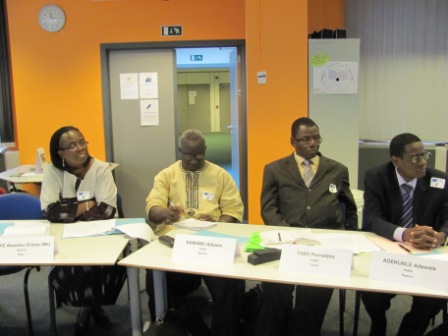
Dan KISAUZI & Silim Mohamed NAHDY
(AFAAS) ; Paco SEREME & Harold
ROY MACAULEY (CORAF) ;
David NIELSON (World Bank)

David NIELSON, Melissa BROWN, Bremala
MALLI & Juergen ANTHOFER (WB)
The objectives of this meeting were to:
  • share experiences of African continental and sub-regional leading organizations linked to agricultural research, advisory services, and tertiary agricultural education on how these organisations have contributed to the objectives of the Comprehensive African Agriculture Development Programme (CAADP) under the Framework for African Agricultural Productivity (FAAP);
  • Carolyn GLYNN & Philip CHIVERTON
    (Swedish University of Agricultural 

    Sciences)
    Nicoliene OUDWATER 

    (AgriCulture ETC Foundation)
  • dialogue with representatives of African continental and sub-regional organisations, Development Partners organisations, and EC/EU experts on the key lessons learnt through such processes – what worked well and less well and why;
  • looking to the future, discuss how such processes might continue to be strengthened into the future and scaled up where appropriate, share views of African organisations on their future role in their mandate areas and discuss this with representatives of the Development Partners organisations and EC/EU experts.
The outcomes were:
Aissetou Drame YAYE (ANAFE), Adipala
EKWAME (RUFORUM), Ramadjita TABO
& Adewale ADEKUNLE (FARA)
  • raised awareness of the value of African continental and sub-regional leading organizations linked to agricultural research, advisory services, and tertiary agricultural education in support to the objectives of CAADP;
  • shared experience on key initiatives of African continental and sub-regional leading organizations linked to agricultural research, advisory services, and tertiary agricultural education to advance African agriculture;
  • Patrick TAWONEZVI & Mwape
    BWANALI (CCARDESA)
  • deepen understanding of the challenges and opportunities of African continental and sub-regional leading organizations linked to agricultural research, advisory services, and tertiary agricultural education to support the objectives of CAADP;
  • recommendations made to donors and Development Partners organisations on how to increase effectiveness of their support to agricultural research, advisory services, and tertiary agricultural education in support to the objectives of CAADP.

Saturday, 3 March 2012

FARA Weekly Update


Please find below a summary of announcements received in the week of 27 Feb. -3 March  2012. Thank you

News and Events

  1.       Press release: New genomic resources for maize breeding
  2.       Empowering Women in Agriculture
  3.     Biennial Updates: Second Announcement and sample abstract

Opportunities for training, scholarships and fellowships

  1.   International Journal of  Mechanical Engineering and Research, submissions open for Volume 1,Issue 1,Feb. - April, 2012
  2.   ITOCA CEPD 2012 Short Course: Marketing for the Information Professional
  3.  West African Network on Organic Agriculture Research Training
  4.  Online Course March 2012 Adaptation.  CSDi Solution-Oriented Program Examples for Community Challenges in DRR, CBA and Rural Development.
  5.    Formation Internationale " Comment Relier les Agriculteurs aux Marchés en Afrique" Bamako, Mali, Avril 9-13, 2012

Job Vacancies

1.       Avis de recrutement charge de suivi de projets pilote redd & adaptation

2.       Postdoc Position in Geography - Namibia - Switzerland

3.       Call for applications:

a.       Graduate Research Program on Climate Change and Agriculture.  Download application form.

b.      Graduate Research Program on Climate Change and Biodiversity.  Download application form

New Resources

1.       New EIARD policy briefs: