Showing posts with label AGRA. Show all posts

Thursday, 3 November 2011

Increasing Agricultural Productivity and Enhancing Food Security in Africa: New Challenges and Opportunities


The November 1–3 conference “Increasing Agricultural Productivity and Enhancing Food Security in Africa: New Challenges and Opportunities,” was co-organized by the International Food Policy Research Institute (IFPRI), the African Union Commission (AUC), the United Nations Economic Commission for Africa (UNECA), and the Forum for Agricultural Research in Africa (FARA). Speakers and participants showcased opportunities to improve agricultural productivity and explored how they can be effectively implemented through the framework of the Comprehensive Africa Agriculture Development Programme.

Experts at the conference also examined issues related to:
  • science, technology, and innovation in agriculture;
  • rural services and access to inputs;
  • markets, trade, and regional integration and value chains;
  • investments, institutions, and policies for supporting agriculture;
  • agriculture, nutrition, and health linkages;
  • agriculture and climate change mitigation and adaptation;
  • capacity development for agriculture through education and training; and
  • the nexus of agriculture and the rural nonfarm sector in growth and poverty reduction
The keynote address - ‘harnessing the potential of science and the numbers’ was given by FARA’s Monty Jones. He emphasized the need for ‘radical approaches’ and ‘radical actions.’ Africa should come up with its own unique interventions, he said, and listen to the voices of the 600 million African farmers.

Stephen Muchiri of the Eastern Africa Farmers Federation said:

“The major challenge in increasing agriculture productivity in Africa is low agro investment, markets are not well developed, there are market restrictions, farmers can’t easily access the market, and they don’t have power to have their own markets. If there is no access to markets, the entire value chain will be affected. Markets are the way to boost research, input, credit facilities and risk mitigation. When farmers are involved in value chains they are going to be able to access market information that helps them prepare their production in ways that suit market demand.”
Keynote Speech by Yusuf Abubakar, ARCN. Strengthening capacity for agricultural science and technology in Africa


Keynote Speech by Namanga Ngongi, AGRA. Delivering African agricultural productivity and food security through a Green Revolution: prospects and challenges

Saturday, 3 September 2011

African parliamentary support for agriculture

African parliamentary support for agriculture. Final Report for the Pilot ProgrammeAssociation of European Parliamentarians with Africa. 29 pp.


This is the final report of a pilot programme which investigated how parliamentary agriculture committees can be supported to help to provide better oversight on programmes looking at such things as achieving sustainable agricultural growth, food security and economic empowerment of smallholder farmers. It covered Ghana, Kenya, Rwanda and Tanzania.

The programme looked at ways in which agricultural committees can be assisted to develop and implement a strategic approach to support agriculture in their respective countries and constituencies.

The report acknowledges that much more work needs to be done to develop the link between MPs and government agricultural services such as the extension services at constituency level.

It also suggested that any future programme would need to put more emphasis on strengthening (or in some cases establishing) the links within a parliaments; between parliamentary committees and the executive; between different houses of parliament (two of the four countries have or will have senates as well as assemblies); and between parliamentary committees and other stakeholders such as farmers' organizations and research institutions.

Tuesday, 7 June 2011

Partnership promoting agricultural development unveiled in Southern Sudan

6 May 2011. The United States, Netherlands and two leading agriculture-focused nonprofits are collaborating to back the Southern Sudanese government’s efforts “to transform farms into businesses.

The communiqué was signed between the U.S. Agency for International Development, Dutch government, Alliance for a Green Revolution in Africa and International Fertilizer Development Center on May 6 at the commercial Rajaf Farm outside Juba, according to a USAID news release.

Minister of Agriculture and Forestry Dr. Anne Itto represented the Government of Southern Sudan (GOSS) at the event. She mentioned during her remarks that southern Sudan has enormous potential for agricultural development-with more than 640,000 square kilometers of land, only four percent is now farmed.

The new partnership seeks to help develop southern Sudan's commercial agriculture sector by increasing agricultural productivity, supporting agribusinesses, and improving agricultural research and technology through:

  • Expanded use of quality seed and integrated soil fertility management
  • Development and expansion of an agro-dealer network
  • Revitalization of local agricultural training and research centers
  • Development of policies and regulations that support business development, sound regulatory practices, and innovation
  • Development of institutions that promote and support market infrastructure and information systems
  • Increasing farmers' and entrepreneurs' access to finance.

Tuesday, 31 May 2011

AGRA and USDA explore ways to help smallholder farmers in Africa through coordinated research, exchanges, training and development activities

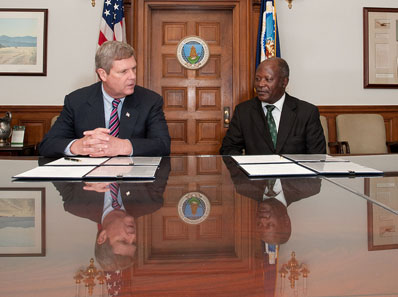
May 26, 2011. WASHINGTON. The Alliance for a Green Revolution in Africa (AGRA) and the United States Department of Agriculture (USDA) signed a Memorandum of Understanding (MOU) to explore ways to help smallholder farmers in Africa through coordinated research, exchanges, training and development activities.

U.S. Department of Agriculture Secretary Tom Vilsack (left)
and Alliance for a Green Revolution in Africa (AGRA)
President Dr. Namanga Ngongi (right) signed a
Memorandum of Understanding in Secretary Vilsack’s office
 in Washington, DC, on Thursday, May 26, 2011.
AGRA and USDA joint efforts to promote seed development and soil enhancement, reduce crop loss, manage water resources, improve data collection, develop farmer training programs, create market information systems, and improve human capacity and food-related infrastructure in Africa.

The MOU will be in effect for five years. AGRA and USDA will initially focus on increasing food production in African breadbasket regions – areas with high potential because of existing policies, infrastructure and growing conditions – such as Ghana, Kenya, Mali, Tanzania and Mozambique.

Wednesday, 8 September 2010

The African Green Revolution forum

4th September 2010. The African Green Revolution Forum (AGRF) ended on September 4, 2010, with concrete resolutions to transform African agriculture and tackle issues of food security. Closing the forum in Accra, Ghana, AGRF Chair, Kofi Annan, praised efforts by public and private institutions, development organisations, donors and farmers to accelerate the African green revolution.


This week I saw something I have never seen before. The bankers for Africa were in attendance. The CEOs of Africa were in attendance. And they stayed for three days! This is something you never hear of on this continent. Friends said this is the first time they have ever seen such a group of top bankers and CEOs at an agricultural event. This is excellent news. We are finally getting the message across. Agriculture pays. Agriculture is a business. And we are ready to run it as one, for millions of smallholder farmer. I saw African scientists this week who are at the forefront of developing Africa’s own solutions to unlock agricultural productivity. I saw our women – from farmers to scientists, policy makers to owners of agri business – rallying behind the movement. This is encouraging for only they know, better than anyone, that the green revolution is first and foremost about them. Africa’s women will lead the change. I saw civil society organizations that are critical to the movement step up with renewed commitment. I was particularly delighted to see the cream of Africa’s parliamentarians join us. They carried a unique message. “We represent our constituencies, the majority of whom are farmers.” They pledged to step up to the plate and make sure the green revolution happen, to transform their people’s lives. Of course we had African political figures come out in force. The Prime Minister from Tanzania. The Vice President of Ghana. And the indefatigable presence of the former President of Nigeria, His Excellency Obasanjo. These gracious, impassioned leaders threw their political weight behind this shining moment of transformation for Africa. So you can feel my heart beat, for I know that we have arrived at the tipping point. We have converted words to action. We have launched ourselves on a trajectory toward taking the green revolution to scale.


A lack of adequate infrastructure, particularly access roads, has been identified by African farmers as one of the major obstacles hindering them from getting their crops to markets. They said that the high cost of transporting their produce to market made them reluctant to even consider increasing the size of their farming operations.

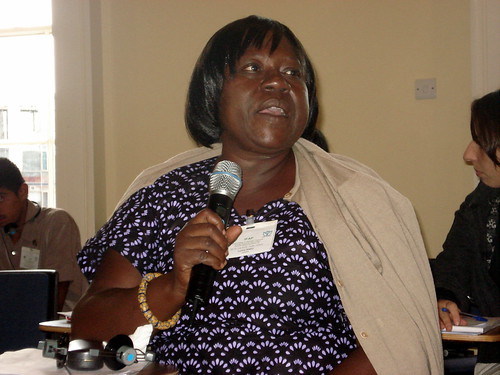
Lydia Sasu, leader of the Farmers Organisation Network in Ghana and second vice president of the Réseau des Organisations Paysannes et de Producteurs de l'Afrique de l'Ouest, (ROPPA), said

Africans will be able to feed themselves if they can all work together and collaborate in the production of a range of crops. She cited the example of Ghana where not only rice, but a number of other crops such as yam, cocoa, plantain and cassava are also widely enjoyed.

"If we continue to propagate all those crops and put more innovation into them as researchers have been showing us, we can produce more, eat more but not only one crop. We can also diversify; in Ghana we have many - maize and others," she said.

Sasu also insisted that the voices of rural women need to be heard at all levels. She noted that women are the ones who normally keep whatever it is that requires keeping. Women are able to nurture so that even if something has been destroyed, they are able to bring it back to life. There is therefore, a need to collaborate with rural women to enable them learn more about agricultural methods which they can improve on and reach a level where new techniques can be applied and play a role in the green revolution.

Sasu appealed to women to put their house in order by coming together and taking part whenever there is something to discuss about agriculture, "because it concerns us more than any other thing in the community, we need to be involved. It is only when we know what is going on that we can be part of it".


Press Releases

Monday, 7 December 2009

AGRA launches micro dosing fertiliser project

5 december. Ouagadougou. AGRA has initiated an $8.9 million fertilizer project for smallholder farmers in West Africa’s desert margins.

The funding will be implemented by the International Crops Research Institute for the Semi-Arid Tropics (ICRISAT) and national partners. The project will enable 300,000 farm households to tackle the challenges of harsh climate and depleted soils.

Through the program, farmers will use targeted, minute amounts of fertilizers to increase crop productivity, combined with strengthened farmer organizations, and improved access to credit and to agro-dealer shops. The program aims to sustainably boost farmers’ grain yield by 50% and their income by 30%, the statement said.

Commenting on the project, Dr Namanga Ngongi, President of AGRA said “dry lands need not be barren lands. We have seen farmers pilot the use of microdosing to nourish their crops and grow their incomes. Our new partnership will scale-up these efforts, to reach hundreds of thousands of farmers.”

According to the statement, microdosing applies small amounts of fertilizer with the seed rather than spreading it over an entire field. It is affordable and gives plants a quick start by boosting their root growth, which enables the plant to capture the small amounts of water that fall in West Africa’s dry lands.

Reference:

AGRA supports West Africa's farmers with $8.9m fertilizer project

Friday, 27 November 2009

Coalition for African Rice Development Steering Committee meeting

23 - 25 November 2009. Accra. The steering Committee fo the Coalition for African Rice Development met at FARA. The meeting was co-chaired by AGRA president Namanga Ngongi and FARA executive Director Dr. Monty Jones

The Coalition for African Rice Development (CARD) is a consultative group of bi-lateral donors, regional and international organizations working in collaboration with rice-producing African countries. Its goal is to support the efforts of African countries to double rice production on the continent to 28 million tones per annum within 10 years (by 2018).
Shimpei Tokuda (JICA), Oja (JICA), George Bigirwa (AGRA), Cheick M. Sourang (IFAD), Kensuke Okada (JIRCAS), Namanga Ngongi (President of AGRA), Joseph Rickman (IRRI), Christine Cornelius (World Bank), Hiroshi Hiraoka (Coordinator CARD), Hiroyuki Kubota (JICA), Caroline Bwire (CARD secretariat), Ralph von Kaufmann (FARA/CARD Secretariat)
(from left to right, no row distinction)

Thursday, 16 July 2009

Inauguration of Africa Liaison Office of the Japan International Research Center for Agricultural Sciences (JIRCAS)

The Japan International Research Center for Agricultural Sciences (JIRCAS) is located in Tsukuba City, Ibaraki Prefecture, Japan, with Dr. Kenji Iiyama as President. JIRCAS has set up recently its Africa Liaison Office in Accra, Ghana inside the premises of Forum for Agricultural Research in Africa (FARA).

Its inauguration ceremony was held on 14th July 2009. During this event Dr. Masami YASUNAKA, vice president of JIRCAS was interviewed.

Recently, there has been an increasing expectation for Japans contribution to agricultural research in Africa since the creation of the Yokohama Action Plan during the TICAD IV Meeting held in May 2008, which states that Japan will provide assistance to the development of agricultural research, extension, and training services for the improvement of agricultural technologies for Africa such as for variety improvement and improvement of soil fertility.

Accordingly, JIRCAS research activities in Africa are being strengthened and its share for research in Africa has been increasing rapidly. Furthermore, JIRCAS will also join the Coalition for African Rice Development (CARD) as a member of the steering committee and hopes to contribute to research and development of rice technologies in Africa.

To strengthen the base and strategy of agricultural research activities in Africa hereafter, it is necessary to build a system that attaches great importance to the collaborative relationships among national and regional agricultural research organizations in Africa and research networks on both crop and subject basis.

Dr. Masami YASUNAKA answers the following questions:

  1. What is JIRCAS' vision to collaborate with Africa
  2. Why was Ghana and FARA choosen to establish a liaison office?
  3. Is climate change one of JIRCA's research topics?

JIRCAS establishes its Africa Liaison Office in Ghana

14th July 2009. Japan International Research Center for Agricultural Sciences (JIRCAS) establishes its Africa Liaison Office in Accra, Ghana -As a base station for agricultural research for Africa conducted by Japanese researchers-

Dr. Masami YASUNAKA Vice president of JIRCAS
presents the JIRCAS activities in Africa.


JIRCAS has recently set up its Africa Liaison Office in Accra, Ghana inside the premises of the Forum for Agricultural Research in Africa (FARA). Its inauguration ceremony was held on 14th July and was attended by guests and representatives from regional offices of international organizations for agriculture, agricultural research institutes in Ghana, as well as staffs of Japanese organizations in Ghana.


A Regional Coordinator was assigned to the Liaison Office to carry out important tasks such as information collection and coordination of research activities, that are relevant to the fulfillment of its function as a base station for agricultural research for Africa conducted by Japanese researchers.

Dr. Monty Jones welcomes warmly the opening of the JIRCAS liaison office inside the premises of the Forum for Agricultural Research in Africa.

The main tasks of the Liaison Office are as follows:

Establishment of close relationships with the international organizations located in Ghana, such as FARA, FAO Africa Regional Office, Alliance for a Green Revolution in Africa (AGRA) Ghana Office, International Water Management Institute (IWMI) West Africa Office, to enable efficient collection and distribution of wide-ranging information on the present situation of African agriculture by meeting with them and by having dialogs with them.


  1. Collection and distribution of the latest information on agricultural research and on the needs for collaborative research by periodic visit to national agricultural research organizations, universities, and governmental organizations in West Africa.
  2. Communication, coordination of and assistance for research activities of JIRCAS and concerned organizations in West Africa.
  3. To introduce JIRCAS activities and to collect information by participation in the meetings to held in Africa.

Reference:

News of the ceremony on the JIRCAS webpage: Establishment of the JIRCAS Liaison Office in Africa

Saturday, 11 July 2009

L'Aquila Food Security Initiative

U.S. President Barack Obama, right, and Indian Prime Minister Manmohan Singh, center, attend a meeting at the G-8 conference.
10th July. L'AQUILA, Italy -- The Group of Eight leading industrial democracies pushed many priorities of their summit to larger groups of countries, placing the next moves in trade negotiations, climate-change talks and containing Iran's nuclear program in front of the so-called G-20 and the United Nations in September.

The nations gathered in L'Aquila did achieve one parting success, a $20 billion pledge over three years to overhaul food and agricultural assistance to the poorest countries. Only about half that pledge is new money, according to the White House, but it roughly doubles nonemergency agricultural assistance.On Thursday, it had seemed that the total would be only $12 billion, below the level intended just days before. Instead, last-minute pledges came from Canada and the European Union, among other countries.

Mr. Obama, in a Friday morning session, made an emotional, personal appeal, saying richer nations had an obligation to act. But he also said recipient nations had to acknowledge that they were complicit in their poverty, through corruption, a lack of transparency and other barriers to growth.

Reference:

The Joint Statement on Global Food Security ("L'Aquila Food Security Initiative") is endorsed by the G8 and by Algeria, Angola, Australia, Brazil, Denmark, Egypt, Ethiopia, India, Indonesia, Libya (Presidency of the African Union), Mexico, The Netherlands, Nigeria, People's Republic of China, Republic of Korea, Senegal, Spain, South Africa, Turkey, Commission of the African Union, FAO, IEA, IFAD, ILO, IMF, OECD, The Secretary General's UN High Level Task Force on the Global Food Security Crisis, WFP, The World Bank, WTO who attended the food security session at the G8 Summit in L'Aquila on 10 July 2009 and by the Alliance for a Green Revolution in Africa (AGRA), Bioversity/Consultative Group on International Agricultural Research (CGIAR), Global Donor Platform for Rural Development , Global Forum on Agricultural Research (GFAR).

Monday, 29 June 2009

The lessons from the recent global food crisis


30 June 2009. Geneva. Interactive panel discussion on African food security during the forty-seventh executive session of the Trade and Development Board: "The lessons from the recent global food crisis". The Interactive panel discussion on African food security, entitled "The lessons from the recent global crisis", featured keynote speaker Dr. Akinwumi Adesina, Vice-President for Policy and Partnerships, Alliance for a Green Revolution in Africa.

The panellists included Emeritus Professor Marcel Mazoyer, Comparative Agriculture and Agricultural Development, National Agricultural Institute in Paris; and Ambassador Jean Feyder, Permanent Mission of the Grand Duchy of Luxembourg. Dr. David Nabarro, Assistant Secretary General, Coordinator for the Global Food Security Crisis and Avian & Pandemic Influenza, UNSIC, will be the discussant.

Monday, 22 June 2009

CAADP calls for more private sector involvement

June 17 to 18, 2009 in Dakar Senegal. The Economic Community of West African States (ECOWAS) Commission and the New Partnership for Africa’s Development (NEPAD) brought together representatives of the public and private sectors, including farmer’s organizations, development partners and civil society to propose a framework for integrating the private sector into the CAADP Agenda.

The workshop was aimed at creating specific public-private alliances in the areas of smallholder-friendly value chain development through enterprise growth and finance in major commodity sectors for the purposes of boosting economic growth and competitiveness.
  • Deliberations were held on how regional and domestic market development through policy reforms, institutional innovations, and infrastructure investments could be directed towards raising supply, improving quality whilst also reducing the cost of moving modern inputs and products across local and trans-border markets.
  • Participants at the workshop were also keen to explore the issue of institutional development and capacity building to overcome tariff and technical barriers to accessing global markets.
  • The meeting reflected on the value of existing partnerships, alliances and developments such as those concerning the Hewlett Infrastructure Project, ReSAKSS, AGRA’s announcement of an agreement with Standard Bank and private equity investments in agri-related projects.
  • It is within this context that the key issue of public sector investment in support CAADP was also reviewed with many participants arguing that African agricultural stakeholders and leaders need to push for more private-public partnerships in agriculture in order to sustain Africa’s recovery plan.

Participants at the workshop included CMA / AOC, the Government of Senegal, AU / NEPAD / ECOWAS, the World Bank, IFPRI, USAID, AfDB, ECA, the private sector, AGRA, FAO, the Bill and Melinda Gates Foundation, the EU and farmers organizations.

Monday, 15 June 2009

Africa’s Rice Production to Double

June 3-4, 2009 Tokyo. AGRA and JICA entered into a long-term pact that builds on the strengths of each organization to reach their ambitious goal.

The pact was formalized at the second General Meeting of the Coalition for African Rice Development (CARD). Mr. Kofi Annan, Chair of the AGRA Board of Directors, attended the signing ceremony, along with Madam Sadako Ogata, President of JICA. Dr. Namanga Ngongi, Agra’s President, and Mr. Kenzo Oshima, Senior Vice President of JICA signed the agreement on behalf of their organizations.

CARD is a consultative group of major donors, rice research organizations and a number of other development entities, which together are working with 21 African countries to strengthen their ability to produce this valuable commodity. Current CARD members include AGRA, FAO, the Forum for Agricultural Research in Africa (FARA), the International Rice Research Institute (IRRI), JICA, the Japan International Research Center for Agricultural Sciences (JIRCAS), NEPAD and the Africa Rice Center (WARDA). The main target of the CARD initiative is reflected in the Yokohama Action Plan, which was one of the main documents adopted at the recent TICAD IV (The Fourth Tokyo International Conference on African Development) held in Yokohama, May 2008.

Since its inception one year ago, CARD has focused on supporting the efforts of 12 countries to develop more effective National Rice Development Strategies. This “first wave” of African rice producing nations includes Cameroon, Ghana, Guinea, Kenya, Madagascar, Mali, Mozambique, Nigeria, Senegal, Sierra Leone, Tanzania and Uganda.

With the support of the CARD Secretariat, which is hosted by AGRA, all 12 counties have produced the first versions of their strategies. During the CARD meeting, Coalition members will discuss how to best support the national plans while refining them through policy dialogues. In the coming year, CARD will work on similar strategies with the “second wave” of rice-producing countries (Benin, Burkina Faso, Central African Republic, Cote d’Ivoire, the Democratic Republic of Congo, Liberia, Rwanda, The Gambia and Togo).

Reference:
African Excutive 10/06 Africa’s Rice Production to Double

Friday, 12 June 2009

Sustainable Modernization of Agriculture and Rural Transformation (SMART) in Africa

8-12 June, 2009. IITA, Ibadan, Nigeria. The Main Objectives of the current Ibadan SMART training workshop was to enhance the capacity of African countries to formulate and implement appropriate programmes, strategies and policies towards a Sustainable Modernisation of Agriculture and Rural Transformation (SMART).


The Specific Objectives were:
  • General overview of agriculture and rural development.
  • Discuss African agriculture: Unique features and paradigm shifts.
  • Achieving sustainable agriculture and rural development in Africa: Lessons learned from Africa. Country case studies including cassava in Nigeria, rice in Senegal, maize in Malawi, banana plantain in Cameroon, milk in South Africa and water in DR Congo.
  • Achieving sustainable agriculture and rural development in Africa: Lessons from Asia (e.g. case of Saemaul Undong Movement).Formulation of appropriate programmes

Related blogpost: Expert Group Meeting on SMART Indicators and Lessons

Background: Saemaul Undong Movement in Korea has become a model case of agricultural reform. The New Community Movement, also known as the New Village Movement or Saemaeul Movement, was a political initiative launched by former South Korean president Park Chung Hee to modernize the rural South Korean economy. The most significant aspect was spreading orange tiled houses throughout the countryside to replace tradition-bound straw-thatched or choga-jip houses.The following introductory videos on Saemaul Undong will help you understand what Saemaul Undong Movement is. The SU model is to contribute to the SMART and Green Revolution in Africa. Download Saemaul Handbook

Tuesday, 10 February 2009

High-Level Meeting on African Agriculture in the 21st Century

9-10 February 2009. Windhoek, Namibia. This inter-sessional meeting considered how African governments and other stakeholders can revitalize African agriculture and the broader rural economies in ways that are economically, socially and environmentally sustainable.
2 Main Themes
The meeting focused on two main themes:
Theme 1: how to operationalize a green revolution in Africa;
Theme 2: integrating African agriculture into global markets.
(See agenda overview).
Sub-Themes
Each theme was divided into 2 sub-themes:
Sub-Theme 1.1: Incorporating sustainable land management and agricultural practices into African agriculture
Sub-Theme 1.2: Increasing agricultural productivity in Africa
Sub-Theme 2.1: Moving African agriculture up the value chain
Sub-Theme 2.2: Integration of small farmers into global supply chains.

Discussions on day one centered on how to operationalize a Green Revolution in Africa, focusing on two central themes: how to incorporate sustainable land management and agricultural practices into African agriculture; and how to increase agricultural productivity in Africa. During plenary, participants stressed the need to develop an African approach for a sustainable Green Revolution, community involvement and locally-driven development in agriculture, and creating an enabling policy environment.In the ensuing discussion, topics discussed included developing an agro-ecological approach to farming, integrating crops and livestock production systems, the empowerment of women; water management, and land reform.

Reference:
New Era Namibia 10th February 2009 Food Security Equals National Security’
IISD
Meeting Website

Saturday, 31 January 2009

Drought-Tolerant Maize for Africa

Maize is the staple food of more than 300 million Africans. The crop, however, is severely affected by frequent drought. Drought leads to crop failure, hunger, and poverty. Global climate change is expected to worsen the problem. Recently, a public-private partnership was formed to develop drought-tolerant maize varieties using conventional breeding, marker-assisted breeding, and biotechnology.

Known as Water Efficient Maize for Africa (WEMA), the project is led by the African Agricultural Technology Foundation (AATF) in collaboration with CIMMYT (International Maize and Wheat Improvement Center), Monsanto Company, and agricultural research systems, farmer groups and seed companies in Kenya, Mozambique, South Africa, Tanzania and Uganda.

The Bill and Melinda Gates Foundation has committed funding of US $42 million to the project. The first conventional WEMA varieties are expected to be available in six to seven years. Transgenic drought-tolerant varieties will be available in about ten years. Reference: AATF

Friday, 30 January 2009

Aligning efforts on agricultural policy and knowledge systems in support of CAADP


On January 6 and 7, 2009, FARA participated to the meeting organised by NEPAD, IFPRI, AGRA, and the World Bank in Dakar, Senegal to align efforts on agricultural policy and knowledge systems in support of CAADP.

The discussions centred on alignment of efforts for CAADP implementation, the roles of agencies involved in the process and focused on the implications of alignment of efforts on agricultural policy and knowledge systems. After six years of CAADP, aligning efforts is crucial in an environment where financial, human and infrastructural resources are limited. In order to achieve a common African vision, a good system should be developed to provide reliable data collection, analysis and timely reporting and in the right format for use by decision makers. Such knowledge systems should be able to adapt and react to ongoing challenges and emerging issues. The systems should be demand driven. Building local capacity to design and identify appropriate approaches, methods and tools is critical to maintain sustainability.

Reference:
The draft agenda of the meeting is available here.
Further information and conference presentations available on the ReSAKSS Events page.

Related:
2008 proved to be a prolific year for ReSAKSS, with 15 new working papers, 3 issue briefs, an annual trends report, and 4 other documents becoming publicly available to policymakers, researchers and development thinkers.

The documents cover a wide variety of relevant and useful topics, including agricultural growth and poverty options for several African countries, an analysis of rising food prices in South Africa, and agricultural expenditures in Africa. Other documents have laid out the strategic planning guidelines for practitioners and the monitoring and evaluation framework for CAADP.

View all ReSAKSS publications on the ReSAKSS website.

Monday, 26 January 2009

Farmer First Revisited

Farmer First Revisited (forthcoming March 2009) returns to the debates about farmer participation in agricultural R&D and looks to the future.

With over 60 contributions from across the world, the book presents a range of experiences that highlight the importance of going beyond a focus on the farm to the wider innovation system, including market interactions as well as the wider institutional and policy environment. If, however, farmers are really to be put first, a politics of demand is required in order to shape the direction of these innovation systems.

This calls for a major rethinking of agricultural R&D, the boosting of the knowledge and capacities of farmers’ organizations to innovate, the strengthening of networks and alliances to support, document and share lessons on farmer-led innovation, and the transformation of agricultural higher education.

PART ONE
Farmer First Revisited
Challenges to strengthening Agricultural Innovation Systems
Fostering Farmer First methodological innovation
PART II: SYSTEMS OF INNOVATION
PART III: THE POLITICS OF DEMAND AND ORGANIZATIONAL CHANGE
PART IV: NEW PROFESSIONALISM, LEARNING AND CHANGE

Reference
future-agriculture

Related FARA blog post 12th December 2007
Farmer Participatory Research and Development Twenty years on

Thursday, 2 October 2008

Selection for the Women and Young Professionals in Science Competitions

CTA in collaboration with the Forum for Agricultural Research in Africa (FARA), the Regional Universities Forum for Capacity Building in Agriculture (RUFORUM), the New Partnership for Africa’s Development (NEPAD), the Alliance for a Green Revolution in Africa (AGRA) and the African Technology Policy Studies Network (ATPS) received 248 abstracts in response to the two science competitions that were launched in July 2008: Women and Young Professionals in Science Competitions.

The competitions seek to identify and recognize women and young professionals in sub-Saharan Africa (SSA) and the Diaspora who are engaged in innovative and pioneering research and development and communicating the outputs (knowledge, technologies, approaches) for enhancing agricultural performance in SSA.

The entrants came from 34 countries in Sub-Saharan Africa, Egypt and Germany. The partners received 133 abstracts from women in science and 115 abstracts from young professionals. The expert group reviewed at FARA in Accra 1st to 3rd October the submissions and selected the top 40, who will be invited to present their full papers for final judging at the Ministerial Forum on Higher Education. Initially this was schedulded to take place in Lusaka, Zambia from 27 – 31 October 2008. but now this is postponed till February 2009 -place and date to be confirmed.

Hereunder an interview with Judith Francis of CTA on 03/10 who explains how the selection went and why it is important to give visibility to research of African Young porfessionals and Women in agriculture.

Thursday, 25 September 2008

Creating a World That Can Feed Itself

Here's a 36-minute video on YouTube recorded on 17th September featuring an unusual forum with Monsanto CEO Hugh Grant, talking with "In Defense of Food" author Michael Pollan and Google.org's head of global development, Sonal Shah, on the topic of "Creating a World That Can Feed Itself." (Larry Brilliant, executive director of Google.org, moderated the panel, telling the Google audience that he and Grant became friends when both visited the Doomsday seed vault in Norway.)


Related:

If a green revolution was possible in Asia then why not in Africa?
With these words Akin Adesina (AGRA) took the floor and challenged participants during the first panel of the Brussels briefing of 2nd July on “New drivers, new players in ACP rural development”Is a green revolution in Africa possible?

While new technologies and crop varieties can help, they cannot alone offer a solution. Africa faces additional challenges to improve agricultural production: farmers’ access to new technologies is limited; markets are poorly developed, soils are drained of nutrients and fertilizer use is low. To address these challenges, the Alliance for a Green Revolution in Africa - AGRA - intervenes with a number of programmes, which Mr. Adesina presented, including improving seed systems, soil health and market access as well as policy advocacy.

On top of these, locally based and consistent policies are of central importance. Mr. Adesina argued that World Bank structural adjustment programmes of the 1980s were disastrous for African agriculture and he urged that it was time to end the “Washington Consensus” and adopt a real “African Consensus” for policy development. He reminded participants of African success stories past and present; arguing that if “maize revolutions” have been possible in countries like Zimbabwe, Zambia and Malawi, then productivity growth is possible. He concluded that all actors, public and private, need to ensure that institutions, infrastructures, markets, and technology are working together for a green revolution in Africa.