Showing posts with label ANAFE. Show all posts

Saturday, 24 March 2012

Informal stakeholder consultation on agriculture research in Africa

Prof. Monty JONES (FARA)
20-22 March 2012. Brussels, organized by the European Commission Directorate General for Development and Cooperation - DG DEVCO. Improving the quality and effectiveness of development cooperation with African agricultural knowledge organisations: Informal stakeholder consultation.

In order to improve the quality and effectiveness of development cooperation with African continental and sub-regional agricultural knowledge organisations, the European Commission organized an informal stakeholders consultation which brought together representatives of African agricultural knowledge organisations, of the Development Partners, and EC/EU experts.
Dan KISAUZI & Silim Mohamed NAHDY
(AFAAS) ; Paco SEREME & Harold
ROY MACAULEY (CORAF) ;
David NIELSON (World Bank)

David NIELSON, Melissa BROWN, Bremala
MALLI & Juergen ANTHOFER (WB)
The objectives of this meeting were to:
  • share experiences of African continental and sub-regional leading organizations linked to agricultural research, advisory services, and tertiary agricultural education on how these organisations have contributed to the objectives of the Comprehensive African Agriculture Development Programme (CAADP) under the Framework for African Agricultural Productivity (FAAP);
  • Carolyn GLYNN & Philip CHIVERTON
    (Swedish University of Agricultural 

    Sciences)
    Nicoliene OUDWATER 

    (AgriCulture ETC Foundation)
  • dialogue with representatives of African continental and sub-regional organisations, Development Partners organisations, and EC/EU experts on the key lessons learnt through such processes – what worked well and less well and why;
  • looking to the future, discuss how such processes might continue to be strengthened into the future and scaled up where appropriate, share views of African organisations on their future role in their mandate areas and discuss this with representatives of the Development Partners organisations and EC/EU experts.
The outcomes were:
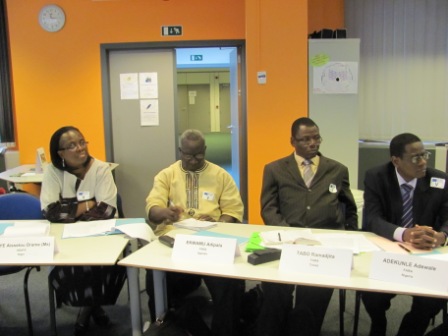
Aissetou Drame YAYE (ANAFE), Adipala
EKWAME (RUFORUM), Ramadjita TABO
& Adewale ADEKUNLE (FARA)
  • raised awareness of the value of African continental and sub-regional leading organizations linked to agricultural research, advisory services, and tertiary agricultural education in support to the objectives of CAADP;
  • shared experience on key initiatives of African continental and sub-regional leading organizations linked to agricultural research, advisory services, and tertiary agricultural education to advance African agriculture;
  • Patrick TAWONEZVI & Mwape
    BWANALI (CCARDESA)
  • deepen understanding of the challenges and opportunities of African continental and sub-regional leading organizations linked to agricultural research, advisory services, and tertiary agricultural education to support the objectives of CAADP;
  • recommendations made to donors and Development Partners organisations on how to increase effectiveness of their support to agricultural research, advisory services, and tertiary agricultural education in support to the objectives of CAADP.

Friday, 23 December 2011

Boosting Agricultural Higher education into CAADP

28th to 30th November 2011. Ouagadougou, Burkina Faso. The African Network for Agriculture, Agroforestry and Natural Resource Education (ANAFE), ACP-EU Technical Centre for Agricultural and Rural Development Cooperation (CTA), Forum for Agricultural Research in Africa (FARA), the NEPAD Coordinating Agency, CORAF-WECARD and the Regional Universities Forum for Capacity Building in Agriculture (RUFORUM) held a Sensitization workshop for Engaging French Speaking African Higher Agricultural Education Institutions into CAADP.

Other key partners of the organization are the University of Ouagadougou, University of Abomey Calavi (Benin), the Association of African Universities (AAU), the African and Malagasy Council for Higher Education (CAMES), the Conference of rectors of Universities of Francophone West Africa, Central and Indian Ocean (CRUFAOCI), the Network of Institutions of higher Education in
Fishing (Afri-FishNet), the European Alliance on Agricultural Knowledge for development (Agrinatura) and the French consortium Agreenium.

During the three days conference, a number of papers were presented, followed by debates and discussions, and propositions made. This led to the following results:
  • An increased awareness about the objectives, the constants and the expected outputs of the CAADP;
  • A better understanding of the role to be played by Universities and other agricultural higher education institutions in cooperation with their supervisory ministries and those in charge of agriculture;
  • The massive presence at the meeting of Universities, other higher education institutions and technical and financial partners, is a testimony of their willingness to be involved in actions undertaken for the attainment of the CAADP objectives;
  • Important activities were formulated which will lead to a stronger involvement of agricultural training institutions;
  • Concertation frameworks were proposed with CAADP, ANAFE, RUFORUM and FARA which will be able to serve for interaction between Universities and Agricultural training institutions.
Resources:

Friday, 25 November 2011

Training program on agribusiness incubation for SSA

Dr Ralph von Kaufmann, Technical Coordinator,
UniBRAIN-FARA, in a discussion with Dr Dar and others
21-24 November. Aiming to promote agribusiness ventures in sub-Saharan Africa (SSA) through value-chain based agribusiness incubators, ICRISAT’s Agri-Business Incubation (ABI) program under its
Agribusiness Innovation Platform (AIP) organized a training program on “Strengthening the capacity of UniBRAIN – Agribusiness Innovation Incubation Consortia (AIIC) members” at ICRISAT-Patancheru.

The training program primarily aimed to strengthen the capacity of AIIC members in incubator planning and management, in view of UniBRAIN’s plan to set up an African Business Incubators Network (AFBIN) similar to the Network of Indian Agri Business Incubators (NIABI) of India. The training was focused on incubator management, planning for incubation operations, client selection, setting up systems and processes, and other key aspects of setting up successful business incubators to promote entrepreneurship in sub-Saharan Africa.

Tamil Nadu Agricultural University (TNAU)
Twenty six participants from the Forum for Agricultural Research in Africa (FARA), Universities, Business and Research in Agricultural Innovation (UniBRAIN), Pan African Agribusiness and Agro Industry Consortium (PanAAC), Agro forestry and Natural Resources Education (ANAFE), Association for Strengthening Agricultural Research in East and Central Africa (ASARECA), Conseil Ouest et Centre Africain pour la Recherche et le Développement Agricoles (CORAF) and SADC joined the training program at Patancheru, which had 30 resource persons from infoDev, ISBA, STC, Trec-STEP, Technopark, Villgro, etc. who provided and shared their vast and rich experiences in agriculture and agribusiness.

The training was continued at the Business Planning and Development (BPD) units of the Tamil Nadu Agricultural University (TNAU), Coimbatore and Ooty.

Background
UniBRAIN is a program of FARA supported by the Royal Danish Ministry of Foreign Affairs (DANIDA). It is facilitated by a team of partner institutions comprising FARA Networking Support Function for Capacity Strengthening (FARA-NSF4) and its associated sub-regional organizations – ASARECA, CORAF, Centre for Coordinating Agricultural Research and Development in Southern Africa
(CCARDESA), African Network for Agriculture, ANAFE, PanAAC, and ICRISAT Agri-Business Incubator (ABI).

Tuesday, 28 July 2009

Is the European FP 7 programme a good model for Africa?

Interview with Dr. Kevin Urama African Technology Policy Studies (ATPS Kenya) at the NEPAD Tertiary Institutions Dialogue FARA Secretariat 28 - 30 July 2009, Accra, Ghana.
He thinks that the modus operandus of the European Framework Programme is very useful because:
  1. it is trying to forge partnerships and collaborations both between disciplines and across cultures and countries. Currently ATPS is working on a Manifesto for Science and Technology involving Indian, European and African partners.
  2. Work packages allow African institutes to take the lead and in this they can set their own research priorities.
  3. The multilateral research platform is a guarantee for quality control. Such types of collaboration should happen more in Africa.

He gives as an example the banana tissue culture which was developed in Kenya but now involves researchers from Cameroon, Nigeria and other places. The requirement of involving policy makers, researchers, the producers and the civil society allows for innovation to develop and forces researchers to think critically about their research.

Dr. Kevin Urama answers following questions:
  • ATPS is currently developing a Donor Watch initiative. Will newcomers like Japan, China and Brazil foster Africa-Africa collaboration ?
  • Will we have one day an African Union FP7 type of programme?

Contributing to the NEPAD agenda of agricultural research networking

Interview with Professor B.K. Ahunu, Provost of the College of Agriculture & Consumer Sciences of the University of Ghana in Legon/Accra. Professor Ahunu explains how the University of Ghana contributes to the NEPAD agenda of agricultural research networking with some concrete examples. He answers the questions
  • Whether the prestige of studying abroad is not an impediment for regional PHD programmes
    If present agricultural research is relevant for national needs

Investments in agricultural research highly depend on external partners

28 - 30 July 2009, Accra, Ghana. NEPAD Tertiary Institutions Dialogue. Interview with Dr. Monty Jones (ED FARA).

Dr. Jones thinks this NEPAD Tertiary Institutions Dialogue comes at an appropriate moment. But he is worried by the fact that agricultural research is highly dependent on the support of external partners with very few of occasional support from the national governments.

He nevertheless trusts that as suggested by Dr. Mayaki (CEO of NEPAD) a paradigm shift is taking place where planning and planning is replaced by more operational activities. But he wonders when this will be fully realised

The NEPAD paradigm shift on agricultural research


28 - 30 July 2009, Accra, Ghana. NEPAD Tertiary Institutions Dialogue. Interview with Dr. Ibrahim Assane Mayaki (CEO NEPAD).

According to Dr. Ibrahim Assane Mayaki policies used to be defined by the binoom of African governments and external partners. Today there is a need to include the civil society, producers and research institutes/universities in the elaboration of sectorial policies.

He answers following questions:

  • Is the lack of research done in the African universites not a problem?
  • What are the present big challenges of agricultural research?

Participants at the NEPAD Tertiary Dialogue

Overview of the participants at the NEPAD Tertiary Dialogue: FARA, Accra 28-30/07

Dr. Monty Patrick Jones
Executive Director
Forum for Agricultural Research in Africa
Accra, Ghana
Remi Kahane
Global Hort
Arusha Tanzania


Lynette Chen
Chief Executive Officer
NEPAD Business Foundation ( NBF)
South Africa


Abdirahman Ismail
Deputy CEO
NEPAD Kenya Secretariat
Nairobi, Kenya

Prof. Richard Nkandawire
Head of Comprehensive Africa Agriculture Development Programme
(CAADP) NEPAD Secretariat
Midrand, South Africa

Dr. Ibrahim Assane Mayaki
Chief Executive Officer
New Partnership for Africa’s Development
( NEPAD) Secretariat

Midrand Johannesburg , South Africa


Leo Pekkala
Faculty of Education, University of Lapland. Rovaniemi, Finland


Joyce Maina
Department of Animal Production,
Ccollege Agriculture & Veterinary Sciences,
University of Nairobi

Angelinna Rudabukana
AU-NEPAD
Johannesburg


Sheryl Hendricks
African Centre for Food Security :
University of Kwa Zulu-Natal
Pietermaritzburg , South Africa

Charles Mkoka
Science and Development Network London(SCIDEV.NET)
Regional Correspondent

Lilongwe, Zambia

Sloans K. Chimatiro,
Senior Fisheries Advisor,
NEPAD Secretariat,
Midrand, South Africa

Benjamin Ngatunga
Tanzanian Fisheries Research Institute
Dar es Salaam , Tanzania


Thomas Theisohn Learning Network on Capacity Development (LenCD)
Vauvenargues, France

Ekaya Wellington
Regional Universities Forum for Capacity Building in Agriculture (RUFORUM)
Makerere University
Kampala, Uganda


Florence Nazare
New Partnership for Africa’s Development (NEPAD)
Capacity Development : Coordinator
Johannesburg, South Africa

Millicent Seganoe
New Partnership for Africa’s Development (NEPAD)
Johannesburg, South Africa

Samuel Cudjoe
NAPRM – Governing Council Secretariat
Accra, Ghana


John Makumbe
Mass Public Opinion (MPOI)
Board Member
Harare, Zimbabwe

Samira Hotobah-During
Forum for Agricultural Research in Africa
Accra, Ghana


Emmanuel Tambi

Forum for Agricultural Research in Africa
Accra, Ghana

Kevin Urama
African Technology Policy Studies Network (ATPS)
P.O. Box 10081, Nairobi, Kenya


Elizabeth Omino
Plant Resources of Tropical Africa (PROTA)
Nairobi , Kenya

Odularu Gbadebo
Forum for Agricultural Research in Africa
Accra, Ghana

Tetsuji Oya
Japan International Research Center for Agricultural Sciences (JIRCAS)
Accra, Ghana


Unami Mpofu
InWent Capacity Building International
Johannesburg , South Africa

Arne Schuffenhauer
German Technical Cooperation Pretoria , South Africa


Rawda Omar Clinton
United Nations Economic Commission For Africa (UNECA)
Addis Ababa , Ethiopia

Kane Alioune
University Cheikh Anta Dior (UCAD)
Dakar , Senegal

Ashagrie Gibtan
Addis Ababa University (AAU)
Department of Biology
Addis Ababa , Ethiopia


Rufaro Madakadze
Alliance for A Green Revolutions in Africa (AGRA)
Nairobi , Kenya

Prof. Ben Ahunu
University of Ghana
Legon,Ghana

Panduleni Elago
Inland Aquaculture Centre Ministry of Fisheries & Marine Resources (IAC)
Namibia

Jurgen Hagmann
Institute for People,Innovation and Change in Organizations (PICO)
Pretoria, South Africa


Professor Wilson A. Rajerison
Université d’Antananarivo – Institut of Water
UA-LISTE
Antananarivo, Madagascar
Eddie Kofi Abban
CSIR-Water Research Institute
Accra , Ghana

Isabel Omar
National Institute for Aquaculture Development- Ministry of Fisheries Mozambique (INAQUA)

Maputo, Mozambique

Antoine Chikou
Faculté Des Sciences Agronomiques Université D’Abomey-Calavi (FSA/UAC)
Cotonou, Benin

Kachaka Sudi Kaiko
University of Kinshasa/ DRC Faculty of Agricultural Sciences
Kinshasa , Democratic Republic of Congo


Christophe Lesueur
HUB Rural , Platform for Rural Development in West and Central Africa
Dakar , Senegal


Edosa Omoregie
Department of Fisheries & Aquatic Sciences , University of Namibia
Windhoek, Namibia


Hlami Ngwenya
SA Institute for People Innovation and Change in Organizations (PICOTEAM-SA)
Pretoria , South Africa

Irene Frepong
SCARDA progam officer
FARA
Accra, Ghana
François Stepman
Communication Expert FARA
Accra, Ghana