Showing posts with label ASARECA. Show all posts

Saturday, 24 March 2012

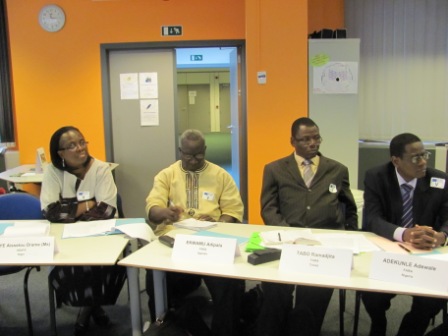
Informal stakeholder consultation on agriculture research in Africa

Prof. Monty JONES (FARA)
20-22 March 2012. Brussels, organized by the European Commission Directorate General for Development and Cooperation - DG DEVCO. Improving the quality and effectiveness of development cooperation with African agricultural knowledge organisations: Informal stakeholder consultation.

In order to improve the quality and effectiveness of development cooperation with African continental and sub-regional agricultural knowledge organisations, the European Commission organized an informal stakeholders consultation which brought together representatives of African agricultural knowledge organisations, of the Development Partners, and EC/EU experts.
Dan KISAUZI & Silim Mohamed NAHDY
(AFAAS) ; Paco SEREME & Harold
ROY MACAULEY (CORAF) ;
David NIELSON (World Bank)

David NIELSON, Melissa BROWN, Bremala
MALLI & Juergen ANTHOFER (WB)
The objectives of this meeting were to:
  • share experiences of African continental and sub-regional leading organizations linked to agricultural research, advisory services, and tertiary agricultural education on how these organisations have contributed to the objectives of the Comprehensive African Agriculture Development Programme (CAADP) under the Framework for African Agricultural Productivity (FAAP);
  • Carolyn GLYNN & Philip CHIVERTON
    (Swedish University of Agricultural 

    Sciences)
    Nicoliene OUDWATER 

    (AgriCulture ETC Foundation)
  • dialogue with representatives of African continental and sub-regional organisations, Development Partners organisations, and EC/EU experts on the key lessons learnt through such processes – what worked well and less well and why;
  • looking to the future, discuss how such processes might continue to be strengthened into the future and scaled up where appropriate, share views of African organisations on their future role in their mandate areas and discuss this with representatives of the Development Partners organisations and EC/EU experts.
The outcomes were:
Aissetou Drame YAYE (ANAFE), Adipala
EKWAME (RUFORUM), Ramadjita TABO
& Adewale ADEKUNLE (FARA)
  • raised awareness of the value of African continental and sub-regional leading organizations linked to agricultural research, advisory services, and tertiary agricultural education in support to the objectives of CAADP;
  • shared experience on key initiatives of African continental and sub-regional leading organizations linked to agricultural research, advisory services, and tertiary agricultural education to advance African agriculture;
  • Patrick TAWONEZVI & Mwape
    BWANALI (CCARDESA)
  • deepen understanding of the challenges and opportunities of African continental and sub-regional leading organizations linked to agricultural research, advisory services, and tertiary agricultural education to support the objectives of CAADP;
  • recommendations made to donors and Development Partners organisations on how to increase effectiveness of their support to agricultural research, advisory services, and tertiary agricultural education in support to the objectives of CAADP.

Monday, 2 January 2012

South Sudan joins ASARECA

14-16th December 2011. Entebbe, Uganda. The world’s newest country was unanimously accepted to become the 11th member of the Association for Strengthening Agricultural Research in East and Central Africa (Asareca) during its first general assembly.

According to Harvard professor Calestous Juma, who gave the keynote address, South Sudan will play a key role in developing agriculture in the region by providing opportunities to apply the latest technologies on untested ground.

“South Sudan is lucky because it will get started with the latest and best agricultural technologies as it embarks on developing its economic base,” he said adding that since agriculture is the most viable industry the country can tap into and reap substantially because of being endowed with unfarmed soils and plenty of irrigation water from the Nile, it has potential to feed the region and generate more for selling into a food deficit world.

1st ASARECA GENERAL ASSEMBLY
By an interesting coincidence, a young Sudanese researcher who is studying in Kenya at the Kenyatta University’s department of biotechnology, Rashar Omer, has made history by developing the first drought-resistant maize gene that was unveiled at the conference and named Asareca gene. Slated for commercialisation in 2018, the gene is being touted by scientists who are excited by the breakthrough as having the potential to finally lead Africa to an agrarian revolution that has evaded the continent for decades.(source: The East African 28/12/2011, South Sudan - Africa's Next Farming Frontier)

Friday, 25 November 2011

Training program on agribusiness incubation for SSA

Dr Ralph von Kaufmann, Technical Coordinator,
UniBRAIN-FARA, in a discussion with Dr Dar and others
21-24 November. Aiming to promote agribusiness ventures in sub-Saharan Africa (SSA) through value-chain based agribusiness incubators, ICRISAT’s Agri-Business Incubation (ABI) program under its
Agribusiness Innovation Platform (AIP) organized a training program on “Strengthening the capacity of UniBRAIN – Agribusiness Innovation Incubation Consortia (AIIC) members” at ICRISAT-Patancheru.

The training program primarily aimed to strengthen the capacity of AIIC members in incubator planning and management, in view of UniBRAIN’s plan to set up an African Business Incubators Network (AFBIN) similar to the Network of Indian Agri Business Incubators (NIABI) of India. The training was focused on incubator management, planning for incubation operations, client selection, setting up systems and processes, and other key aspects of setting up successful business incubators to promote entrepreneurship in sub-Saharan Africa.

Tamil Nadu Agricultural University (TNAU)
Twenty six participants from the Forum for Agricultural Research in Africa (FARA), Universities, Business and Research in Agricultural Innovation (UniBRAIN), Pan African Agribusiness and Agro Industry Consortium (PanAAC), Agro forestry and Natural Resources Education (ANAFE), Association for Strengthening Agricultural Research in East and Central Africa (ASARECA), Conseil Ouest et Centre Africain pour la Recherche et le Développement Agricoles (CORAF) and SADC joined the training program at Patancheru, which had 30 resource persons from infoDev, ISBA, STC, Trec-STEP, Technopark, Villgro, etc. who provided and shared their vast and rich experiences in agriculture and agribusiness.

The training was continued at the Business Planning and Development (BPD) units of the Tamil Nadu Agricultural University (TNAU), Coimbatore and Ooty.

Background
UniBRAIN is a program of FARA supported by the Royal Danish Ministry of Foreign Affairs (DANIDA). It is facilitated by a team of partner institutions comprising FARA Networking Support Function for Capacity Strengthening (FARA-NSF4) and its associated sub-regional organizations – ASARECA, CORAF, Centre for Coordinating Agricultural Research and Development in Southern Africa
(CCARDESA), African Network for Agriculture, ANAFE, PanAAC, and ICRISAT Agri-Business Incubator (ABI).

Thursday, 15 April 2010

Regional Policy Dialogue on Promoting Access to Regional and International Markets for Agricultural Commodities in Eastern and Southern Africa

24-25 March 2010, Nairobi, Kenya. Regional Policy Dialogue on Promoting Access to Regional and International Markets for Agricultural Commodities in Easter and Southern Africa.

Objective: To increase awareness about policy issues affecting regional and international agricultural trade, promote dialogue among policymakers and key stakeholders on these issues, and to catalyze a consensus-building process toward trade enhancing policies.

Co-organizers of the Dialogue:
Group Photograph


        Breakout sessions                                


Tuesday, 9 March 2010

OBITUARY: Cyrus Ndiritu 24th August 1949 - 7th March 2010

Cyrus Ndiritu 24th August 1949 - 7th March 2010
Cyrus Ndiritu, died on Sunday 7th March 2010. Over the last twenty years he has been involved in applied research that aspired to promote rural development through agricultural innovations and the enhancement of agri-business in Africa. He was the the Executive Director of the Kenya Agricultural Research Institute (KARI) for twelve years from 1989 to 2000.


 He helped to found in 1994, the Association for Strengthening Research in East and Central Africa (ASARECA) and played a key role in founding the Forum for Agricultural Research in Africa (FARA). After retiring from active management of public research in 2000, he continued the engagement with agricultural research. He was the Director-General of ISNAR in 2003. Dr. Ndiritu obtained his Bachelor’s degree in veterinary medicine from the University of Nairobi, a Master of Science degree in pathology from the University of California-Davis, and a Ph.D. from the University of Nairobi.
We in the international community are aware of the great contributions he made to advancing the cause of African agricultural research and advisory services. He served as a scientist, a manager and a director of several important institutions and on many reviews and boards because he was recognised as an accomplished scientists with a great depth of experience and sound judgement. These are attributes that are in short supply and for which he will be missed by the colleagues with whom he served. More importantly, we have all lost a friend whose cheerful can-do attitude to life was a constant source of inspiration.  
Dr. Monty Jones, Executive Director FARA

Saturday, 9 January 2010

Sudan: the role of scientific research in agricultural development

22- 24 December 2009. Wed Medanni. Sudan.
The overall objective of the Conference was:
To maximize the utilization of research results, scientific studies and practical efforts to serve the agricultural renaissance in the Sudan for the development of society.
Prof Mohamed Galal director of the National Center of Research (NCR) in a Statement to Sudan TV

Main recommendations of the Conference: Adoption of national programmes in the following
1. Production, manufacture and marketing of medicinal and aromatic plants with a view to investment.
2. Weed control of resistant species and Mesquite control
3. Expansion of the durra crop in the Sudan and rehabilitation of infrastructure in the targeted areas of agricultural development.
4. Call on the state to adopt a contracting approach with research groups to develop practical solutions to increase production.
5. Involve the private sector in supporting research programs for researchers to achieve mutual benefit.
6. To promote research that increase and improve agricultural production and the diversity of both plant and animal care beneficiaries.
7. The provision and availability of climate information needed by researchers at nominal cost.
8. The importance of incorporating the interests and concerns of farms in the lever agenda of research and technical knowledge and develop its potential in the use of technologies and pesticides with the help of agricultural extension.
9. Emphasized that the concept of sustainable development is not only scientific research and footage of information and statistics to see what we have and build on it.
10. The use of local knowledge and benefit from the experience of farmers in the development of research.
11. Emphasis on the use and resettlement of biotechnology and genetic engineering-friendly environment in the development of varieties resistant to pests and many fast-growing and production.
12. Taking into account the rational use of natural resources for sustainability and maintenance of the deterioration in the adoption of the financing of any agricultural activities.
13. Preservation and maintenance of germplasm of Sudan and the traditional practices are harmful.
14. Pay more attention to areas of water resources taking into account the criteria of efficiency and rational use and to consider the environmental dimension in the planning and implementation of development projects.
15. Formation of a joint committee from the National Center for Research and the Agricultural Research Organization and the Livestock Research Institute and the Ministry of Agriculture, Forestry and agricultural development program to follow up the implementation of the recommendations above under the auspices of Mr. Ali Osman Vice President of the Republic.

Reference:
Conference website

Tuesday, 8 December 2009

Announcement: Policy Dialogue on Promoting Access to Regional and International Markets for Agricultural Commodities in Africa

18 – 20 February 2010. Nairobi, Kenya. A workshop on Policy Dialogue on Promoting Access to Regional and International Markets for Agricultural Commodities in Africaw will be held.

The workshop is being organized by the Forum for Agricultural Research in Africa (FARA) in collaboration with a number of other partners (TBC).

The purpose of the Regional Policy Dialogue in Eastern and Southern Africa is to contribute towards peoples’ awareness about policy issues affecting regional and international agricultural trade, promote dialogue among policymakers and key stakeholders on these issues, and to catalyze a consensus-building process toward trade enhancing policies with a view to building up broad-based support for such policies.

The workshop will provide open space for public discussion on important agricultural trade policy issues such as subsidies, tariff and non-tariff barriers, and food safety and quality assurance.

The specific objectives are to:
  • Provide space for public discussion of important trade policy issues with a view to building up broad-based support for such policies.
  • Stimulate discussion and dialogue among major stakeholders including policymakers, academics, experts, representatives of regional economic communities, representatives from business community, NGOs and other civil society groups on alternative regional agricultural trade policy issues.
  • Advocate for pragmatic regional agricultural trade policies that promote and facilitate access to regional and international markets.
  • Identify and agree on policy options to respond to the problems of increased subsidies provided by developed countries as well as address issues of SPS requirements.
  • Disseminate the outcomes stemming from the dialogue discussion to a broad spectrum of stakeholders.

Tuesday, 27 October 2009

The 2009 Borlaug Dialogue

12 - 17 October 2009. the 2009 Borlaug Dialogue symposium asked experts and decision-makers from around the world how their fields – in policy, industry, science and academia, and development – can ensure adequate access to food and nutrition for, and thus contribute to the security of, all people.

To address that question, several hundred participants representing more than 65 countries – including leading policymakers and diplomats, CEOs and senior private-sector executives, and experts from academia, research, and the development community – engaged in a range of conversations on compelling and critical topics including:

  • Food and agriculture in the context of national and international security
  • Poverty, hunger, and food security in global crisis areas
  • Continuing to address gender in agricultural development
  • Providing nutrition and enhancing health, especially among women and young children
  • New and cutting-edge technological approaches to farming and food
  • Harmonizing organic and sustainable agricultural practices with modern technology and genetics
  • The future of agriculture in an urban, global world
  • Preserving and renewing soil and water resources
  • Prospects for trade in agriculture and food
  • The institutions necessary for a food-secure world
  • Assessing progress in global agriculture and identifying areas for needed investment
On 13th October Seyfu Ketema - Executive Director, ASARECA participated in the Conversation: Trends and threats in global agricultural yields

Reference:
View Symposium Brochure
AGENDA + SPEAKER BIOS + TRANSCRIPTS

Related:
2009 World Food Prize winner Gebisa Ejeta. The Ethiopian native's work to develop sorghum hybrids resistant to drought and the devastating Striga weed (witchweed) increased the production and availability of one of the world's five principal grains and enhanced the food supply of millions of people in sub-Saharan Africa.

Ejeta has worked to integrate his scientific breakthroughs with farmer education programs and soil and water conservation initiatives and to empower subsistence farmers and promote economic development in rural Africa. Ejeta earned his Ph.D. in plant breeding and genetics at Purdue University, where he later became a faculty member and today holds a distinguished professorship. It was during his post-graduate work at the International Crop Research Institute for the Semi-Arid Tropics (ICRISAT) office in Sudan that he developed his first hybrid sorghum. See: Iowa State University: Lecture: "Revitalizing Agricultural Research for Global Food Security"

Gebisa Ejeta 2009 World Food Prize Laureate


Wednesday, 21 October 2009

Africa Alliance of sub-regional Farmer Organizations (AAFO)

8 – 9 October, 2009. Accra, Ghana. Promoting Inclusiveness of Farmers Organizations in
African Agricultural Research Agenda: a FARA –PAFFO (Pan African Farmers Forum) Collaborative Initiative.

In order to further consolidate the achievement recorded by FOs, FARA convened a 2-day multi-stakeholder consultation that aimed to catalyze the participation of FOs in African ARD. During the meeting, stakeholders identified some of the stumbling blocks to FOs’ participation in ARD. These include weak human and institutional capacity, poor governance, poor linkage and access to research outputs and outcomes, and poor market access and infrastructure.
List of participants (excluding FARA):
  1. Dr. Stephen Muchiri, Chief Executive Officer, East African Farmers Federation EAFF, Nairobi
  2. Mr. Ewole Gustave, Chargé de Programme, PROPAC, Cameroon
  3. Mr. Alangeh Romanus Che, Executive Bureau Member, PROPAC, Cameroon
  4. Dr. Ndiogou FALL, President, Réseau des Organisations Paysannes et des Producteurs Agricoles de l’Afrique de l Ouest, ROPPA, Senegal
  5. Dr. Mohamadou MAGHA, Coordinator , Réseau des Organisations Paysannes et des Producteurs Agricoles de l Afrique de l Ouest, ROPPA, Burkina-Faso
  6. Mr. Motsepe Ramotse Donald Matlala, Vice President, SACAU, South Africa
  7. Mr. Benito Odala Eliasi, Capacity Development Advisor, SACAU, South Africa
  8. Mr.Mahaman Bader M.Dioula, Regional Coordinator for Africa, IFAP, France
  9. Mr. Jacques Bonou, Vice President, IFAP, Benin
  10. Dr. Sidi SANYANG , Manager of the Capacity Strengthening and Knowledge Management Programs, CORAF/WECARD, Senegal
  11. Mr. Moses Oremo, Programme Assistant, ASARECA, Uganda
  12. Mrs. Lydia Sasu, National Women’s Leader , F.O.N.G, Ghana
  13. Mr. Max Olupot , Coordinator ASS/ Program Assistant, AFAAS, Uganda
  14. Dr. Clesensio Tizikara, ICART project coordinator, SADC-FANR/ICART, Botswana

Saturday, 22 August 2009

Call for expressions of interest Agricultural Biodiversity for Africa

August 19, 2009. The Forum for Agricultural Research in Africa (FARA), in partnership with its four sub-Regional Organizations (CORAF/WECARD, ASARECA SADC-FANR, NASRO), and Bioversity International will be organizing a conference on agricultural biodiversity in Africa, back-to-back with the Africa Science Week and FARA General Assembly to be held in Ouagadougou, Burkina Faso on the 19-24th July 2010

The overall goal of the conference is to increase awareness, raise the appeal and generate support for research and development in relation to agricultural biodiversity for development in Africa. The conference will facilitate the sharing of innovative ideas in areas of agricultural biodiversity conservation and use science, research and development in Africa. It will also provide an opportunity to bring the agricultural biodiversity research community together to exchange experiences and lessons learnt, establish linkages and foster post-conference networking.
Reference:

Wednesday, 15 July 2009

Participants to the RAILS side event at IAALD

12-13 July 2009. RAILS Side-event at the 2nd IAALD Africa Chapter Conference on the theme ‘Towards Opening Access to Information & Knowledge in the Agricultural Sciences and Technology in Africa’.

Participants:

JANVIER Nkunzebose
Institut Des Sciences Agronomiques du Burundi (ISABU),
Bujumbura Burundi.

Rachel Rege
Kenya Agricultural Research Institute (KARI), Assistant Director, Information Documentation Services Nairobi.Kenya

MAQALIKA MATSEPE
Agricultural Information Services Ministry Of Agriculture And Food Security, Senior Agricultural Information Officer, Lesotho


Senior Communications Officer, SLARI, National Agricultural Research Coordinating CouncilFreetown - Liberia
Francois Stepman
Communications Expert
FARA


Jacqueline Nyagahima
ASARECA
Uganda

Paula Pimentel
Agricultural Research Institute of Mozambique (IIAM),Researcher - Technology Transfer And Information Systems DirectorateMaputo, Mozambique

Jacky Nnam
Knowledge Sharing Officer
Forum for Agricultural Research in Africa.
Accra- Ghana
Keven Nancy Principal OfficerResearch and DevelopmentSeychelles Agricultural Agency Republic of Seychelles
Ifidon Ohiomoba PSTAD OfficerForum for Agric Research in Africa. Ghana
Sostino Mocumbe Communications Officer Institute of Agricultural Research of Mozambique Maputo, Mozambique


Abdoulaye Aziz BANGOURA
IRAGResponsable Information Scientifique & TechniqueConakry - Guinee
Francine Rasolofonirina
Ministry of Agriculture-Livestock and fisheries -Head, Extension Service and Farmer's Training DepartmentDirectorate of Extension Service and Farmer's Support Ministry of Agriculture, Livestock and FisheryAntananarivo - Madagascar

Richard AWAH NCHE
Director, Department of Communication and Documentation,Institute of Agricultural Research for Development (IRAD),Yaounde - Republic of Cameroun
Issel Ould Abdatt
Centre national d'élevage et de recherches vétérinaires. CNERV. Directeur General adjoint. Nouakchott Mauritanie
Forum for Agric Research in Africa. RAILS Program OfficerAccra- Ghana
Hadiza Gabey
INRAN, Chef De La Division Information. Valorisation et Documentation. Niger, Niamey
Justin Chisenga
Information Management SpecialistFood and Agriculture Organization of the United Nations – FAO - Regional Office for AfricaAccra, Ghana
Jocelin Makoko
INERA-Chef deDivision Biométrie & Informatique Président du Comité National de Pilotage (CNP) du Réseau Régional de l'Information Agricole (RAIN ) RD Congo

Claudine Umukazi
Institut des Sciences Agronomiques du Rwanda (ISAR)
Kigali Rwanda
KONE Yékéminan Anatole
Information/Communication Manager
CORAF/WECARDDakar - Senegal
Myra Wopereis
Forum for Agric Research in Africa. Director, Access to Knowledge and TechnologyAccra- Ghana
Kedro Diomande
Centre national de recherche agronomique, directeur des systemes d'informationAbidjan Cote-d’ Ivoire
Emmanuel Mbembe
Chef de service de la Communication et de la Vulgarisation,
Délégation Générale à la Recherche Scientifique et Technologique/Centre National de Documentation et d’Information Scientifique et Technique ( CNDIST),
Congo-Brazzaville

Frank W Dulle
Sokoine University of Agriculture,P.O.Biox 3158, Chuo kikuu,Morogoro-Tanzania.
Krishan Bheerninck
Regional Information, Communication and Training Officer,Implementation & Coordination of Agricultural Research & Training(ICART) projectFood, Agriculture and Natural Resources (FANR) DirectorateSADC Secretariat, GaboroneGaborone, Botswana

Goliath Leon Mwale
ZARI Lusaka, Zambia.
Davy Simumba
Zambia Agriculture Research Institute -Mount Makulu Central Research StationChilanga - Zambia

Joel Sam
Deputy Director
CSIR-INSTIAccra-Ghana
AHLAM ISMAIL MUSA
Agricultural Research Corporation (ARC), Central Library,Head Librarian And Manager Agris Resource Centre Of The Sudan,Agricultural Research Corporation (Arc)Sudan
Rafaa Ashamallah Ghobrial
Information Research Assistant Professor Head of Information Services and Systems Documentation and Information Centre National Centre for Research Ministry of Science and TechnologyKhartoum, Sudan
RASOANINDRAINY Andrianjafy
CAETIC-IT & Project Management specialistAdministratorCAETIC DevelopmentAntananarivo, Madagascar

Grace Kamau
Head - InfocentreInternational Livestock Research Institute (ILRI)Nairobi Kenya